Interim Management
Procurement to level-up Procurement

My Customers

Interim Management Procurement

Interim Management in Procurement is a matter of trust, particularly in times of fragile supply networks and the need for significant bottom-line contributions. Interim Management is all about setting a clear strategic direction and taking responsibility for people, organizations, budgets, suppliers, and the day-to-day operations.


I step in. I lead. I deliver on an interim basis. Whether it's leading your Procurement organization, driving restructuring and transformation projects, or navigating a crisis, I take interim ownership and get results. My approach is simple: create clarity, build trust, and execute with speed. Need strategic guidance without a full-time commitment? I'm also available as an on-demand Executive coach and Board Advisor. Globally.


As a Procurement Leader with 30 years of international experience, responsible for up to 5.0 billion in spending, teams on four continents, and a recognized transformation, digitalization, and risk management expert, I have restructured, stabilized, and led several global organizations. I know firsthand the challenges of many industries, from SMEs to international corporations, and I speak the language of decision-makers and buyers alike. With compassion and perseverance, I manage the day-to-day business and important stakeholders. Let’s develop and empower your Procurement and make it a powerhouse, creating a competitive advantage.

Interim Management im Einkauf

JAN-HENNER THEISSEN

Customer Projects (Selection)

09/25 -06/26 Interim CPO, Company Officer, Member of Executive Team. Leading Procurement, €1.7 bn. spend, 110+ FTE, IDW-S6-Restructuring & Transformation

12-month Interim Management; Leading the Procurement Organization, Transformational Consulting & Execution, Restructuring, Organizational Design (Qatar)

6-month Interim Head of Procurement: Stabilize and develop the Procurement organization

Interim Management; Support Managing Board & CPO. Stabilization of operations and organizational development (3 months)

Development and implementation of a global Supply Chain Risk Management approach (Governance, People, Digital, Change) - Sweden

Maturity & Potential Analyzis to restructure Global Procurement across als BUs Efficiency improvement Plan, Target Operating Model, Roles & Responsibilities

Maturity & Potential Analyzis to restructure Procurement. Target Operating Model, Roles & Responsibilities 

(JV Daimler & Volvo Truck).Maturity & Potential Analysis, Organizational Design, Target Operating Model, Internationalization Strategy, Develop Supply Chain Risk Mgmt.

Development and implementation of a global Supply Chain Risk Management approach (Governance, People, Digital, Change) - Hong Kong

Trained Zurich risk engineers (EU, Americas, APAC) in Procurement, Supply Chain, and Supply Chain Risk Mmgt.; improved risk audit compentencies

Procurement Experience

01

Founder targetP,: Procurement Advisory & Interim Management. Organizational Design and Transformation, Digitalization, Turnaround, Risk Management, Cost Improvement

02

AGCO Corporation, Duluth, GA (USA)

2011 - 2017

Global Director Strategy & Methods, Led the Global Procurement Transformation, Built the first Global Procurement Organization, Led Supplier Development & Cost Analytics Teams and Procurement Excellence

03

Benteler Automotive, Germany/USA

2004 - 2011

Global Director Strategy , Methods, Supplier Cost Analysis - Sr. Manager Strategy & Planning North America - , Purchasing Manager BMW E70

04

ThyssenKrupp AG

2001 - 2004

Strategic Purchasing Automotive Chassis & Structural Components and Systems

05

Business Management, University of Applied Sciences, Osnabrueck

1996 - 2001

Majors: Controlling, Logistics, Degree: Dipl.-Kaufmann (= M.A)

06

Preussag AG: Deutsche Tiefbohr AG & Bentec

1994 - 2001

Buyer Oilfield Materials, Apprenticeship: Business Administrator

Interim Management with Expertise and Passion

My job is to take on responsibility and lead people through transformation, crisis, and change. I empower and stabilize teams, optimize cost structures, and strengthen the Procurement function to drive a competitive advantage. With empathy, perseverance, and passion, I ensure rapid EBIT-relevant contributions and long-term success. It’s time to give Procurement the role it deserves.

Awarded Solutions

Award: BME Excellence in eSolutions 2015 – Supply Chain Risk Management

BVL Supply Chain Award 2016 – New Supply Chain Strategy incl. Supplier & Risk Mgmt.

FORBES Magazine, 2015 & 2022, Best Practice Solutions for Risk Management (AGCO & Autoliv)

What my clients say

I’ve been working with targetP! for some time now. I have experienced Jan as an experienced Procurement executive who brings plenty of „Horsepower“ to the ground by executing and implementing innovative as well as proven solutions. Jan is a fundamental contributor in terms of repositioning Procurement as well as in extensive employee development. targetP! masters the theory and knows how to bring it to practice.

Thomas Schnadt Co Founder of INNOSourcing GmbH, former CPO of UBS and Credit Suisse

targetP! is our partner to call about procurement excellence and people development. They are no-nonsense, straight-to-the-point procurement leaders with a strong entrepreneurial mindset. targetP!’s emphasis on connecting theory and practice gives them an impressive breadth of knowledge that’s much wider than the typical range of consultants. They took the time to understand our business needs and then delivered results fast using a hands-on approach that helped us tremendously to increase our capabilities in the area of procurement.

Heiko Schwarz Managing Director riskmethods GmbH, Munich/Boston

Prior to joining the company the procurement organization was regionally divided, focusing on price and delivery as their value proposition. Jan and his team led the transformation of procurement into a global commodity-based organization, improving the methods employed and developing the necessary processes within the global team resulting record highs in material savings and visibility in the overall value proposition of procurement. I would recommend Jan and the team to anyone trying to move the bar in their procurement organization.

Brian Zydel VP-Industrial Controller; AGCO Corporation

Jan and his team have done a phenomenal job in helping transform our procurement department, He has definitely brought world class know-how and expertise to the team. It’s a long journey but we are definitely on the right track.

Akram Iswaisi, CPA Group CFO and Head of Investments at Milaha

Congratulations Jan-Henner Theißen to your wonderful and very successful journey with targetP! Your are one of the best procurement experts I have ever met. And your strength as a consultant is to apply pragmatic solutions at large, medium and small sized procurement organizations which really work show a sustainable and fast impact. Your ideas are shaped by creativity and knowledge, and your advice uses a language which is understandable for management as well as for operations. Keep up the great work! All the best for the next years!

Dr. Ulrich Piepel Former CPO at RWE AG & innogy SE

Contact me at any time.

Please enable JavaScript in your browser to complete this form.
Name
GDPR consent
CFO Supply Chain Risk Management

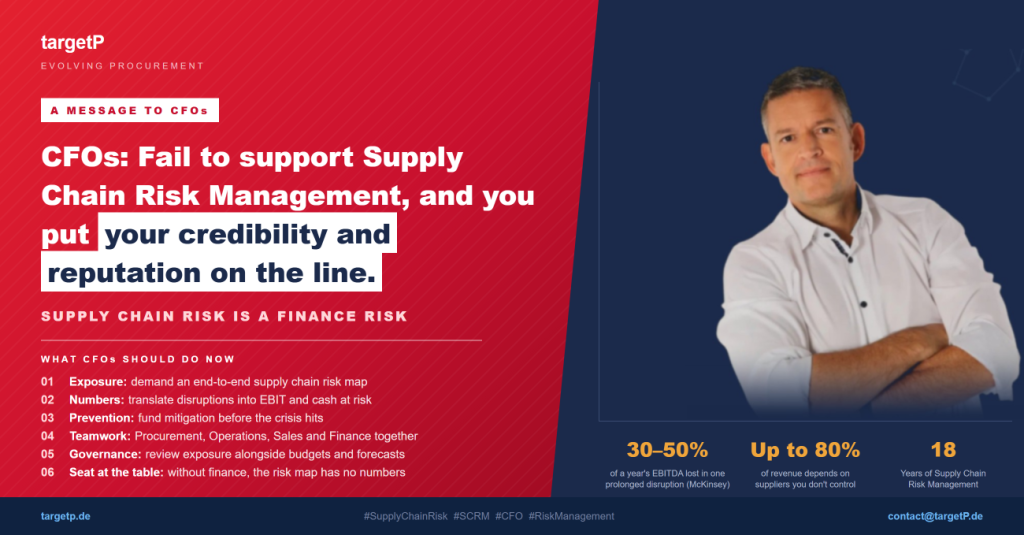
CFOs: Supply chain risk is a finance risk.

CFOs: Your Supply Chain May Be Undermining Your Financial Commitments And Your Credibility! You can build a solid financial plan, commit to an EBIT target, and present a confident forecast to your board. But how much of that plan depends on a supply chain you cannot fully see, predict, or control? Supply chain risk is not just an operational problem. It directly threatens financial performance and your credibility as CFO. One supply chain disruption can erase 30-50% of a year’s EBITDA (McKinsey). Often 50-80% of your revenue depends on a supplier network you don’t control. Here is what is at stake: EBIT and profit: Expediting fees and emergency freight quietly eat the margin you promised the board. Production stoppages, lost sales, idle capacity, and unexpected sourcing costs turn planned profit into missed targets. Cash flow and working capital: Disruptions force unplanned spending, tie up cash in precautionary inventory, and delay customer payments. Regulatory failures can trigger penalties, compensation claims, and additional costs. Forecast accuracy: Every supply chain shock that hits cash flow makes your forecasts look wrong. Every unexpected revenue shortfall puts your financial plan under pressure. Your credibility & reputation are on the line: This is where the issue becomes personal. When your financial commitments repeatedly miss the mark due to supply chain issues, your credibility is on the line. What should CFOs do now? ✅Sit at the table when the risk map is built. ✅Demand a clear picture of exposure. ✅Demand a clear picture of exposure. ✅Insist on prevention, not just crisis response. ✅Make risk management cross-functional ✅Build supply chain risk into your financial governance Supply chain risk is a finance risk. Treat it like one, or keep explaining variances you could have seen coming. Supply chain risk belongs on the CFO agenda. The CFO who owns it walks into the next earnings call with answers. Now, let’s turn those insights into capability. Build people and organizations who are ready to act. My training/workshop will perfectly prepare you for it. —- Hi. I am Jan, your SCRM Builder. Not a consultant who theorizes about risk. A procurement leader and risk practitioner who has built 15 SCRM programs globally, trained 1,200 people, and led procurement and risk organizations through crisis. I share what works and help you build an effective SCRM. I work globally.
Read More »
Multi-Layer-Defense Risk Management

Multi-Layer-Defense Risk Management

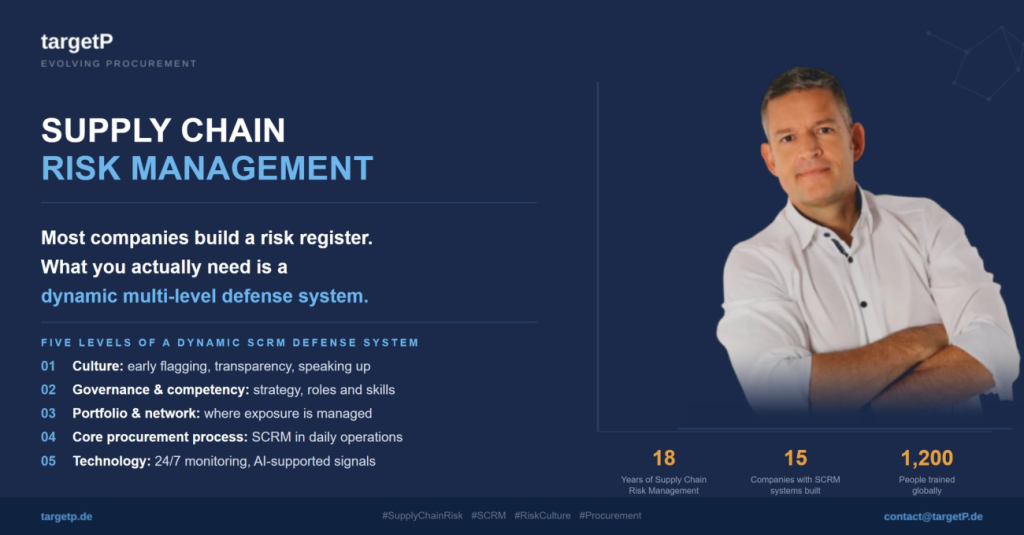
🛡️ Most Companies Build a Risk Register. What You Actually Need Is a DYNAMIC Multi-Layer-Defense Risk Management. The well-known and widely used 3 Lines of Defense model was developed for institutional risk management in finance. Despite years of criticism, too many risk professionals still treat it as the holy grail and believe they can use it across organizations for all kinds of risk management activities. My experience: For SCRM, the model is not usable at all. However, even the big four consulting firms still bother their clients with this ineffective approach. Experienced supply chain (risk) experts never work with it. So do I, and based on 18 years of building SCRM systems across 15 companies, I developed and use a dynamic five-level risk model that translates the lines-of-defense principle into something that actually works in practice: Level 1: SCRM Culture Framework: The foundation everything else rests on. If the culture doesn’t support early flagging, transparency, speaking up, and cross-functional accountability, no process or system will compensate. Culture is not soft. It is the prerequisite. Level 2: Governance & Competency Framework: Strategy, roles, responsibilities, and the skills to execute them. Here, the CPO and procurement leadership define what SCRM means for the organization and how they operationalize it. And this is where the organization becomes agile and responsive. Level 3: Category & Supplier Portfolio/Network Management: The analytical core: category and market analysis, supplier portfolio assessment, and a risk-centered sourcing strategy. This is where procurement teams actively manage exposure. Level 4: Core Process Framework: SCRM embedded into daily procurement operations: supplier qualification and onboarding, sourcing and re-sourcing decisions, and ongoing supplier network management Level 5: Technology Framework: Digital supply chain monitoring running 24 hours a day, 365 days a year. AI-supported signal detection, automated alerts, pattern recognition, scenario modeling, impact analytics. Technology does not replace human judgment. The critical principle behind this model: These five levels are not silos. Insights from the process level feed back into portfolio strategy. The technology layer supports all operational levels simultaneously. The culture layer at the top is why it all works under pressure. SCRM is never static. The moment you treat SCRM as a project, you have already fallen behind. Forever! Now, let’s turn those lessons into capability. Build people and organizations who are ready to act. My training/workshop will perfectly prepare you for it. Hi. I am Jan, your SCRM Builder. Not a consultant who theorizes about risk. A procurement leader and risk practitioner who has built 15 SCRM programs globally, trained 1,200 people, and led procurement and risk organizations through crisis. I share what works and help you build an effective SCRM. I work globally.

Read More »
Supply Chain Risk Assessment

Improving Decisions

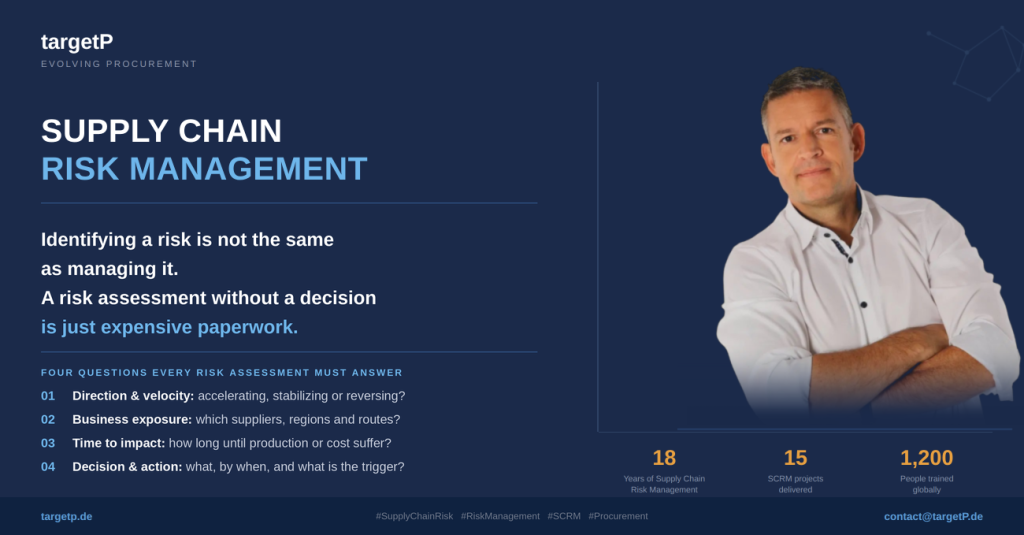
Supply Chain Risk Management Has Plenty of Tools. But Are They Actually Improving Decisions? Next episode of our series: Supply Chain Risk Management done right! PESTLE. PESTEL. Risk Matrices. Scenario Planning. Supplier Risk Assessments. Most organizations use these tools to identify, assess, and monitor risks. But here is the critical question:  What actually changes because of them, and how are we improving decisions? Too often, risk management stops at the analysis. A geopolitical assessment identifies rising trade tensions. A risk matrix classifies it as “high risk.” A scenario analysis describes what could happen if a critical supplier fails. All useful. But identifying a risk is not the same as managing it. Regardless of the tool we use, an effective risk assessment should answer four questions: 1️⃣ Direction & velocity: Is the risk accelerating, stabilizing, or reversing? How quickly is the situation changing? 2️⃣ Business exposure: How does it affect our specific supply base, critical suppliers, sourcing regions, and logistics routes? 3️⃣ Time to impact: If the risk materializes, how much time do we have to respond before production, cost, or service levels are affected? 4️⃣ Decision & action: What decision is required, by when, and what would trigger a change in course? Consider a practical example. Knowing that geopolitical tensions are rising is useful. Knowing that three of your five single-source suppliers are located in the affected region, have 14-week lead times, and no qualified alternatives is far more actionable. But even that is not enough. The real test is what you decide to do with that information. Do you qualify alternative suppliers? Adjust inventory levels? Reassess your sourcing strategy? Or consciously accept the exposure? Any of these could be the right decision. The important point is that the decision is informed by the risk, not disconnected from it. Risk management isn’t about producing more analyses, matrices, or reports. It is to make better-informed decisions under uncertainty and to act while we still have options. Better decisions are the objective. Everything else is a process. Now, let’s turn those lessons into capability. Build people and organizations who are ready to act. My training/workshop will perfectly prepare you for it. —- Hi. I am Jan, your SCRM Builder. Not a consultant who theorizes about risk. A procurement leader and risk practitioner who has built 15 SCRM programs globally, trained 1,200 people, and led procurement and risk organizations through crisis. I share what works and help you build an effective SCRM. I work globally.

Read More »
en_USEnglish
About the company:
Joint Venture Truck OEMs
(Germany & Sweden)
Development Hydrogen fuel cell systems
approx. 500Employees, strong growth
GlobalTechnologyInnovator

Case Study

Industry: Automotive

Area: Organisation

Land: Deutschland & USA

Duration: 12 Months

Starting Point / Assignment

  • approx. EUR 400 million Procurement spend p.a. (rapidly increasing)
  • Independent joint venture between two large truck manufacturers
  • Start of series production in 2027 and development of the North American market with local production requires far-reaching development and expansion of Procurement, particularly regarding a global organization (skills, capacities, x-functional collaboration) and digitalization

Objectives

  • Creating transparency about the maturity level of the Procurement function
  • Prioritized action plan to gradually increase the maturity level regarding competencies, x-functional cooperation, productivity/efficiency, digitalization, etc.
  • Development of target organization model (2023, 2027, 2030) for production and non-production materials Procurement incl. all role descriptions and necessary capacity (FTE sizing)
  • Detailed transformation plan for the global Procurement organization aligned with the milestones "Start of series production" and "Market entry & local production North America“
  • Review of Procurement’s digital strategy and projects including future recommendations

Approach

  • Comprehensive maturity analysis of Procurement (targetP! method) with a focus on organization and digitalization based on personal interviews (all Procurement staff and top stakeholders) as well as in-depth document and data analysis (strategies, guidelines, process descriptions, digitalization initiatives, standards for category & supplier management, order & invoice volumes, etc.).
  • S/T/O analysis to determine the actual capacity utilization of all Procurement employees as part of individual interviews
  • Workshops/interviews with IT & Procurement on the Procurement system landscape and digital strategy

Results / „Deliverables“

  • Detailed maturity assessment report on Procurement (production and non-production materials) including prioritized actions and quick wins
  • Procurement digital strategy benchmark against best practices with specific recommendations for actions, risk analysis, and quick wins
  • Transparency regarding the actual use of capacity in Procurement, gap analysis of the respective profiles and stakeholder expectations
  • Role-based target Procurement organization with a step-by-step development plan (staffing, development, reallocation)
  • Tailor-made role descriptions for use in subsequent recruiting measures
About the company:
Family Owned Business with international Footprint
approx. 500 Mio.Turnover
approx. 3.000 Employees
Technology & Market Leaderin Harvesting Equipment

Case Study

Industry: Agricultural Machines

Area: Transformation

Country: Germany

Duration: ~ 18 Months

Starting Point / Assignment

  • approx. 200 million Procurement volume
  • Sole focus on operational processes (clerical function)
  • Strong focus on German plants, not prepared for internationalization and cooperation, despite of having operating units in the USA and China
  • Strong growth in turnover and increased internationalization
  • Procurement’s priority: Supply security (“keep the plants running”)
  • Digitalization not actively driven

Objectives

  • Create an understanding of Procurement’s maturity level
  • Identify potential (e.g., value contribution, efficiency, compliance), through more professional category & supplier management and digital support
  • Elaborate on alternative measures to develop Procurement and create an action plan, particularly concerning process improvements
  • If necessary, determine and argue capacity requirements
  • Optimize structures to prepare for growth and improved resource utilization

Approach

  • Comprehensive maturity analysis of Procurement (targetP! method) with a focus on organization and operational improvements (personal interviews with Procurement staff and top stakeholders) as well as in-depth document and data analysis (strategies, guidelines, process descriptions, digitalization initiatives, etc.)
  • Development of a holistic transformation plan and target organization model including roles and responsibilities, stakeholder integration, etc.
  • Early involvement of employees "future conferences to build my organization“
  • Joint creation of a practicable category structure, a Procurement Vision & Strategy


Results / „Deliverables“

  • First-time definition of a Procurement strategy with aligned objectives
  • Capacity optimization through targeted personnel expansion
  • Optimized organizational model and a more rigid category structure established
  • First system reviews with digital solution providers based on a digital action plan and precise requirements
  • Design of a customized multi-year training program for all roles
  • Implementation of Category Management training with pilots
  • Development and implementation of Procurement processes
About the company:
Leading Healthcare Provider
High reputation (Top rated Medical Care)
Site: approx. 825 Mio. Turnover
approx. 1.700employees
> 80.000 Patienten/Jahr

Case Study

Industry: Health Care/Clinic

Bereich: Interim & Entwicklung

Country: Germany

Duration: 6 Months

Starting Point / Assignment

  • approx. EUR 60 million spend p.a., complex spend structure
  • Procurement with a strong focus on processing and operational processes, no systematic spending management
  • Significant operational problems in day-to-day business led to high costs
  • Very insecure, demotivated team due to degrading treatment and extreme micromanagement by the previous Procurement Manager
  • Non-existent digitalization of core processes and tasks
  • Extensive, sometimes paralyzing bureaucracy in general and when approving requirements such as Requisitions, Purchase Orders and Contracts
  • Lack of discipline and ethics among sales reps (back-door selling, etc.)
  • Low reputation within the hospital, especially among chief physicians

Objectives

  • Main objective: Stabilization and reactivation of a highly frustrated team
  • Stabilization of day-to-day business, also due to above-average absences
  • Better distribution of the workload among the team members
  • Creating an understanding of the actual maturity level of Procurement, identifying potential (e.g., value contribution, efficiency, compliance)
  • Elaborating alternative measures to develop Procurement, and create an action plan, particularly concerning process simplifications (approvals of Requisitions, Purchase Orders, Contracts)
  • Improving customer service quality and interaction with internal customers

Approach

  • Comprehensive maturity analysis of Procurement involving stakeholders
  • Creation and coordination of a holistic development plan
  • Open door policy and individual meetings several times a week
  • Regular visits to the hospital wards to understand the needs and build trust
  • Frequent exchange with internal customers (regular personal exchange, participatory approach: Involvement of all employees, e.g. we
  • Weekly team meetings to discuss issues, improvement ideas, and solutions to ensure full commitment and involvement in improvement projects
  • Strong involvement in day-to-day business (negotiations, sourcing)
  • Process analyses, in particular, SAP optimization options & approvals

Results / „Deliverables“

  • Team stabilized, motivation increased, absences and absenteeism reduced (CEO quote: "You calmed people down very quickly with professional empathy and got them behind you")
  • First-time definition of a Procurement strategy with agreed upon targets
  • Regular coordination with internal customers (Chief physician quote: "we talk to each other now, things run faster, we finally feel well looked after")
  • Approval and implementation of moderate staff expansion with restructuring of work areas and balancing of workload
  • Redesign of framework agreements with improved commercial conditions
  • Complete processing of unfinished order processes (backlog)
  • Simplification and definition of core Procurement processes;
  • Addition of new SAP functionalities to drive automation & workload reduction
About the company:
Highly renowned Qatari company
approx. 825 mn.Turnover
approx. 3.500 Employees
Regional Market Leader
Shipping, Maritime Logistik & Services

Case Study

Industrie: Reederei & Maritim

Bereich: Organisation & Interim

Country: Qatar

Duration: ~ 12 Months

Starting Point / Assignment

  • approx. EUR 300 million Procurement spend p.a.
  • Procurement with a strong focus on processing and operational processes, no systematic spending management
  • Significant operational problems in day-to-day business led to high costs for troubleshooting, escalations, and internal conflicts with stakeholders
  • Low acceptance and appreciation of Procurement and high political pressure despite excellent company results
  • Long-term vacancy in Procurement leadership impacts performance, customer satisfaction, and insecurity and leading to high fluctuation on buyer level
  • Digitalization of core processes and tasks only marginally developed

Objectives

  • Create an understanding of the true maturity level of Procurement and gain buy-in from the Executive Board
  • Identify potential (e.g., value contribution, efficiency, compliance), through more professional category & supplier management and automation
  • Elaborate on alternative measures to develop Procurement and create an action plan, particularly concerning process simplifications
  • Improve strategic and operational reporting for the CFO
  • Implement organizational and structural optimization to improve service quality
  • After two months: additional Role as VP Ad Interim due to the dismissal of the Head of Procurement

Approach

  • Comprehensive maturity analysis of Procurement involving stakeholders
  • Creation and coordination of a holistic transformation plan with staff adjustments, digitalization, and skills requirements
  • Development of a target organization model (category management) with role descriptions, responsibilities and recruiting support
  • Highly participative approach with intensive involvement of all employees, e.g., as part of "future conferences" (for the first time in the company) and expert teams with topic champions
  • Further development of Procurement and sourcing governance, e.g., tailored Category Structure, Procurement Vision & Procurement strategy and policies

Results / „Deliverables“

  • First-time definition of a Procurement strategy with aligned objectives
  • Approval and implementation of moderate staff expansion and allocation and expansion of required skills through comprehensive training plans
  • Start of digitalization projects based on a digital action plan (Supplier Portal)
  • Implementation of a Category Management approach and process and execution of 10 category pilots to identify additional value contribution
  • Development and implementation of comprehensive Supplier Management involving a newly designed supplier qualification process (Supplier Portal)
  • Implementation of a Procurement guideline & process manual and creation of comprehensive Procurement reporting with PowerBI
  • 10-month Interim Management and stabilization of the organization