
🚨Cost of AI and How Not to Go Bankrupt
AI just hit the meter. Procurement is about cost management, and AI costs need to be managed, too. Urgently!
Business Leaders who bragged about AI adoption rates in 2025 are the same ones quietly explaining 2026 budget overruns to their boards, because every leader now has to manage AI spend as deliberately as they manage its advantages, or watch a tool built to save money become the fastest way to burn it.
Lately, Microsoft made Copilot Cowork generally available across MS 365, an agent that reads documents, pulls Excel numbers, writes in Word, and files the results in SharePoint from a single instruction. The interesting part is not what it can do. It is how it gets billed. On top of the existing Copilot license, Cowork bills by the task, from about 100 credits to well over 700, depending on the model, context, tools called, and runtime.
Microsoft is not the exception; it is the pattern. GitHub Copilot moved its whole user base to usage-based billing on June 1. Cursor switched from fixed allotments to credit pools in 2025, an episode that ended in a public apology and refunds. Anthropic now layers credit pools for agentic work onto its subscriptions.
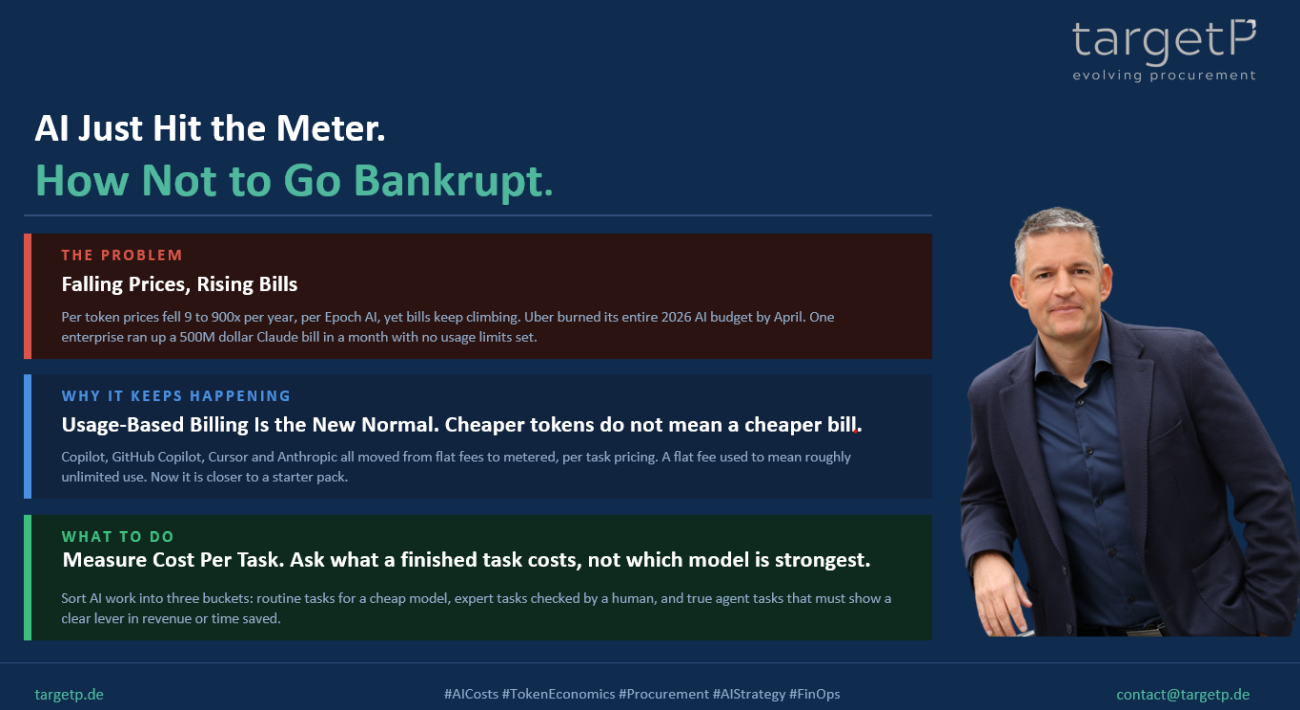
A flat fee used to mean roughly unlimited use. Now it is closer to a starter pack.
📉 The paradox nobody budgeted for: token prices keep falling, by 9 to 900 times per year depending on the benchmark, per Epoch AI. Yet bills keep rising. Goldman Sachs expects AI agents to drive a 24-fold jump in token use by 2030. The reason is structural. A chatbot answers one question and stops. An agent plans, calls tools, checks its own output, sometimes redoes the work, and only then answers.
The examples are no longer hypothetical. It’s said that Uber burned through its entire 2026 AI budget by April, helped by an internal usage leaderboard. Its COO has since said the company cannot link that spending to any measurable improvement.
⚠️ Axios reported an unnamed enterprise that ran up a 500 million USD Claude bill in one month, because nobody set usage limits on employee licenses. Amazon shut down an internal usage leaderboard after employees gamed it. JPMorgan flagged employees who are now spending more on tokens than their salary.
These are not careless organizations. They are sophisticated buyers, and they still got surprised.
✅ The fix: stop asking which tool is most powerful. Ask what a finished task actually costs. Sort AI work into three buckets:
1. routine tasks for a cheap model,
2. valuable expert tasks where a stronger model earns its keep only if checked,
3. true agent tasks that should produce a clear lever in revenue or time saved, since they are also the most expensive to run.
✅Measure cost per task, time saved, output quality, and the share needing no rework. Without those numbers, you are running on vibes.
targetP evolving procurement. 35+ digitalization projects in Procurement don’t lie. Either don’t decades in Procurement
 English
  Deutsch