Risk Awareness Week 2026

Risk Awareness Week 2026

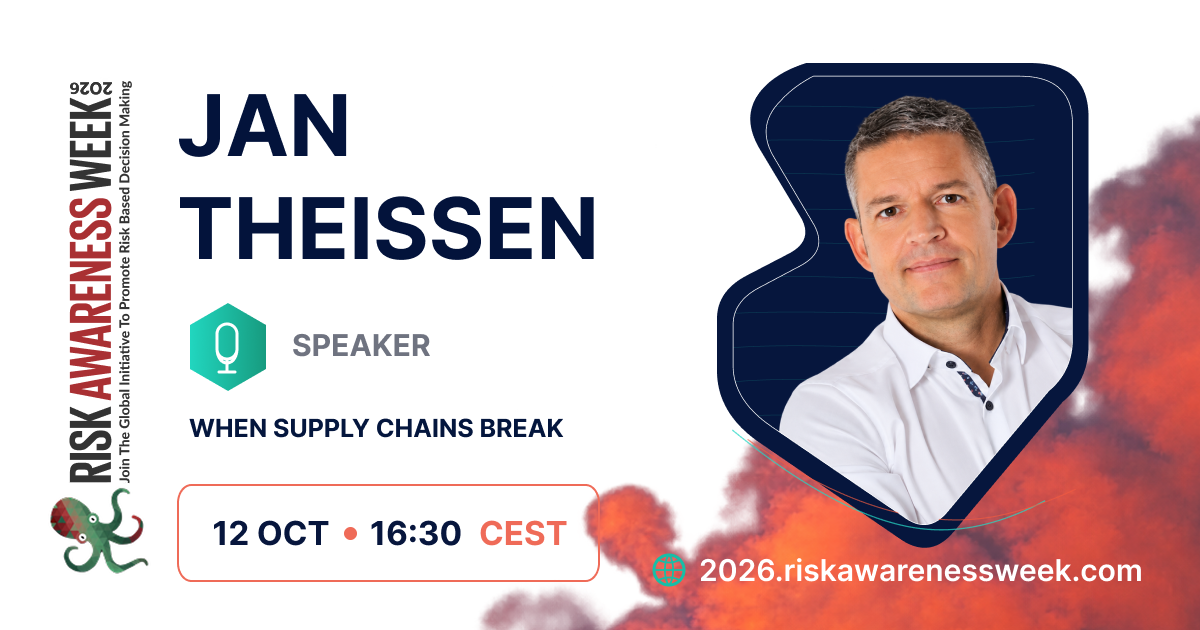
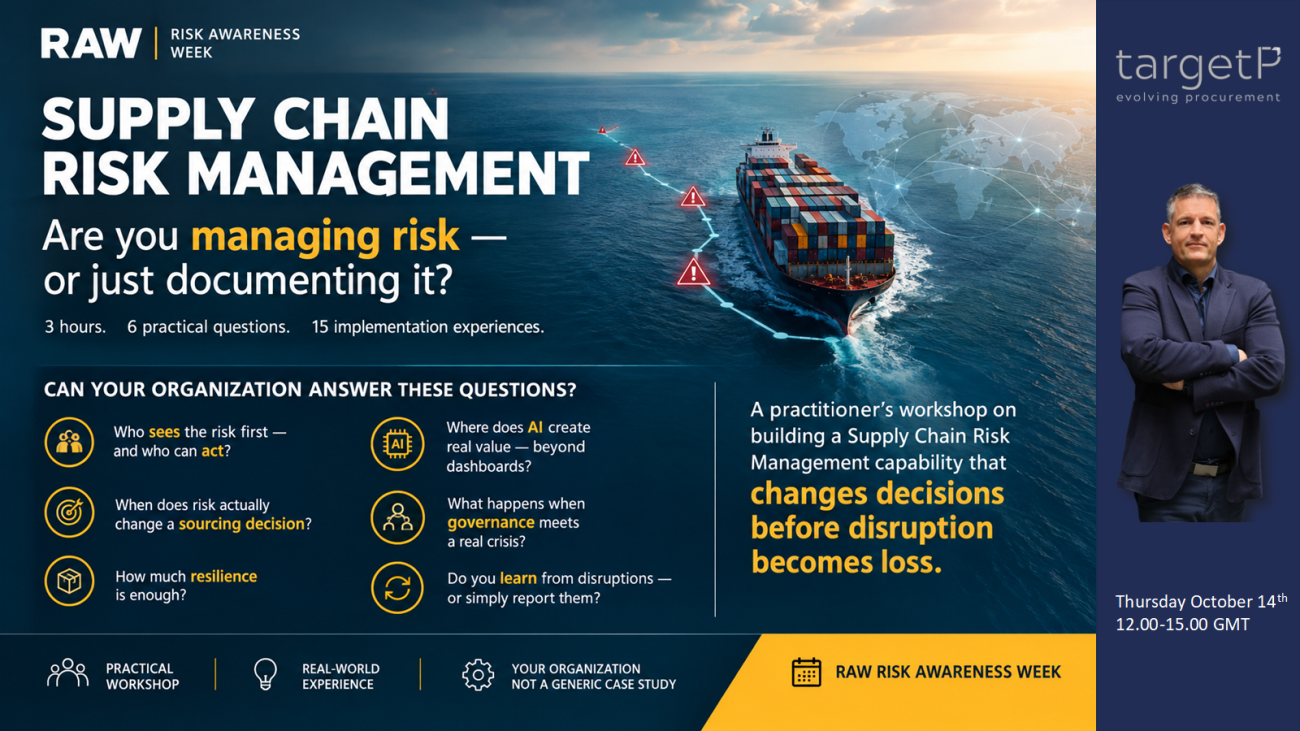
RISK AWARENESS WEEK 2026 – JOIN 22,000 RISK PROFESSIONALS IN OCTOBER I’m speaking at Risk Awareness Week 2026 – the largest virtual conference on risk-based decision-making (12–16 October). My sessions: ➡️When Supply Chains Break: How the Best Companies Decide Under Uncertainty (30 min talk) ➡️ Building an Effective Supply Chain Risk Management Capability (3h Workshop). You will learn what it takes to establish an effective SCRM approach along the value chain. From strategy to culture, from risk identification to crisis management, and how digital solutions can help you. Knowledge and experience based on 15 SCRM implementations and multiple supply chain crises. If you haven’t come across RAW, it’s been running every October since 2019 and has reached more than 👉22,000 professionals from over 140 countries. In 2024, FERMA named it 👉Training and Education Program of the Year. My sessions are part of a full week of talks and hands-on workshops running 12–16 October, entirely online – sessions are broadcast at scheduled times and available as replays afterward, so any time zone works. I am happy to add 18 years of Supply Chain Risk Management experience, with award-winning SCRM implementations across numerous industries. As usual, I bring hands-on, practical solutions focused on what it takes to increase speed, save budget, and be effective from day 1. The first two days of the conference are free to attend.  Find out more: https://www.riskawarenessweek.com/ ————– 👉Hi. I am Jan, your SCRM Builder. Not a consultant who theorizes about risk. A procurement leader and risk practitioner who has built 15 SCRM programs globally, trained 1,200 people, and led procurement and risk organizations through crisis. I share what works and help you build an effective SCRM. I work globally.

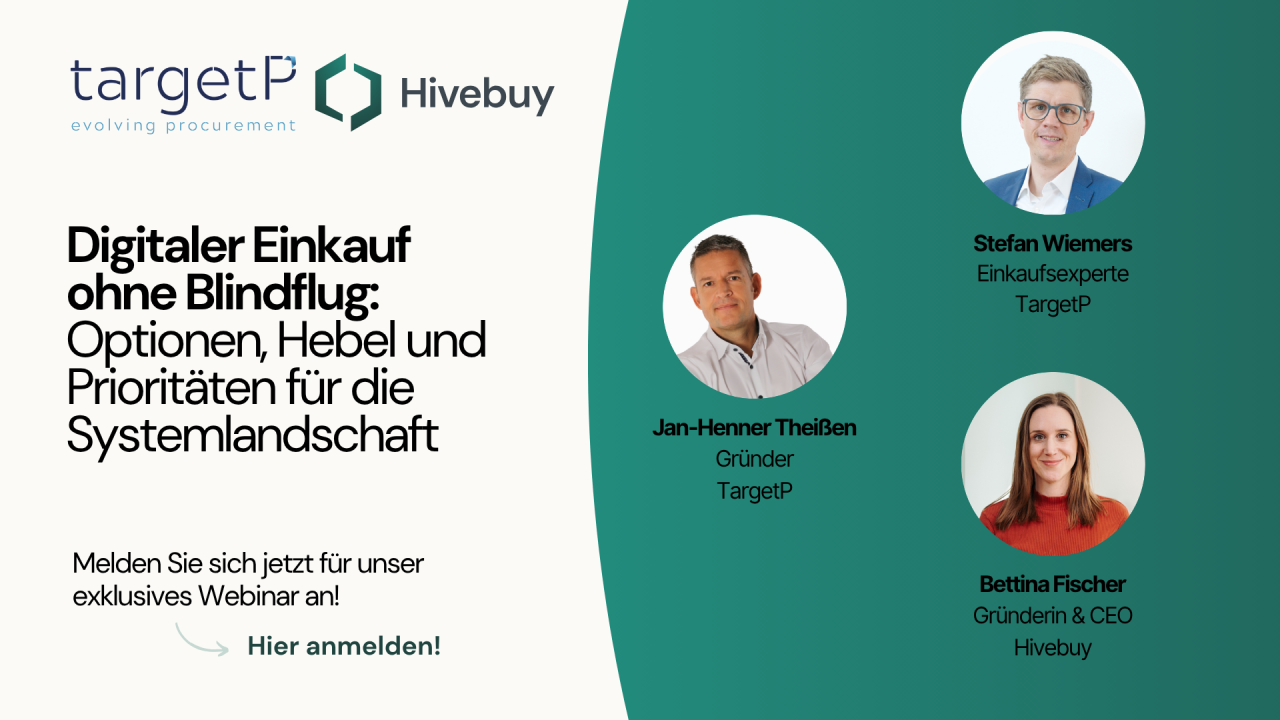
Digitalisierung Einkauf – Webinar

Digitaler Einkauf targetP

Die Kernfrage in jedem Digitalisierungsprojekt im Einkauf: Suite, Best of Breed oder Mix? Die meisten Einkaufsteams wissen, dass sie digitalisieren wollen. Aber nicht, welche Optionen sie wirklich haben. Ein Tool für den direkten Einkauf ist ausgewählt. Der indirekte Einkauf läuft weiter über E-Mail und Excel. Und die IT empfiehlt, was ohnehin schon da ist. Genau darüber sprechen wir am 21. Oktober um 12:30 Uhr im Live-Webinar zur Digitalisierung des Einkaufs: ein interaktives Interview statt Folienschlacht. Jan-Henner Theissen und Stefan Wiemers von targetP evolving procurement bringen Erfahrung aus über 30 digitalen Einkaufsprojekten mit und Bettina Fischer von Hivebuy die Perspektive aus dem operativen Alltag der Hivebuy Kunden. Darum geht es: <✔ Standortbestimmung: Wie ehrlich ist Ihre Einschätzung des digitalen Reifegrads? ✔ Zielbild statt Toolauswahl: Welche Optionen ergeben sich aus der Strategie? ✔ All-in-One-Suite vs. Best of Breed: Kriterien, Fehlentscheidungen, Erfahrungen ✔ Direkter und indirekter Einkauf: Ein System oder spezialisierte Lösungen? ✔ Wer entscheidet eigentlich? Einkauf, IT oder SAP als Standardantwort ✔ Hebel und Prioritäten: Welche Schritte zuerst, wie der Business Case entsteht<br> ✔ Kosten und Risiko zusammen denken: TCO, Compliance, Risikoabdeckung<br><br>Im Anschluss gibt es eine Checkliste zur Standortbestimmung und Systemauswahl. 21. Oktober 2026, 12:30 Uhr, 45 Minuten inkl. Q&A Anmeldung hier: https://www.hivebuy.com/webinar-digitaler-einkauf-ohne-blindflug

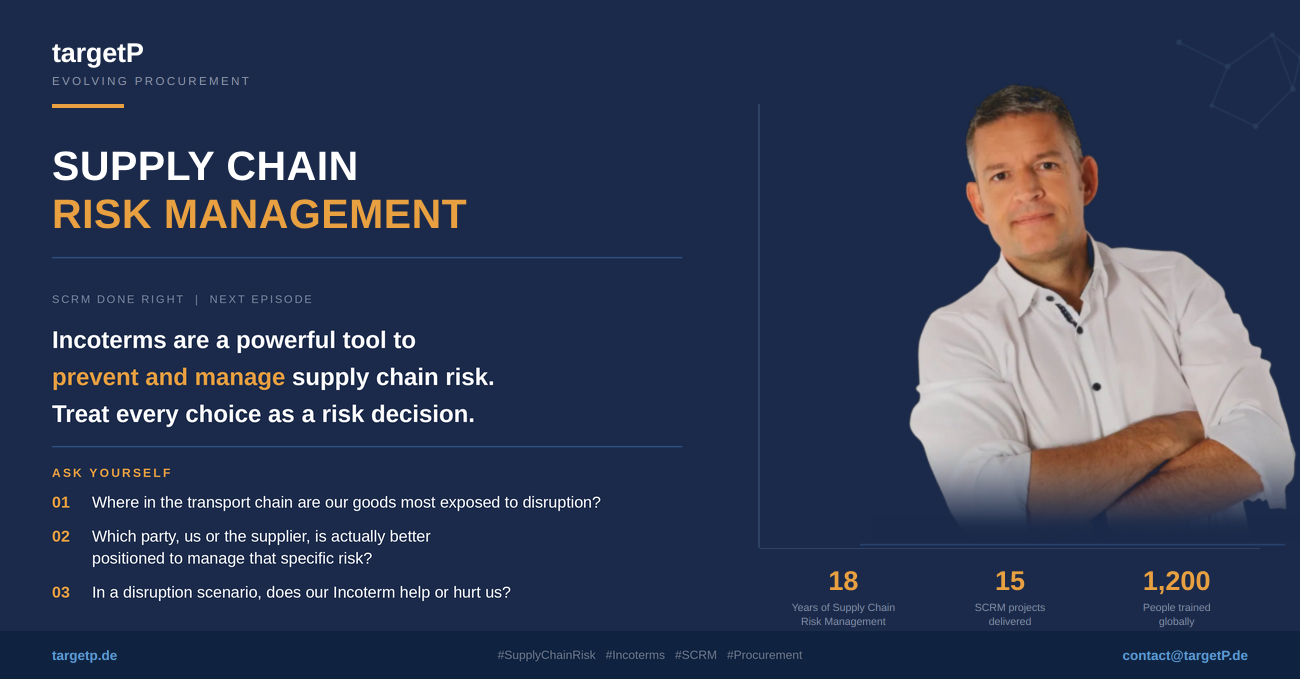
Incoterms: A powerful risk management tool

Incoterms. Supply Chain Risk Management

Most Procurement Teams Treat Incoterms Just as a Logistics Decision Next episode of our series: Supply Chain Risk Management done right! Incoterms can do more for you than you think. They are also a powerful risk tool and a risk decision. And that distinction costs companies more than they realize. When you buy DDP (Delivered Duty Paid), your supplier owns the risk of getting goods to your door. Port congestion, customs delays, a freight rate spike: technically, that is their problem to solve. However, I would never recommend working that way. Solve it jointly, but remind your supplier that he must be an active problem solver! When you buy EXW (Ex Works), you own all of that risk the moment the goods leave their factory floor. Neither is automatically the right choice. But the selection should be a deliberate risk decision, not a default inherited from a contract template from ten years ago. Here are the questions every category/supply chain manager and buyer should be asking: ⚠️Where in the transport chain are our goods most exposed to disruption? ⚠️ Which party, us or the supplier, is actually better positioned to manage that specific risk? ⚠️ Does our current Incoterm reflect where risk actually sits, or is it just what we have always done? ⚠️ In a disruption scenario like a port closure, political instability, or a strike, does our Incoterm help or hurt us? In high-risk sourcing regions, Incoterm selection can be one of the fastest, lowest-cost risk-mitigation levers available to procurement. It does not require a new supplier. It does not require a capital investment. It requires a conversation and a contract amendment. Yet it is rarely reviewed as part of your risk prevention and mitigation! Now, let’s turn those lessons into capability. Build people and organizations who are ready to act. My training/workshop will perfectly prepare you for it. —- Hi. I am Jan, your SCRM Builder. Not a consultant who theorizes about risk. A procurement leader and risk practitioner who has built 15 SCRM programs globally, trained 1,200 people, and led procurement and risk organizations through crisis. I share what works and help you build an effective SCRM. I work globally.
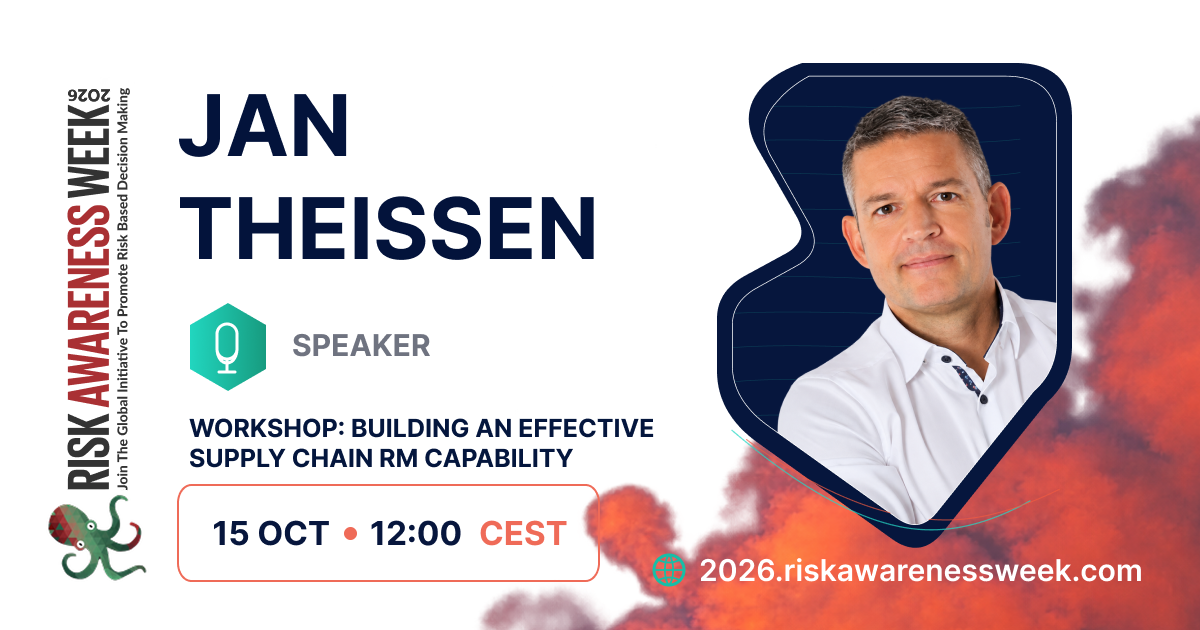
Risk Awareness Week October 2026

Risk Awareness Week

🚨 RISK AWARENESS WEEK 2026 – JOIN 22,000 RISK PROFESSIONALS IN OCTOBER I’m speaking at Risk Awareness Week 2026 – the largest virtual conference on risk-based decision-making (12–16 October). My sessions: ➡️When Supply Chains Break: How the Best Companies Decide Under Uncertainty (30 min talk) ➡️ Building an Effective Supply Chain Risk Management Capability (3h Workshop). You will learn what it takes to establish an effective SCRM approach along the value chain. From strategy to culture, from risk identification to crisis management, and how digital solutions can help you. Knowledge and experience based on 15 SCRM implementations! If you haven’t come across RAW, it’s been running every October since 2019 and has reached more than 22,000 professionals from over 140 countries. In 2024, FERMA named it Training and Education Program of the Year.  The conference’s central theme is that risk management is not about risks; it’s about decisions. The program focuses on practitioners showing how to put credible estimates on uncertainty and use them where decisions are actually made: budgets, forecasts, projects, insurance. My sessions are part of a full week of talks and hands-on workshops running 12–16 October, entirely online – sessions are broadcast at scheduled times and available as replays afterward, so any time zone works. I am happy to add 18 years of Supply Chain Risk Management experience, with award-winning SCRM implementations across numerous industries. As usual, I bring hands-on, practical solutions focused on what it takes to increase speed, save budget, and be effective from day 1. The first two days of the conference are free to attend.  You can register and see the full program here: Workshop: https://2026.riskawarenessweek.com/talks/workshop-building-an-effective-supply-chain-risk-management-capability/ Talk: https://2026.riskawarenessweek.com/talks/when-supply-chains-break-how-the-best-companies-decide-under-uncertainty/ 👉Hi. I am Jan, your SCRM Builder. Not a consultant who theorizes about risk. A procurement leader and risk practitioner who has built 15 SCRM programs globally, trained 1,200 people, and led procurement and risk organizations through crisis. I share what works and help you build an effective SCRM. I work globally.
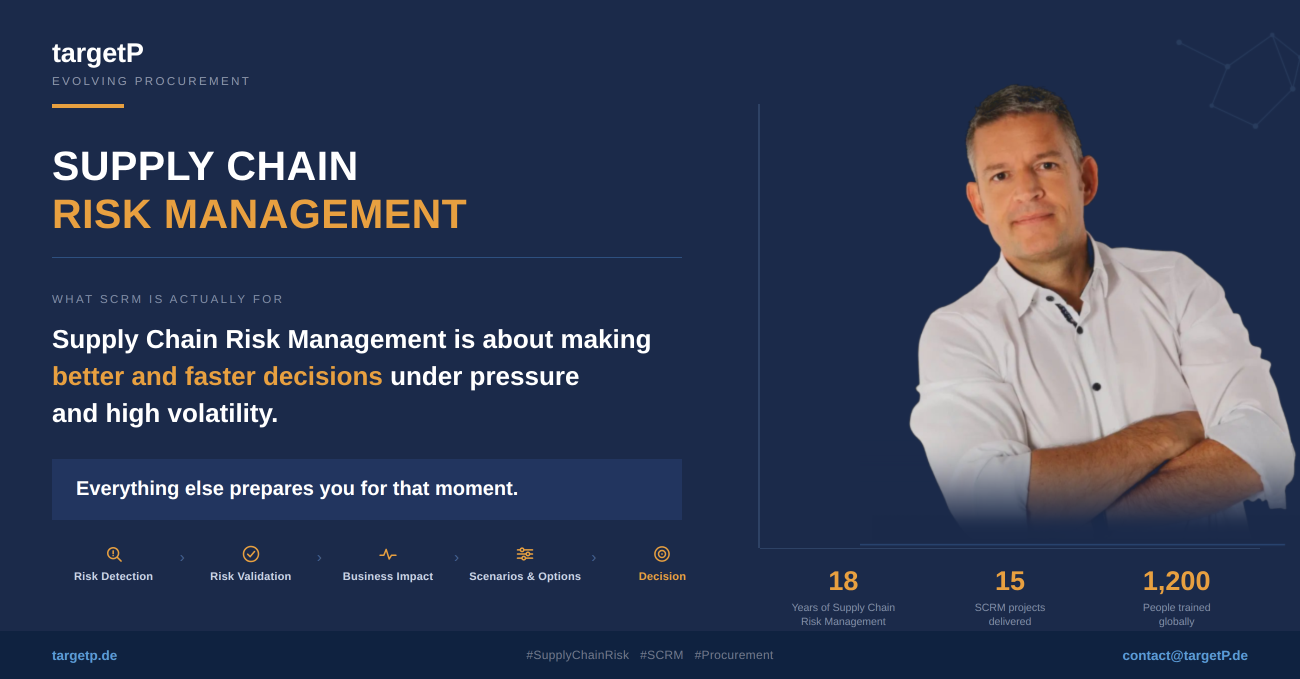
Risk Management: Make Better Decisions

Risk Management is to make Better Decisions

🎯 Risk Management Is NOT About Knowing More Risks. It Is About Making Better Decisions! Next episode of our series: Supply Chain Risk Management done right! What was the last supply risk your board actually decided on, rather than noted? You know it: A plant is short on parts. Three customers want the same allocation. Everyone in the room has an opinion. Nobody has facts. As always! The risk register didn’t help, as always! It named the supplier, but it didn’t say which plants would stop, on what day, how much revenue was at stake, or who could spend to fix it. Again, SCRM is more than predicting risks, listening to signals, or identifying risk. ⚠️It is about making educated decisions under pressure and high volatility. ⚠️It is about making better decisions faster, at the level where the risk actually lives. Everything else prepares you for that moment. 1️⃣ WHICH DECISIONS ARE AT STAKE Every one of these now rests on exposure the Board cannot currently see. That is why boards must demand it, not delegate it. 🔀 Strategy and footprint. Where we produce, source, and commit to markets. 🔀 Make or buy. Where we accept dependency and pay for backup. 🔀 Capital, inventory, and coverage. Where stock buys resilience, where it is dead money. 🔀 Allocation in a crisis. Which plants, customers, and orders get served first. 🔀 Commitments we sign. What we promise customers, what we accept from suppliers. Five board-level decisions. You can’t make any of them well from a simple heat map. 2️⃣ WHAT RISK MANAGEMENT MUST DELIVER Stop producing risk reports. Start producing decision packages. The same five things, every time: ✅ Transparency. Who supplies what, into which plant, at which tier. ✅ Detection and validation. Signals defined, verified, turned into named exposure. ✅ Impact. Revenue, output, customers, cash, compliance. ✅ Scenarios. Best, expected, worst. Days of cover, time to recover. ✅ Options and a recommendation. Two or three costed choices, trade-offs, one owner. 3️⃣ WHAT THE BOARD MUST ESTABLISH Your team cannot deliver the above alone. Only the board can provide guidance, set risk strategy and appetite, and criticality, mandate supplier, part, and plant data as a governed asset, fund the capability as a line item, name who may stop, spend, and commit within how many days, and put decision packages on a standing agenda instead of status slides. ⚠️No facts. No scenarios. No options. No decision. 👇 Now, let’s turn those lessons into capability. Build people & organizations who are ready to act. My training/workshop will perfectly prepare you for it. —- 👉Hi. I am Jan, your SCRM Builder. Not a consultant who theorizes about risk. A procurement leader & risk practitioner who has built 15 SCRM programs globally, trained 1,200 people, and led procurement and risk organizations through crisis. I share what works and help you build an effective SCRM. I work globally.
Customer Centric Supply Chain Risk Management

Customer Centric Supply Chain Risk Management

What if your biggest supply chain risk is losing sight of your CUSTOMER? Next episode: Supply Chain Risk Management done right! Many companies treat SCRM as an isolated project. They create registers, assess suppliers, and define mitigation plans. But: one critical perspective is often missing: THE CUSTOMER! Effective SCRM must be CUSTOMER-CENTRIC. That perspective works on two levels, and both determine whether it creates value or burns budget! ➡️SCRM aligned with the customer The ultimate purpose of managing risk is to protect the customer promise. Your customer does not buy your heatmap; he buys certainty. Certainty about delivery, quality, and integrity. And certainty that when something does go wrong, they hear it from you first. That’s why reliability, availability, and the ability to respond to changing customer expectations need to be at the heart of SCRM. A risk only becomes truly relevant when we understand its potential impact on the customer. What happens to customer experience if a critical component is unavailable? What is the financial impact? And how much resilience is actually required to protect them? This is where SCRM becomes a business capability. So the honest test for any SCRM setup is simple. Does it protect what the customer actually values? If your risk dashboard cannot be translated into those four things, it is an internal hobby. ➡️ Customer-centricity in the Supply Chain SCRM cannot operate in isolation. All internal stakeholders have different needs and risk perspectives. The interaction across the entire value chain is the real success factor. Suppliers are not the object of the exercise; they are part of it. A supplier who understands why you ask for capacity data, and who gets something back for sharing it, will tell you about a problem weeks earlier.  Sales needs to know what it can promise. Production planning needs to know which components deserve a buffer. Finance needs to know which exposure is worth insuring. The board needs a view it can act on rather than a heat map in fifty shades of orange. Your opportunity: Supply chain resilience can be monetized. The cost of resilience can be linked to customer retention, revenue protection, service levels, and market opportunities. Risk insights can become part of Sales and Marketing strategies. It is about protecting the customer promise, enabling the business, and creating trust across the entire value chain. That makes risk management a competitive advantage in the good years and a life insurance policy in the bad ones. Now, let’s turn those lessons into capability. Build people who are ready to act. Make SCRM work when it matters. 👉Hi. I am Jan, your SCRM Builder. Not a consultant who theorizes about risk. A procurement leader & risk practitioner who has built 15 SCRM programs globally, trained 1,200 people, and led procurement and risk organizations through crisis. I share what works and help you build an effective SCRM. I work globally.
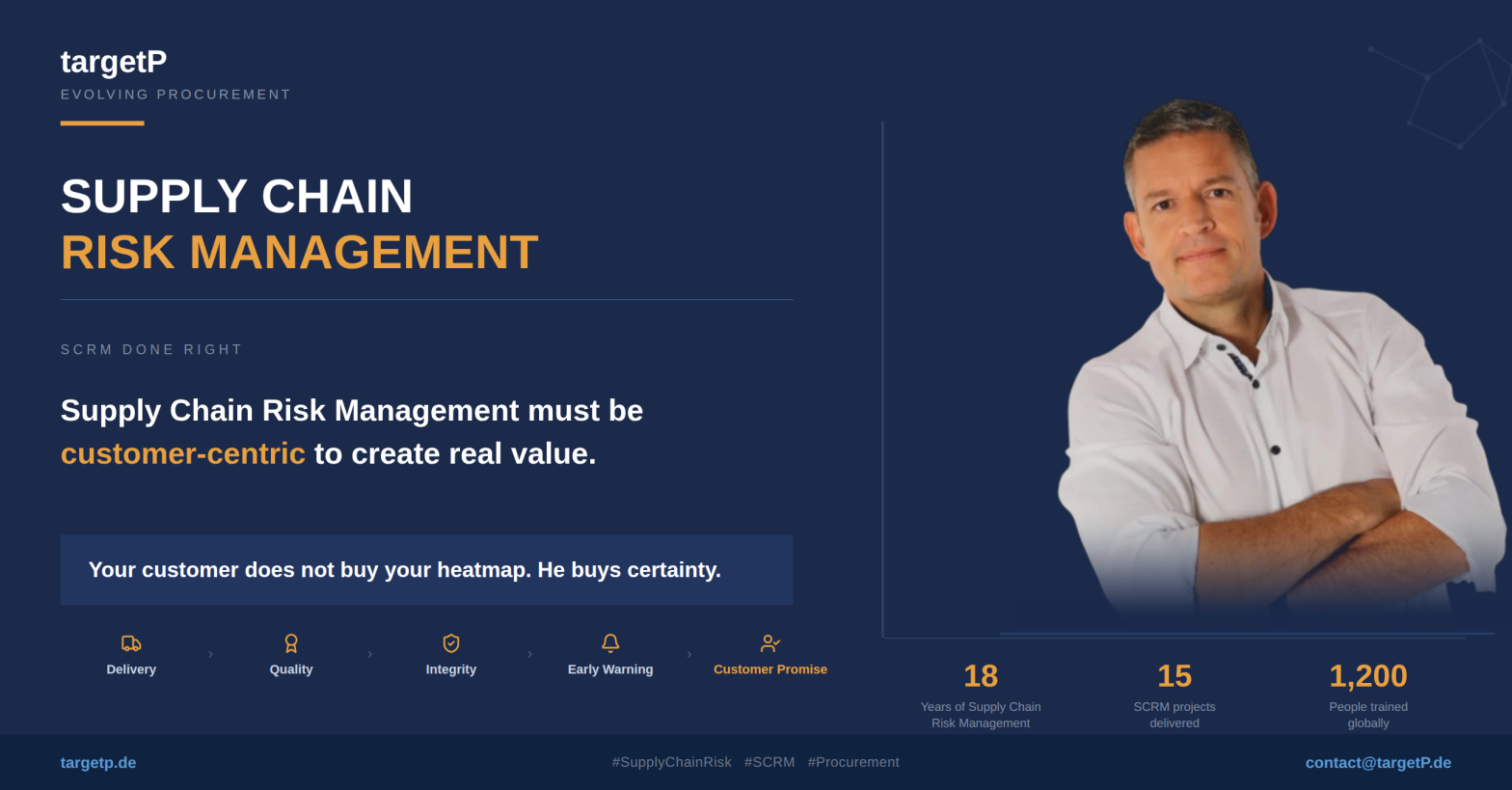
Risk Culture Beats Every Risk Framework

Supply Chain Risk Management Culture

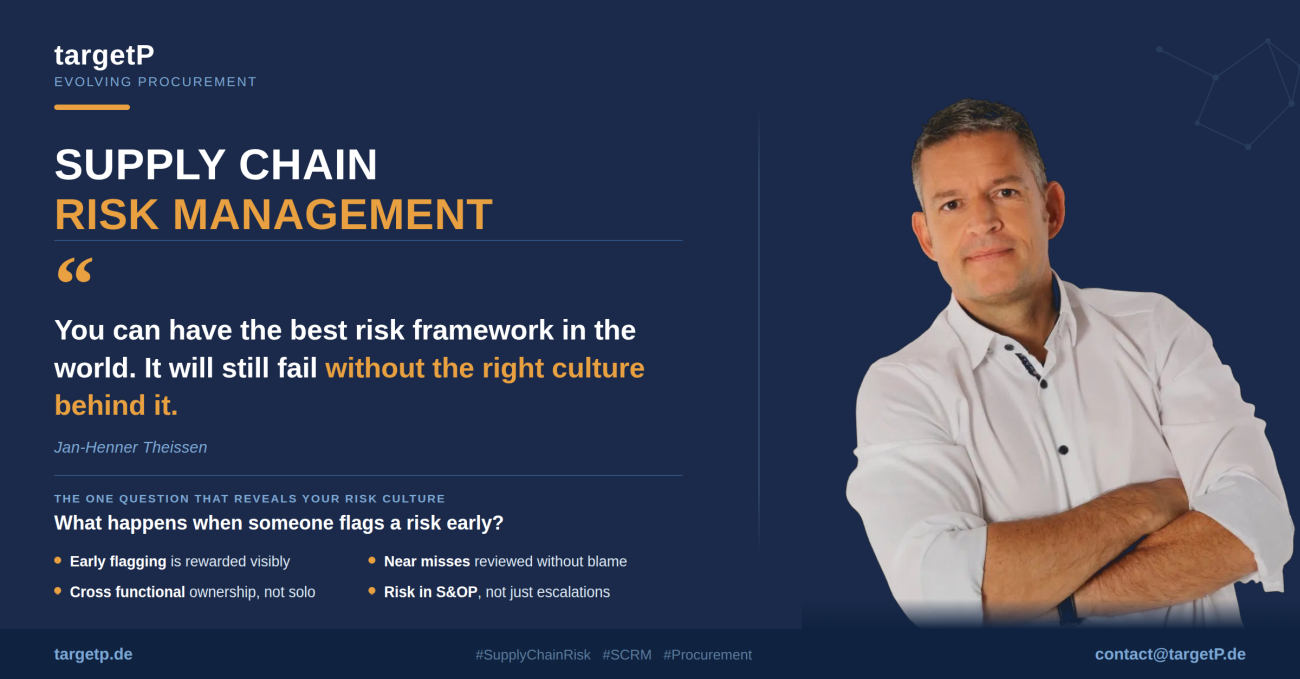
🧠 You Can Have the Best Risk Framework in the World. It Will Still Fail if There is No Risk Culture Next episode of our series: Supply Chain Risk Management done right! Here is the part nobody puts in a framework document. It is also THE part that determines whether everything else works.  I have seen it in multiple organizations across different industries. A buyer spots a worrying signal from a supplier. They are not sure it is serious enough to escalate. They do not want to be seen as alarmist.  They wait:  Three weeks later, it becomes a crisis. The process existed. The governance existed. The risk register existed. But the culture did not support early escalation. Nor was there any trust (remember my post 2 weeks ago?). And that made all the difference. ➡️Risk culture is not a values poster on the wall. It comes down to one question:  „In your organization, what actually happens when someone flags a risk early?“ If the answer involves extra meetings, justification overhead, or quiet skepticism, you have a culture and trust problem, not a process problem. Building a genuine risk culture means a few concrete things: ✅  Leadership visibly rewards early flagging, even when the risk does not materialize ✅  Leadership walks the talk and integrates managing risk into discussions, decisions, and processes – and they listen whenever they are asked to listen! ✅  Near-misses are reviewed without blame, not swept under the rug ✅  Risk is a normal topic in S&OP and supplier reviews, not a special escalation ✅  Cross-functional teams share ownership, so procurement is not carrying it alone ✅  Roles, responsibilities, and incentives get adjusted. Protecting the organization, its assets, and earnings becomes everyone’s responsibility by default. My takeaway after years of building and leading supply chain risk organizations: ➡️ Culture is not just an enabler. It is THE enabler for managing supply chain risk organizations effectively. ➡️ Yes, culture change is slow. Process change is fast. Most organizations default to the fast option. And then they wonder why the processes never quite stick. ➡️If you ignore building and maintaining a risk culture, you are going nowhere, wasting budget and time, and frustrating your entire organization! This isn’t from a textbook or study; it is the experience of a practitioner who learned it the hard way.

Speaker Alert: RISK AWARENESS WEEK 2026

RISK AWARENESS WEEK

RISK AWARENESS WEEK 2026 – JOIN 22,000 RISK PROFESSIONALS IN OCTOBER I’m speaking at Risk Awareness Week 2026 – the largest virtual conference on risk-based decision-making (12–16 October). My sessions: ➡️When Supply Chains Break: How the Best Companies Decide Under Uncertainty (30 min talk) ➡️ Building an Effective Supply Chain Risk Management Capability (3h Workshop) If you haven’t come across RAW, it’s been running every October since 2019 and has reached more than 22,000 professionals from over 140 countries. In 2024, FERMA named it Training and Education Program of the Year. The conference’s central theme is that risk management is not about risks; it’s about decisions. The program focuses on practitioners showing how to put credible estimates on uncertainty and use them where decisions are actually made: budgets, forecasts, projects, insurance. My sessions are part of a full week of talks and hands-on workshops running 12–16 October, entirely online – sessions are broadcast at scheduled times and available as replays afterward, so any time zone works. I am happy to add the wisdom of 18 years of Supply Chain Risk Management, including 15 global, award-winning SCRM implementations across numerous industries. As usual, hands-on with practical solutions and a focus on what’s really needed to increase speed, save budget, and be effective from day 1. The first two days of the conference are free to attend. You can register and see the full program here: https://www.riskawarenessweek.com/

Your Suppliers Are Sending You Warning Signs. Are You Reading Them

Supply Chain Integrity

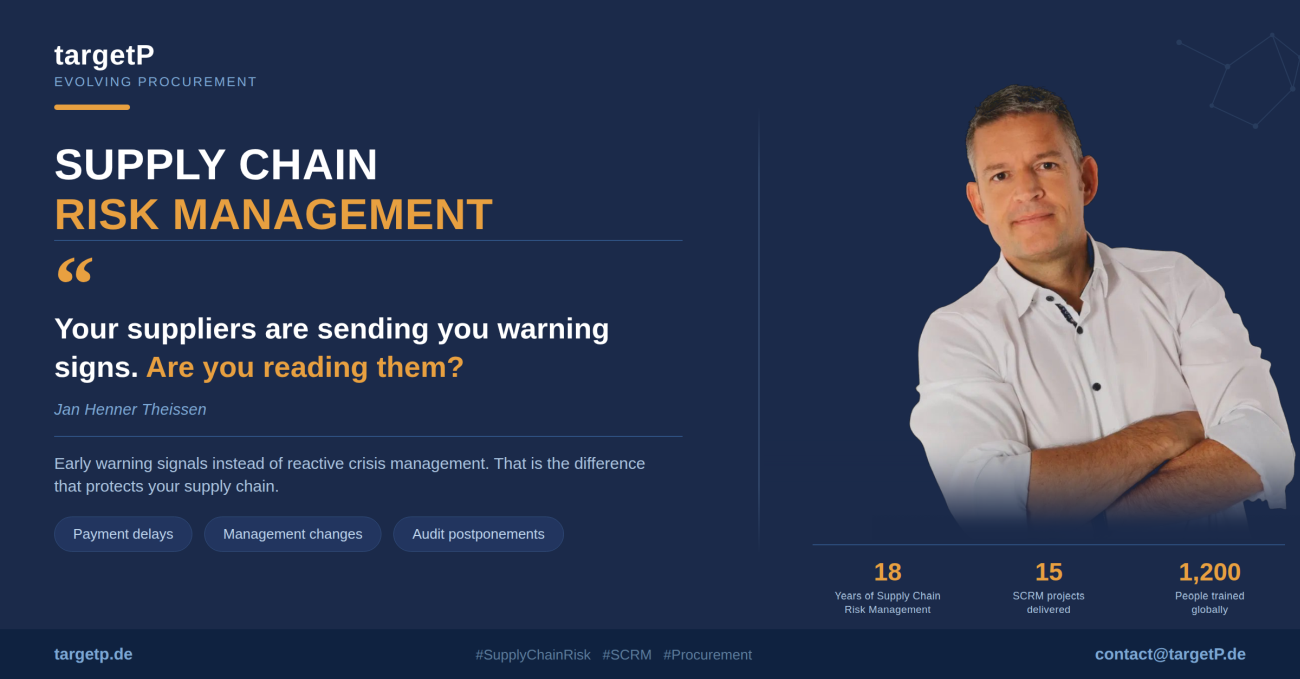
Next episode of our series: Supply Chain Risk Management done right: Supplier Risk Signals Most companies manage supply chain risk backward. They respond to events. THE MORE EFFECTIVE WAY: They should be reading signals. There is a world of difference between the two. An event is when your supplier calls to say they cannot deliver. A signal is the pattern that predicted the call weeks or months earlier. In my 18 years of building SCRM systems across industries, the same warning signs appear before almost every supplier failure: 🔴 Payment delays to their own sub-suppliers 🔴 Supplier asking for early payments 🔴 Unexplained and frequent management changes 🔴 Declining quality or rising non-conformance numbers without a clear root cause 🔴 Layoffs, high fluctuation, and strikes 🔴 Shipment and capacity excuses that keep shifting 🔴 Audit requests are being postponed again and again None of these alone is a crisis. Together, they are a pattern. Patterns are readable if you know what to look for. The problem is not that signals are invisible. It is that most organizations have never defined what a signal means for their specific supply base, and nobody is systematically looking for them. Technology might help with signal identification and pattern analysis, and so will educated, aware employees. Here is a simple starting point: Take your ten most critical suppliers. Do you have a defined set of early-warning indicators you actively monitor regularly? If not, that is exactly where your SCRM journey should begin. Next question you should ask: What signals have you seen precede a supplier failure? ————– Hi. I am Jan, your SCRM Builder. Not a consultant who theorizes about risk. A procurement leader & risk practitioner who has built 15 SCRM programs globally, trained 1,200 people, and led procurement and risk organizations through crisis. I share what works and help you build an effective SCRM. I work globally.
Trust is not a Soft Skill

Supply Chain Risk Management and Trust

🤝 Trust is not a Soft Skill. Responsibility is your Job. Risk Management is all about ✅staying in business. ✅remaining solvent. ✅ continuing to provide work, income, and stability to the people who depend on the organization, whatever its size or legal form. And preparedness is not a luxury reserved for those who can afford a risk department. It is a basic act of responsibility toward your employees, your shareholders, your customers and, ultimately, yourself. It is your job, 365/24/7! THE factor that decides whether that responsibility actually works in practice: ➡️TRUST If you asked me which single factor has the greatest influence on whether risk management actually works, my answer is always the same: TRUST. Trust is the willingness to make yourself vulnerable to another party, expecting them to act with goodwill, competence, and integrity, even without a contract forcing them to. That is exactly what risk management tries to enable: cooperation under uncertainty and in crisis. In calm times, trust is an efficiency factor. In a crisis, it is a survival factor. I once worked through a fire at one of our most critical suppliers. The potential damage ran into the hundreds of millions. The technical response worked exactly as designed. But something else changed the outcome. We sent senior leadership to the site immediately, not to make demands or cite contracts, but to ask what the supplier actually needed, and to rearrange our own production to relieve pressure on them. When production restarted, that supplier prioritized us. Not because we demanded it. Because they wanted to. Only a real relationship could produce that outcome. What you should do: 🔹 Build trust before you need it. Crisis is the wrong moment to start. Follow contracts, solve issues in partnership, help out in a crisis. Easy & no money required. 🔹 Reward early, honest signals from your own people and your suppliers instead of punishing them for raising concerns. 🔹 Stand up for your partners when things go wrong 🔹 Stay critical even in long, comfortable relationships. Familiarity should never replace attention. Trust can take years to grow, and it can be damaged within weeks if behavior is inconsistent. Trust is about building the conditions for honest, early, useful information to reach the people who need it, inside your organization and across your supply base. Ask yourself: Where does trust sit in your risk management approach today? Hi. I am Jan, your SCRM Builder. Not a consultant who theorizes about risk. A procurement leader & risk practitioner who has built 15 SCRM programs globally, trained 1,200 people, and led procurement and risk organizations through crisis. I share what works and help you build an effective SCRM. I work and train globally.

en_USEnglish
About the company:
Joint Venture Truck OEMs
(Germany & Sweden)
Development Hydrogen fuel cell systems
approx. 500Employees, strong growth
GlobalTechnologyInnovator

Case Study

Industry: Automotive

Area: Organisation

Land: Deutschland & USA

Duration: 12 Months

Starting Point / Assignment

  • approx. EUR 400 million Procurement spend p.a. (rapidly increasing)
  • Independent joint venture between two large truck manufacturers
  • Start of series production in 2027 and development of the North American market with local production requires far-reaching development and expansion of Procurement, particularly regarding a global organization (skills, capacities, x-functional collaboration) and digitalization

Objectives

  • Creating transparency about the maturity level of the Procurement function
  • Prioritized action plan to gradually increase the maturity level regarding competencies, x-functional cooperation, productivity/efficiency, digitalization, etc.
  • Development of target organization model (2023, 2027, 2030) for production and non-production materials Procurement incl. all role descriptions and necessary capacity (FTE sizing)
  • Detailed transformation plan for the global Procurement organization aligned with the milestones "Start of series production" and "Market entry & local production North America“
  • Review of Procurement’s digital strategy and projects including future recommendations

Approach

  • Comprehensive maturity analysis of Procurement (targetP! method) with a focus on organization and digitalization based on personal interviews (all Procurement staff and top stakeholders) as well as in-depth document and data analysis (strategies, guidelines, process descriptions, digitalization initiatives, standards for category & supplier management, order & invoice volumes, etc.).
  • S/T/O analysis to determine the actual capacity utilization of all Procurement employees as part of individual interviews
  • Workshops/interviews with IT & Procurement on the Procurement system landscape and digital strategy

Results / „Deliverables“

  • Detailed maturity assessment report on Procurement (production and non-production materials) including prioritized actions and quick wins
  • Procurement digital strategy benchmark against best practices with specific recommendations for actions, risk analysis, and quick wins
  • Transparency regarding the actual use of capacity in Procurement, gap analysis of the respective profiles and stakeholder expectations
  • Role-based target Procurement organization with a step-by-step development plan (staffing, development, reallocation)
  • Tailor-made role descriptions for use in subsequent recruiting measures
About the company:
Joint Venture Truck OEMs
(Germany & Sweden)
Development Hydrogen fuel cell systems
approx. 500Employees, strong growth
GlobalTechnologyInnovator

Case Study

Industry: Automotive

Area: Organisation

Land: Deutschland & USA

Duration: 12 Months

Starting Point / Assignment

  • approx. EUR 400 million Procurement spend p.a. (rapidly increasing)
  • Independent joint venture between two large truck manufacturers
  • Start of series production in 2027 and development of the North American market with local production requires far-reaching development and expansion of Procurement, particularly regarding a global organization (skills, capacities, x-functional collaboration) and digitalization

Objectives

  • Creating transparency about the maturity level of the Procurement function
  • Prioritized action plan to gradually increase the maturity level regarding competencies, x-functional cooperation, productivity/efficiency, digitalization, etc.
  • Development of target organization model (2023, 2027, 2030) for production and non-production materials Procurement incl. all role descriptions and necessary capacity (FTE sizing)
  • Detailed transformation plan for the global Procurement organization aligned with the milestones "Start of series production" and "Market entry & local production North America“
  • Review of Procurement’s digital strategy and projects including future recommendations

Approach

  • Comprehensive maturity analysis of Procurement (targetP! method) with a focus on organization and digitalization based on personal interviews (all Procurement staff and top stakeholders) as well as in-depth document and data analysis (strategies, guidelines, process descriptions, digitalization initiatives, standards for category & supplier management, order & invoice volumes, etc.).
  • S/T/O analysis to determine the actual capacity utilization of all Procurement employees as part of individual interviews
  • Workshops/interviews with IT & Procurement on the Procurement system landscape and digital strategy

Results / „Deliverables“

  • Detailed maturity assessment report on Procurement (production and non-production materials) including prioritized actions and quick wins
  • Procurement digital strategy benchmark against best practices with specific recommendations for actions, risk analysis, and quick wins
  • Transparency regarding the actual use of capacity in Procurement, gap analysis of the respective profiles and stakeholder expectations
  • Role-based target Procurement organization with a step-by-step development plan (staffing, development, reallocation)
  • Tailor-made role descriptions for use in subsequent recruiting measures
About the company:
Family Owned Business with international Footprint
approx. 500 Mio.Turnover
approx. 3.000 Employees
Technology & Market Leaderin Harvesting Equipment

Case Study

Industry: Agricultural Machines

Area: Transformation

Country: Germany

Duration: ~ 18 Months

Starting Point / Assignment

  • approx. 200 million Procurement volume
  • Sole focus on operational processes (clerical function)
  • Strong focus on German plants, not prepared for internationalization and cooperation, despite of having operating units in the USA and China
  • Strong growth in turnover and increased internationalization
  • Procurement’s priority: Supply security (“keep the plants running”)
  • Digitalization not actively driven

Objectives

  • Create an understanding of Procurement’s maturity level
  • Identify potential (e.g., value contribution, efficiency, compliance), through more professional category & supplier management and digital support
  • Elaborate on alternative measures to develop Procurement and create an action plan, particularly concerning process improvements
  • If necessary, determine and argue capacity requirements
  • Optimize structures to prepare for growth and improved resource utilization

Approach

  • Comprehensive maturity analysis of Procurement (targetP! method) with a focus on organization and operational improvements (personal interviews with Procurement staff and top stakeholders) as well as in-depth document and data analysis (strategies, guidelines, process descriptions, digitalization initiatives, etc.)
  • Development of a holistic transformation plan and target organization model including roles and responsibilities, stakeholder integration, etc.
  • Early involvement of employees "future conferences to build my organization“
  • Joint creation of a practicable category structure, a Procurement Vision & Strategy


Results / „Deliverables“

  • First-time definition of a Procurement strategy with aligned objectives
  • Capacity optimization through targeted personnel expansion
  • Optimized organizational model and a more rigid category structure established
  • First system reviews with digital solution providers based on a digital action plan and precise requirements
  • Design of a customized multi-year training program for all roles
  • Implementation of Category Management training with pilots
  • Development and implementation of Procurement processes
About the company:
Family Owned Business with international Footprint
approx. 500 Mio.Turnover
approx. 3.000 Employees
Technology & Market Leaderin Harvesting Equipment

Case Study

Industry: Agricultural Machines

Area: Transformation

Country: Germany

Duration: ~ 18 Months

Starting Point / Assignment

  • approx. 200 million Procurement volume
  • Sole focus on operational processes (clerical function)
  • Strong focus on German plants, not prepared for internationalization and cooperation, despite of having operating units in the USA and China
  • Strong growth in turnover and increased internationalization
  • Procurement’s priority: Supply security (“keep the plants running”)
  • Digitalization not actively driven

Objectives

  • Create an understanding of Procurement’s maturity level
  • Identify potential (e.g., value contribution, efficiency, compliance), through more professional category & supplier management and digital support
  • Elaborate on alternative measures to develop Procurement and create an action plan, particularly concerning process improvements
  • If necessary, determine and argue capacity requirements
  • Optimize structures to prepare for growth and improved resource utilization

Approach

  • Comprehensive maturity analysis of Procurement (targetP! method) with a focus on organization and operational improvements (personal interviews with Procurement staff and top stakeholders) as well as in-depth document and data analysis (strategies, guidelines, process descriptions, digitalization initiatives, etc.)
  • Development of a holistic transformation plan and target organization model including roles and responsibilities, stakeholder integration, etc.
  • Early involvement of employees "future conferences to build my organization“
  • Joint creation of a practicable category structure, a Procurement Vision & Strategy


Results / „Deliverables“

  • First-time definition of a Procurement strategy with aligned objectives
  • Capacity optimization through targeted personnel expansion
  • Optimized organizational model and a more rigid category structure established
  • First system reviews with digital solution providers based on a digital action plan and precise requirements
  • Design of a customized multi-year training program for all roles
  • Implementation of Category Management training with pilots
  • Development and implementation of Procurement processes
About the company:
Leading Healthcare Provider
High reputation (Top rated Medical Care)
Site: approx. 825 Mio. Turnover
approx. 1.700employees
> 80.000 Patienten/Jahr

Case Study

Industry: Health Care/Clinic

Bereich: Interim & Entwicklung

Country: Germany

Duration: 6 Months

Starting Point / Assignment

  • approx. EUR 60 million spend p.a., complex spend structure
  • Procurement with a strong focus on processing and operational processes, no systematic spending management
  • Significant operational problems in day-to-day business led to high costs
  • Very insecure, demotivated team due to degrading treatment and extreme micromanagement by the previous Procurement Manager
  • Non-existent digitalization of core processes and tasks
  • Extensive, sometimes paralyzing bureaucracy in general and when approving requirements such as Requisitions, Purchase Orders and Contracts
  • Lack of discipline and ethics among sales reps (back-door selling, etc.)
  • Low reputation within the hospital, especially among chief physicians

Objectives

  • Main objective: Stabilization and reactivation of a highly frustrated team
  • Stabilization of day-to-day business, also due to above-average absences
  • Better distribution of the workload among the team members
  • Creating an understanding of the actual maturity level of Procurement, identifying potential (e.g., value contribution, efficiency, compliance)
  • Elaborating alternative measures to develop Procurement, and create an action plan, particularly concerning process simplifications (approvals of Requisitions, Purchase Orders, Contracts)
  • Improving customer service quality and interaction with internal customers

Approach

  • Comprehensive maturity analysis of Procurement involving stakeholders
  • Creation and coordination of a holistic development plan
  • Open door policy and individual meetings several times a week
  • Regular visits to the hospital wards to understand the needs and build trust
  • Frequent exchange with internal customers (regular personal exchange, participatory approach: Involvement of all employees, e.g. we
  • Weekly team meetings to discuss issues, improvement ideas, and solutions to ensure full commitment and involvement in improvement projects
  • Strong involvement in day-to-day business (negotiations, sourcing)
  • Process analyses, in particular, SAP optimization options & approvals

Results / „Deliverables“

  • Team stabilized, motivation increased, absences and absenteeism reduced (CEO quote: "You calmed people down very quickly with professional empathy and got them behind you")
  • First-time definition of a Procurement strategy with agreed upon targets
  • Regular coordination with internal customers (Chief physician quote: "we talk to each other now, things run faster, we finally feel well looked after")
  • Approval and implementation of moderate staff expansion with restructuring of work areas and balancing of workload
  • Redesign of framework agreements with improved commercial conditions
  • Complete processing of unfinished order processes (backlog)
  • Simplification and definition of core Procurement processes;
  • Addition of new SAP functionalities to drive automation & workload reduction
About the company:
Leading Healthcare Provider
High reputation (Top rated Medical Care)
Site: approx. 825 Mio. Turnover
approx. 1.700employees
> 80.000 Patienten/Jahr

Case Study

Industry: Health Care/Clinic

Bereich: Interim & Entwicklung

Country: Germany

Duration: 6 Months

Starting Point / Assignment

  • approx. EUR 60 million spend p.a., complex spend structure
  • Procurement with a strong focus on processing and operational processes, no systematic spending management
  • Significant operational problems in day-to-day business led to high costs
  • Very insecure, demotivated team due to degrading treatment and extreme micromanagement by the previous Procurement Manager
  • Non-existent digitalization of core processes and tasks
  • Extensive, sometimes paralyzing bureaucracy in general and when approving requirements such as Requisitions, Purchase Orders and Contracts
  • Lack of discipline and ethics among sales reps (back-door selling, etc.)
  • Low reputation within the hospital, especially among chief physicians

Objectives

  • Main objective: Stabilization and reactivation of a highly frustrated team
  • Stabilization of day-to-day business, also due to above-average absences
  • Better distribution of the workload among the team members
  • Creating an understanding of the actual maturity level of Procurement, identifying potential (e.g., value contribution, efficiency, compliance)
  • Elaborating alternative measures to develop Procurement, and create an action plan, particularly concerning process simplifications (approvals of Requisitions, Purchase Orders, Contracts)
  • Improving customer service quality and interaction with internal customers

Approach

  • Comprehensive maturity analysis of Procurement involving stakeholders
  • Creation and coordination of a holistic development plan
  • Open door policy and individual meetings several times a week
  • Regular visits to the hospital wards to understand the needs and build trust
  • Frequent exchange with internal customers (regular personal exchange, participatory approach: Involvement of all employees, e.g. we
  • Weekly team meetings to discuss issues, improvement ideas, and solutions to ensure full commitment and involvement in improvement projects
  • Strong involvement in day-to-day business (negotiations, sourcing)
  • Process analyses, in particular, SAP optimization options & approvals

Results / „Deliverables“

  • Team stabilized, motivation increased, absences and absenteeism reduced (CEO quote: "You calmed people down very quickly with professional empathy and got them behind you")
  • First-time definition of a Procurement strategy with agreed upon targets
  • Regular coordination with internal customers (Chief physician quote: "we talk to each other now, things run faster, we finally feel well looked after")
  • Approval and implementation of moderate staff expansion with restructuring of work areas and balancing of workload
  • Redesign of framework agreements with improved commercial conditions
  • Complete processing of unfinished order processes (backlog)
  • Simplification and definition of core Procurement processes;
  • Addition of new SAP functionalities to drive automation & workload reduction
About the company:
Highly renowned Qatari company
approx. 825 mn.Turnover
approx. 3.500 Employees
Regional Market Leader
Shipping, Maritime Logistik & Services

Case Study

Industrie: Reederei & Maritim

Bereich: Organisation & Interim

Country: Qatar

Duration: ~ 12 Months

Starting Point / Assignment

  • approx. EUR 300 million Procurement spend p.a.
  • Procurement with a strong focus on processing and operational processes, no systematic spending management
  • Significant operational problems in day-to-day business led to high costs for troubleshooting, escalations, and internal conflicts with stakeholders
  • Low acceptance and appreciation of Procurement and high political pressure despite excellent company results
  • Long-term vacancy in Procurement leadership impacts performance, customer satisfaction, and insecurity and leading to high fluctuation on buyer level
  • Digitalization of core processes and tasks only marginally developed

Objectives

  • Create an understanding of the true maturity level of Procurement and gain buy-in from the Executive Board
  • Identify potential (e.g., value contribution, efficiency, compliance), through more professional category & supplier management and automation
  • Elaborate on alternative measures to develop Procurement and create an action plan, particularly concerning process simplifications
  • Improve strategic and operational reporting for the CFO
  • Implement organizational and structural optimization to improve service quality
  • After two months: additional Role as VP Ad Interim due to the dismissal of the Head of Procurement

Approach

  • Comprehensive maturity analysis of Procurement involving stakeholders
  • Creation and coordination of a holistic transformation plan with staff adjustments, digitalization, and skills requirements
  • Development of a target organization model (category management) with role descriptions, responsibilities and recruiting support
  • Highly participative approach with intensive involvement of all employees, e.g., as part of "future conferences" (for the first time in the company) and expert teams with topic champions
  • Further development of Procurement and sourcing governance, e.g., tailored Category Structure, Procurement Vision & Procurement strategy and policies

Results / „Deliverables“

  • First-time definition of a Procurement strategy with aligned objectives
  • Approval and implementation of moderate staff expansion and allocation and expansion of required skills through comprehensive training plans
  • Start of digitalization projects based on a digital action plan (Supplier Portal)
  • Implementation of a Category Management approach and process and execution of 10 category pilots to identify additional value contribution
  • Development and implementation of comprehensive Supplier Management involving a newly designed supplier qualification process (Supplier Portal)
  • Implementation of a Procurement guideline & process manual and creation of comprehensive Procurement reporting with PowerBI
  • 10-month Interim Management and stabilization of the organization
About the company:
Highly renowned Qatari company
approx. 825 mn.Turnover
approx. 3.500 Employees
Regional Market Leader
Shipping, Maritime Logistik & Services

Case Study

Industrie: Reederei & Maritim

Bereich: Organisation & Interim

Country: Qatar

Duration: ~ 12 Months

Starting Point / Assignment

  • approx. EUR 300 million Procurement spend p.a.
  • Procurement with a strong focus on processing and operational processes, no systematic spending management
  • Significant operational problems in day-to-day business led to high costs for troubleshooting, escalations, and internal conflicts with stakeholders
  • Low acceptance and appreciation of Procurement and high political pressure despite excellent company results
  • Long-term vacancy in Procurement leadership impacts performance, customer satisfaction, and insecurity and leading to high fluctuation on buyer level
  • Digitalization of core processes and tasks only marginally developed

Objectives

  • Create an understanding of the true maturity level of Procurement and gain buy-in from the Executive Board
  • Identify potential (e.g., value contribution, efficiency, compliance), through more professional category & supplier management and automation
  • Elaborate on alternative measures to develop Procurement and create an action plan, particularly concerning process simplifications
  • Improve strategic and operational reporting for the CFO
  • Implement organizational and structural optimization to improve service quality
  • After two months: additional Role as VP Ad Interim due to the dismissal of the Head of Procurement

Approach

  • Comprehensive maturity analysis of Procurement involving stakeholders
  • Creation and coordination of a holistic transformation plan with staff adjustments, digitalization, and skills requirements
  • Development of a target organization model (category management) with role descriptions, responsibilities and recruiting support
  • Highly participative approach with intensive involvement of all employees, e.g., as part of "future conferences" (for the first time in the company) and expert teams with topic champions
  • Further development of Procurement and sourcing governance, e.g., tailored Category Structure, Procurement Vision & Procurement strategy and policies

Results / „Deliverables“

  • First-time definition of a Procurement strategy with aligned objectives
  • Approval and implementation of moderate staff expansion and allocation and expansion of required skills through comprehensive training plans
  • Start of digitalization projects based on a digital action plan (Supplier Portal)
  • Implementation of a Category Management approach and process and execution of 10 category pilots to identify additional value contribution
  • Development and implementation of comprehensive Supplier Management involving a newly designed supplier qualification process (Supplier Portal)
  • Implementation of a Procurement guideline & process manual and creation of comprehensive Procurement reporting with PowerBI
  • 10-month Interim Management and stabilization of the organization