Digital Risk Management

Digital Risk Management

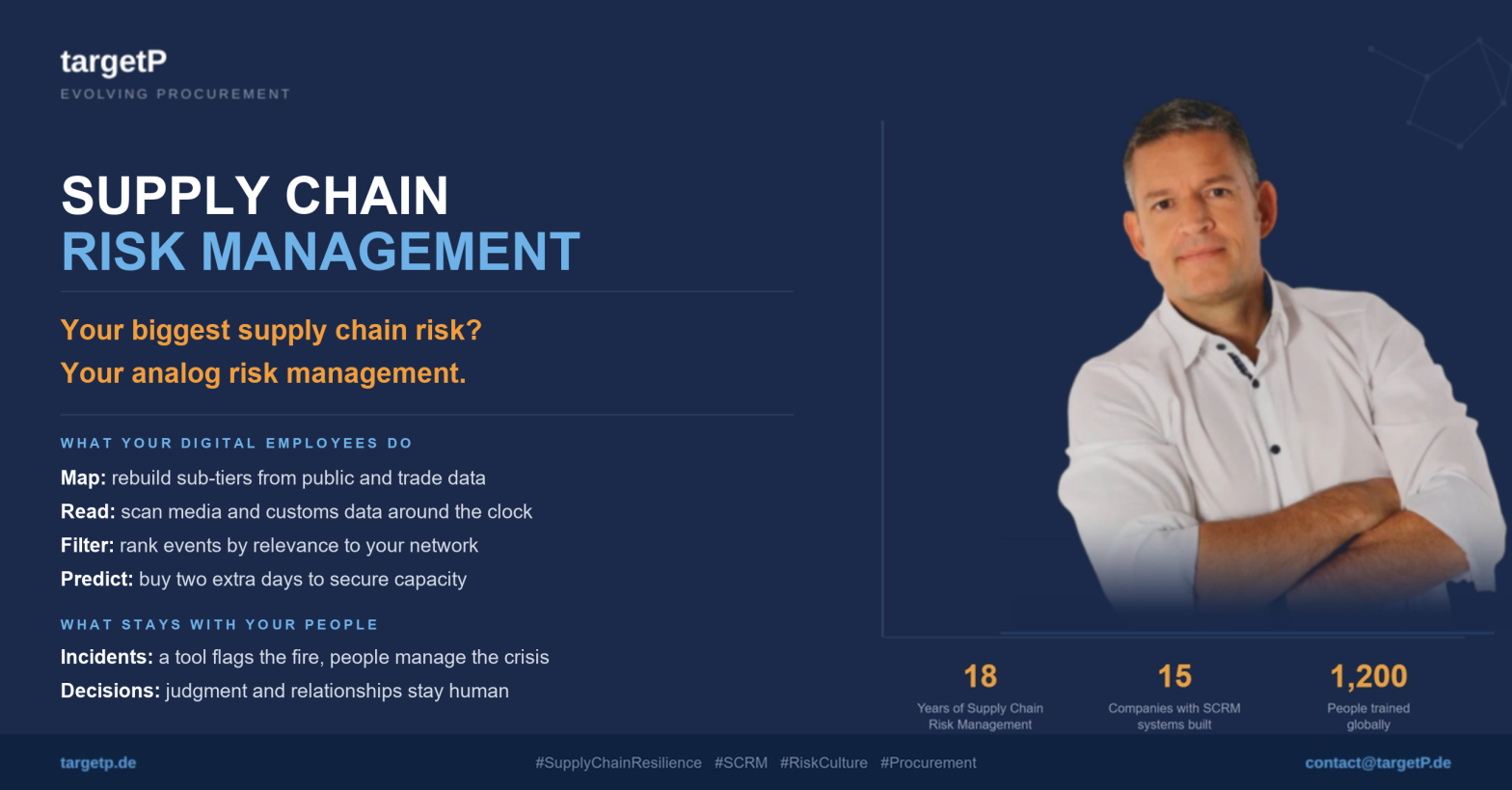
Your biggest supply chain risk? Your analog risk management. LAST episode of our series: Supply Chain Risk Management done right! Thanks for the outstanding feedback and > 650k impressions. Finally, let me share my judgment after using digital risk management platforms since 2013: I would never build an SCRM approach without additional „digital employees.“ They can do things your team can’t do by hand. Do the math. A supply network has thousands of suppliers, sites, ports, and routes. Each one throws off data: news, weather, sanctions lists, financial filings, local posts. That is thousands of data points a day, and no human can monitor them. If you are still running risk on Excel, questionnaires, and a Google Alert, you’re operating under a false sense of security. 🎯They map what your suppliers won’t tell you. In 2026, EcoVadis found that only 12% of organizations say they can see more than half of their Tier 2 suppliers. Cooperation usually ends at Tier 1, as Tier 1 suppliers often won’t disclose their sources. Digital mapping can rebuild the sub-tier network from public and trade data, down to parts and materials. However, be reasonable and don’t expect miracles. 🎯 They read signals around the clock. AI scans media, government reports, and customs data in many languages and local dialects. A strike rumor on a regional blog can reach you before your supplier’s account manager calls. Works mostly well. 🎯 They cut the noise. Good systems rank events by relevance to your network. Think about your resources! 🎯 They buy you time. Predictive models combine history with live signals. Two extra days can decide whether you secure the alternative capacity or your competitor does. Must have Now the uncomfortable part. You can buy all of this and still get blindsided and fail. A tool can flag a fire at a factory. It doesn’t know that this site is your only qualified source, and most importantly: Digital risk management solutions don’t manage incidents and relationships, nor do they make decisions Human-Machine collaboration required Risk identification and decision prep are where humans & machines are strongest together. Machines bring reach, speed, analytics, and scenario modeling. People bring context, judgment, and relationships. Together, they catch the weak signals either one would miss alone, and every analyst verdict fed back into the system makes the next alert better. Effective SCRM takes digital infrastructure, solid procedures, and capable people. Now, let’s turn those lessons into capability. Build people and organizations who are ready to act. My training/workshop will perfectly prepare you for it. Hi. I am Jan, your SCRM Builder. Not a consultant who theorizes about risk. A procurement leader and risk practitioner who has built 15 SCRM programs globally, trained 1,200 people, and led procurement and risk organizations through crisis. I share what works and help you build an effective SCRM. I work globally.

Resilience

Resilience

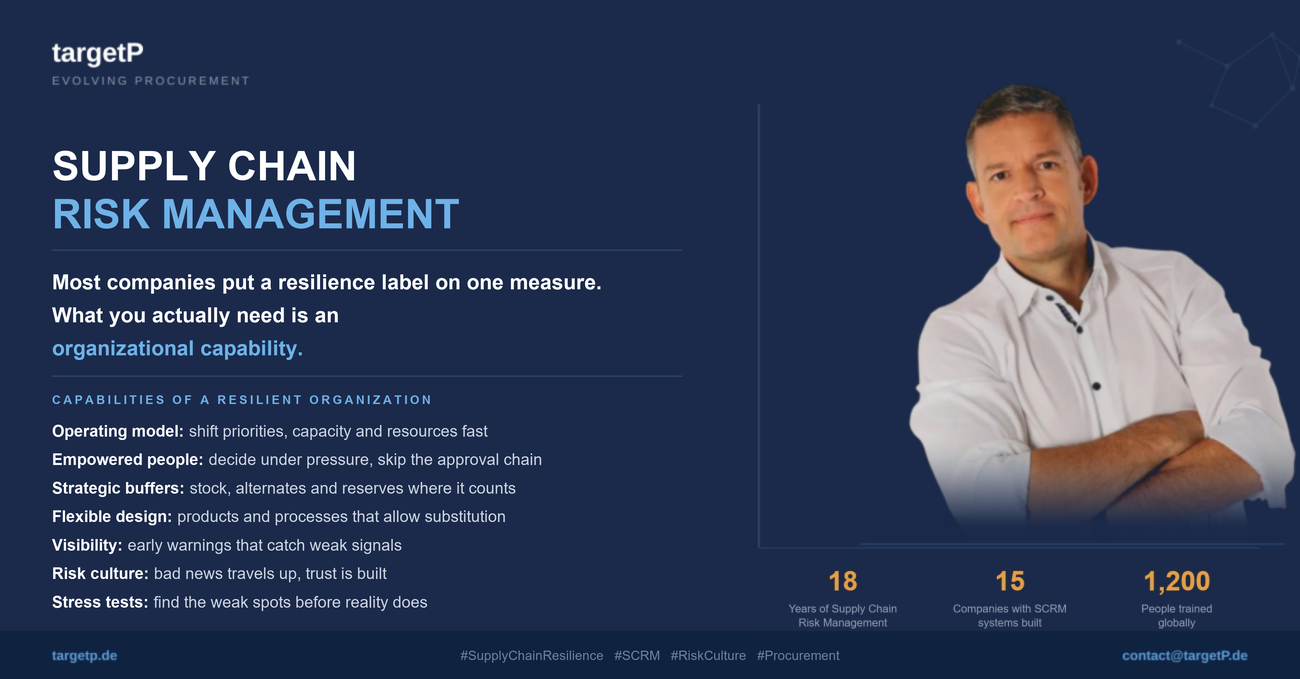
Resilience is one of the most abused words in business. Next episode of our series: Supply Chain Risk Management done right! Every leader claims it, and every simple measure gets labeled „resilience“. Few can explain what it actually means. A second supplier? Safety stock? A digital risk dashboard? These are just measures. Not resilience. A dangerous misjudgment. SCRM is not resilience: SCRM identifies, assesses, and manages exposure. Risk dashboards, supplier ratings, tools, and people help you understand where you are vulnerable. Resilience is not a measure. It is an organizational capability: Dual sourcing is useless if both suppliers depend on the same sub-tier. Safety stock buys time, not immunity. A sophisticated risk tool is worthless if nobody acts on its warnings. Real resilience requires a system of mutually reinforcing capabilities: ✅ Agile, adaptable, responsive operating models that can rapidly shift priorities, capacity, and resources. ✅ Empowered people who can make decisions under pressure instead of waiting for three approval levels. ✅ Strategic buffers: safety stocks, alternative suppliers, and capacity reserves where they matter most. ✅ Flexible product and process design that enables substitutions when critical components disappear. ✅ End-to-end visibility and early-warning mechanisms that detect weak signals before they become crises. ✅ A strong risk culture that challenges assumptions, escalates bad news, builds TRUST, and rewards preparedness over firefighting. ✅ Regular stress tests and scenario exercises that expose weaknesses before reality does. This brings us to the typical debate: Procurement/SCM: “We need to invest in resilience.”Finance: “What’s the ROI?“ Fair question. But companies routinely underestimate the cost of fragility because it is scattered across lost output, premium freight, penalties, idle capacity, and management time. Resilience is not about eliminating risk. It is your organization’s ability to absorb disruption, adapt, and continue delivering when your assumptions fail. Resilience is whether you can take the hit and keep delivering. ⚠️Now, let’s turn those lessons into capability. Build people and organizations who are ready to act. My training/workshop will perfectly prepare you for it.

Risk Management: Make Better Decisions

Risk Management is to make Better Decisions

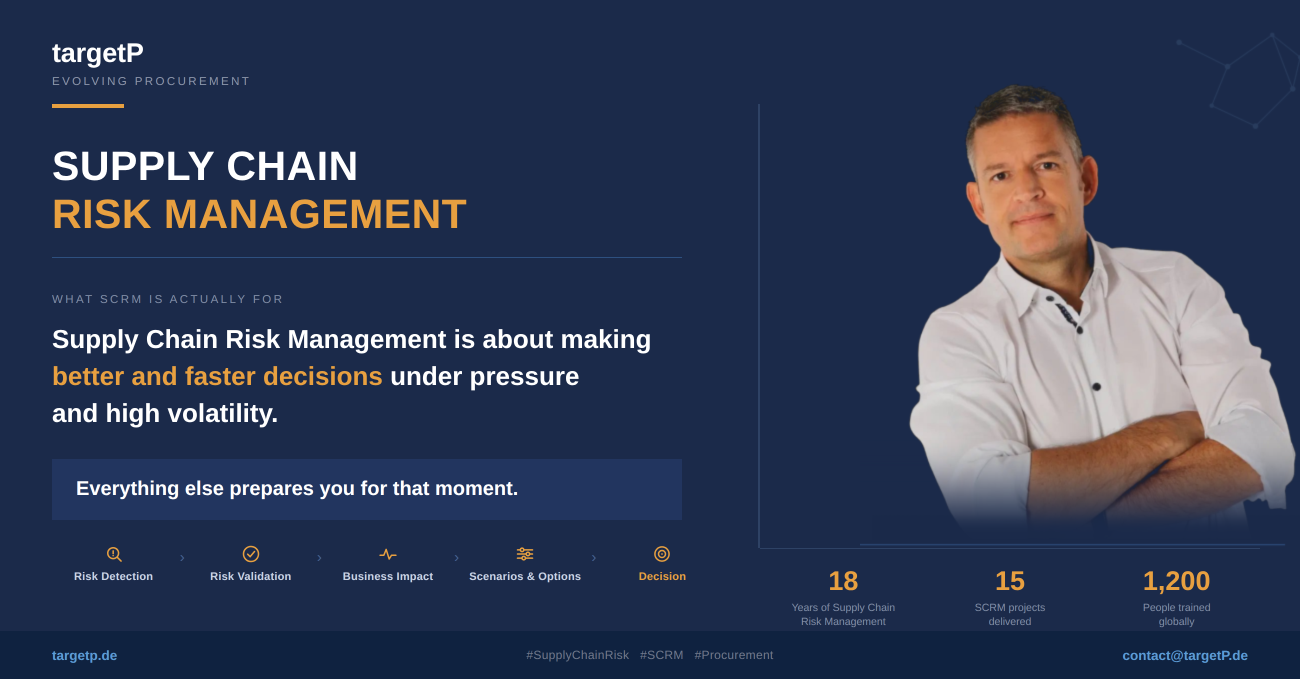
🎯 Risk Management Is NOT About Knowing More Risks. It Is About Making Better Decisions! Next episode of our series: Supply Chain Risk Management done right! What was the last supply risk your board actually decided on, rather than noted? You know it: A plant is short on parts. Three customers want the same allocation. Everyone in the room has an opinion. Nobody has facts. As always! The risk register didn’t help, as always! It named the supplier, but it didn’t say which plants would stop, on what day, how much revenue was at stake, or who could spend to fix it. Again, SCRM is more than predicting risks, listening to signals, or identifying risk. ⚠️It is about making educated decisions under pressure and high volatility. ⚠️It is about making better decisions faster, at the level where the risk actually lives. Everything else prepares you for that moment. 1️⃣ WHICH DECISIONS ARE AT STAKE Every one of these now rests on exposure the Board cannot currently see. That is why boards must demand it, not delegate it. 🔀 Strategy and footprint. Where we produce, source, and commit to markets. 🔀 Make or buy. Where we accept dependency and pay for backup. 🔀 Capital, inventory, and coverage. Where stock buys resilience, where it is dead money. 🔀 Allocation in a crisis. Which plants, customers, and orders get served first. 🔀 Commitments we sign. What we promise customers, what we accept from suppliers. Five board-level decisions. You can’t make any of them well from a simple heat map. 2️⃣ WHAT RISK MANAGEMENT MUST DELIVER Stop producing risk reports. Start producing decision packages. The same five things, every time: ✅ Transparency. Who supplies what, into which plant, at which tier. ✅ Detection and validation. Signals defined, verified, turned into named exposure. ✅ Impact. Revenue, output, customers, cash, compliance. ✅ Scenarios. Best, expected, worst. Days of cover, time to recover. ✅ Options and a recommendation. Two or three costed choices, trade-offs, one owner. 3️⃣ WHAT THE BOARD MUST ESTABLISH Your team cannot deliver the above alone. Only the board can provide guidance, set risk strategy and appetite, and criticality, mandate supplier, part, and plant data as a governed asset, fund the capability as a line item, name who may stop, spend, and commit within how many days, and put decision packages on a standing agenda instead of status slides. ⚠️No facts. No scenarios. No options. No decision. 👇 Now, let’s turn those lessons into capability. Build people & organizations who are ready to act. My training/workshop will perfectly prepare you for it. —- 👉Hi. I am Jan, your SCRM Builder. Not a consultant who theorizes about risk. A procurement leader & risk practitioner who has built 15 SCRM programs globally, trained 1,200 people, and led procurement and risk organizations through crisis. I share what works and help you build an effective SCRM. I work globally.
Customer Centric Supply Chain Risk Management

Customer Centric Supply Chain Risk Management

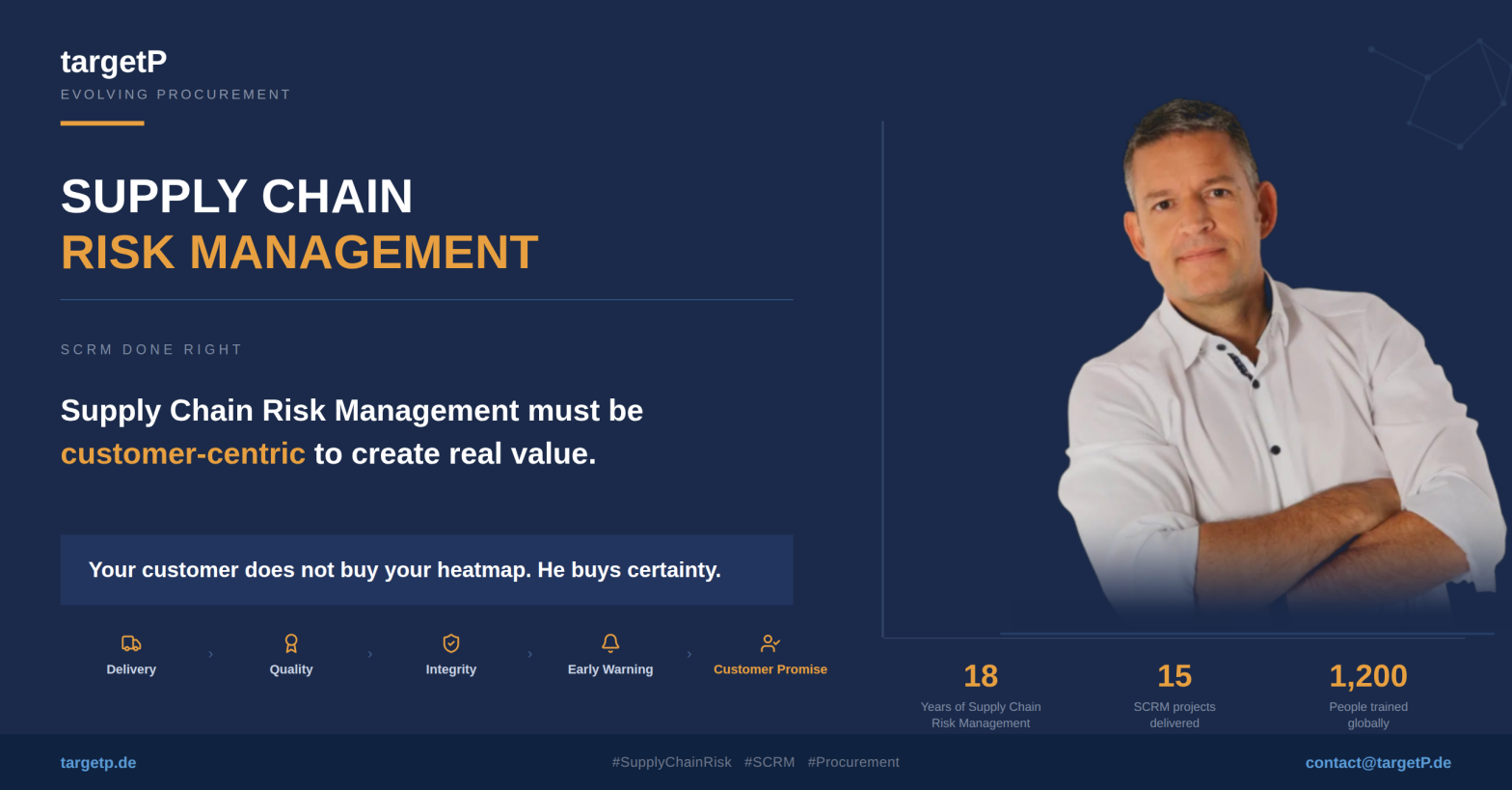
What if your biggest supply chain risk is losing sight of your CUSTOMER? Next episode: Supply Chain Risk Management done right! Many companies treat SCRM as an isolated project. They create registers, assess suppliers, and define mitigation plans. But: one critical perspective is often missing: THE CUSTOMER! Effective SCRM must be CUSTOMER-CENTRIC. That perspective works on two levels, and both determine whether it creates value or burns budget! ➡️SCRM aligned with the customer The ultimate purpose of managing risk is to protect the customer promise. Your customer does not buy your heatmap; he buys certainty. Certainty about delivery, quality, and integrity. And certainty that when something does go wrong, they hear it from you first. That’s why reliability, availability, and the ability to respond to changing customer expectations need to be at the heart of SCRM. A risk only becomes truly relevant when we understand its potential impact on the customer. What happens to customer experience if a critical component is unavailable? What is the financial impact? And how much resilience is actually required to protect them? This is where SCRM becomes a business capability. So the honest test for any SCRM setup is simple. Does it protect what the customer actually values? If your risk dashboard cannot be translated into those four things, it is an internal hobby. ➡️ Customer-centricity in the Supply Chain SCRM cannot operate in isolation. All internal stakeholders have different needs and risk perspectives. The interaction across the entire value chain is the real success factor. Suppliers are not the object of the exercise; they are part of it. A supplier who understands why you ask for capacity data, and who gets something back for sharing it, will tell you about a problem weeks earlier.  Sales needs to know what it can promise. Production planning needs to know which components deserve a buffer. Finance needs to know which exposure is worth insuring. The board needs a view it can act on rather than a heat map in fifty shades of orange. Your opportunity: Supply chain resilience can be monetized. The cost of resilience can be linked to customer retention, revenue protection, service levels, and market opportunities. Risk insights can become part of Sales and Marketing strategies. It is about protecting the customer promise, enabling the business, and creating trust across the entire value chain. That makes risk management a competitive advantage in the good years and a life insurance policy in the bad ones. Now, let’s turn those lessons into capability. Build people who are ready to act. Make SCRM work when it matters. 👉Hi. I am Jan, your SCRM Builder. Not a consultant who theorizes about risk. A procurement leader & risk practitioner who has built 15 SCRM programs globally, trained 1,200 people, and led procurement and risk organizations through crisis. I share what works and help you build an effective SCRM. I work globally.
Your Suppliers Are Sending You Warning Signs. Are You Reading Them

Supply Chain Integrity

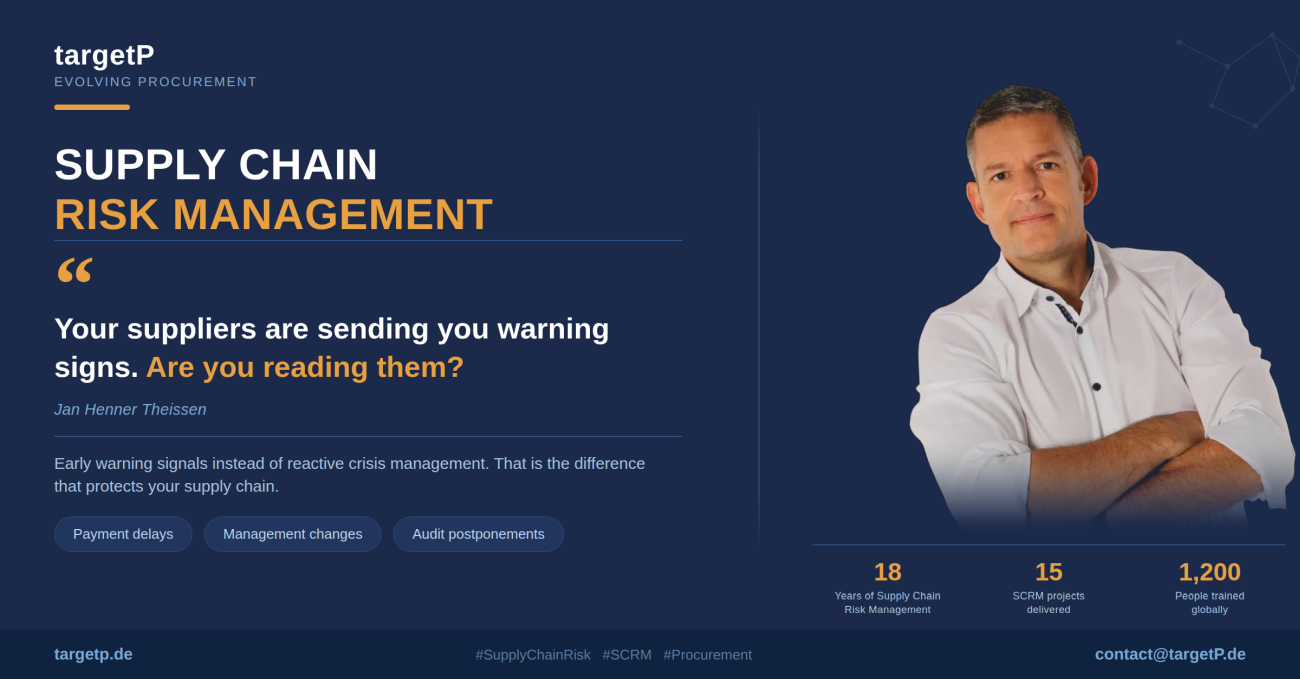
Next episode of our series: Supply Chain Risk Management done right: Supplier Risk Signals Most companies manage supply chain risk backward. They respond to events. THE MORE EFFECTIVE WAY: They should be reading signals. There is a world of difference between the two. An event is when your supplier calls to say they cannot deliver. A signal is the pattern that predicted the call weeks or months earlier. In my 18 years of building SCRM systems across industries, the same warning signs appear before almost every supplier failure: 🔴 Payment delays to their own sub-suppliers 🔴 Supplier asking for early payments 🔴 Unexplained and frequent management changes 🔴 Declining quality or rising non-conformance numbers without a clear root cause 🔴 Layoffs, high fluctuation, and strikes 🔴 Shipment and capacity excuses that keep shifting 🔴 Audit requests are being postponed again and again None of these alone is a crisis. Together, they are a pattern. Patterns are readable if you know what to look for. The problem is not that signals are invisible. It is that most organizations have never defined what a signal means for their specific supply base, and nobody is systematically looking for them. Technology might help with signal identification and pattern analysis, and so will educated, aware employees. Here is a simple starting point: Take your ten most critical suppliers. Do you have a defined set of early-warning indicators you actively monitor regularly? If not, that is exactly where your SCRM journey should begin. Next question you should ask: What signals have you seen precede a supplier failure? ————– Hi. I am Jan, your SCRM Builder. Not a consultant who theorizes about risk. A procurement leader & risk practitioner who has built 15 SCRM programs globally, trained 1,200 people, and led procurement and risk organizations through crisis. I share what works and help you build an effective SCRM. I work globally.
Trust is not a Soft Skill

Supply Chain Risk Management and Trust

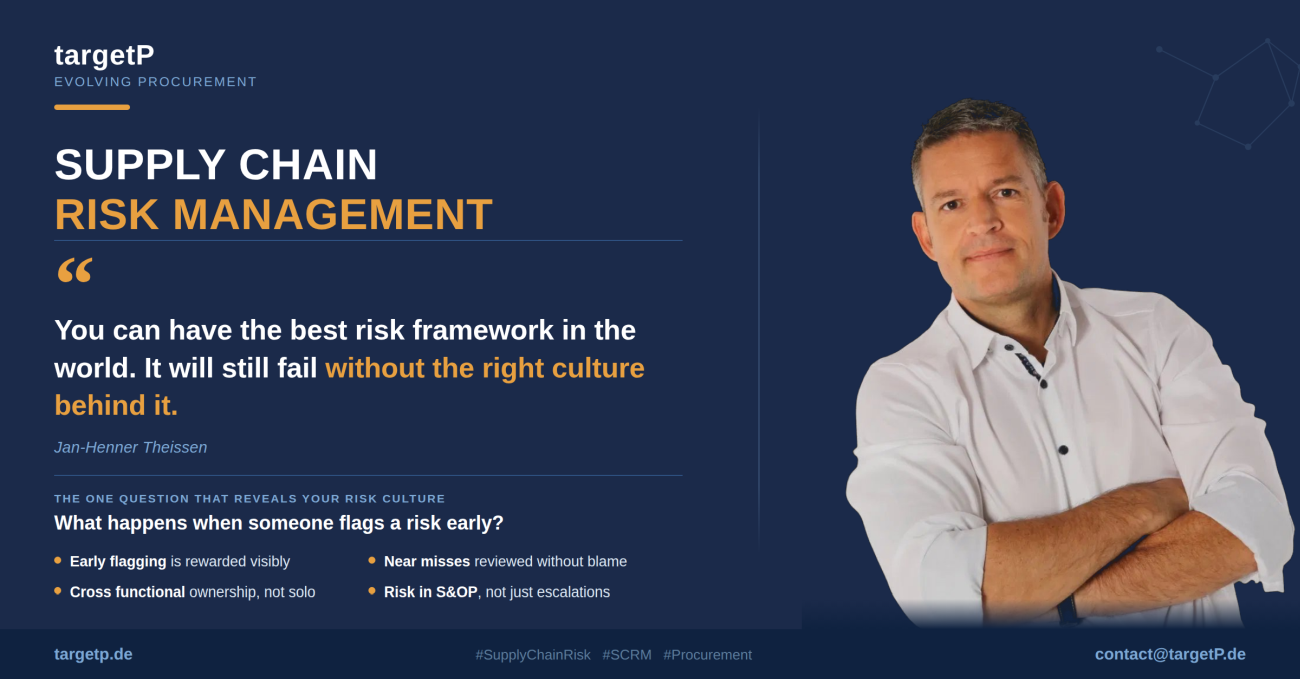
🤝 Trust is not a Soft Skill. Responsibility is your Job. Risk Management is all about ✅staying in business. ✅remaining solvent. ✅ continuing to provide work, income, and stability to the people who depend on the organization, whatever its size or legal form. And preparedness is not a luxury reserved for those who can afford a risk department. It is a basic act of responsibility toward your employees, your shareholders, your customers and, ultimately, yourself. It is your job, 365/24/7! THE factor that decides whether that responsibility actually works in practice: ➡️TRUST If you asked me which single factor has the greatest influence on whether risk management actually works, my answer is always the same: TRUST. Trust is the willingness to make yourself vulnerable to another party, expecting them to act with goodwill, competence, and integrity, even without a contract forcing them to. That is exactly what risk management tries to enable: cooperation under uncertainty and in crisis. In calm times, trust is an efficiency factor. In a crisis, it is a survival factor. I once worked through a fire at one of our most critical suppliers. The potential damage ran into the hundreds of millions. The technical response worked exactly as designed. But something else changed the outcome. We sent senior leadership to the site immediately, not to make demands or cite contracts, but to ask what the supplier actually needed, and to rearrange our own production to relieve pressure on them. When production restarted, that supplier prioritized us. Not because we demanded it. Because they wanted to. Only a real relationship could produce that outcome. What you should do: 🔹 Build trust before you need it. Crisis is the wrong moment to start. Follow contracts, solve issues in partnership, help out in a crisis. Easy & no money required. 🔹 Reward early, honest signals from your own people and your suppliers instead of punishing them for raising concerns. 🔹 Stand up for your partners when things go wrong 🔹 Stay critical even in long, comfortable relationships. Familiarity should never replace attention. Trust can take years to grow, and it can be damaged within weeks if behavior is inconsistent. Trust is about building the conditions for honest, early, useful information to reach the people who need it, inside your organization and across your supply base. Ask yourself: Where does trust sit in your risk management approach today? Hi. I am Jan, your SCRM Builder. Not a consultant who theorizes about risk. A procurement leader & risk practitioner who has built 15 SCRM programs globally, trained 1,200 people, and led procurement and risk organizations through crisis. I share what works and help you build an effective SCRM. I work and train globally.

Supply Chain Risk Is Agnostic

Supply Chain Risk will find you

Supply Chain Risk Does Not Check Your Org Chart Before It Hits A Supply Chain Risk or a cyberattack does not ask whether you are a NASDAQ/DAX corporation or a 12-person family business. A key supplier insolvency does not care if you are privately owned, government-owned, or publicly listed. A flooded port, a sanctioned trade route: none of it checks your balance sheet first. RISK IS AGNOSTIC Just watch the news: It applies to multinational corporates with big risk departments. It applies to the SME with one overworked person handling sourcing, finance, and risk simultaneously. It applies to municipal utilities, hospitals, NGOs. It even applies to the freelancer whose entire business depends on a few clients. None of these organizations are exempt simply because of their size, ownership structure, or sector. What differs is not whether risk will arrive. What differs is whether anyone is prepared for it. I have worked inside large corporates with mature SCRM functions, and I have advised smaller, privately owned businesses with no formal risk process at all. The companies that struggled most were not always the smallest or the least sophisticated. They were the ones who quietly believed that disruption was something that happened to other organizations. At the end of all the frameworks, governance models and digital monitoring tools, there is one plain truth that applies equally to all: This is about staying in business. About remaining solvent. About continuing to provide work, income, and stability to the people who depend on the organization, regardless of its size or legal form. Whether you are an SME or a global corporation makes no difference. Preparation and investment are required either way; a big budget proves nothing about effectiveness, and there is no excuse for inaction or for hiding behind the excuse that this is only for „the big ones.” Preparedness is not a luxury reserved for those who can afford a risk department. It is a basic act of responsibility toward your employees, your shareholders, your customers, and, ultimately, yourself. If you run an organization of any kind, the question is not whether risk will find you. The question is whether you will be ready when it does. Hi. I am Jan, your SCRM Builder. Not a consultant who theorizes about risk. A procurement leader & risk practitioner who has built 15 SCRM programs globally, trained 1,200 people, and led procurement and risk organizations through crisis. I share what actually works and build your effective SCRM. I work and train globally

Cargo Theft

Cargo Theft

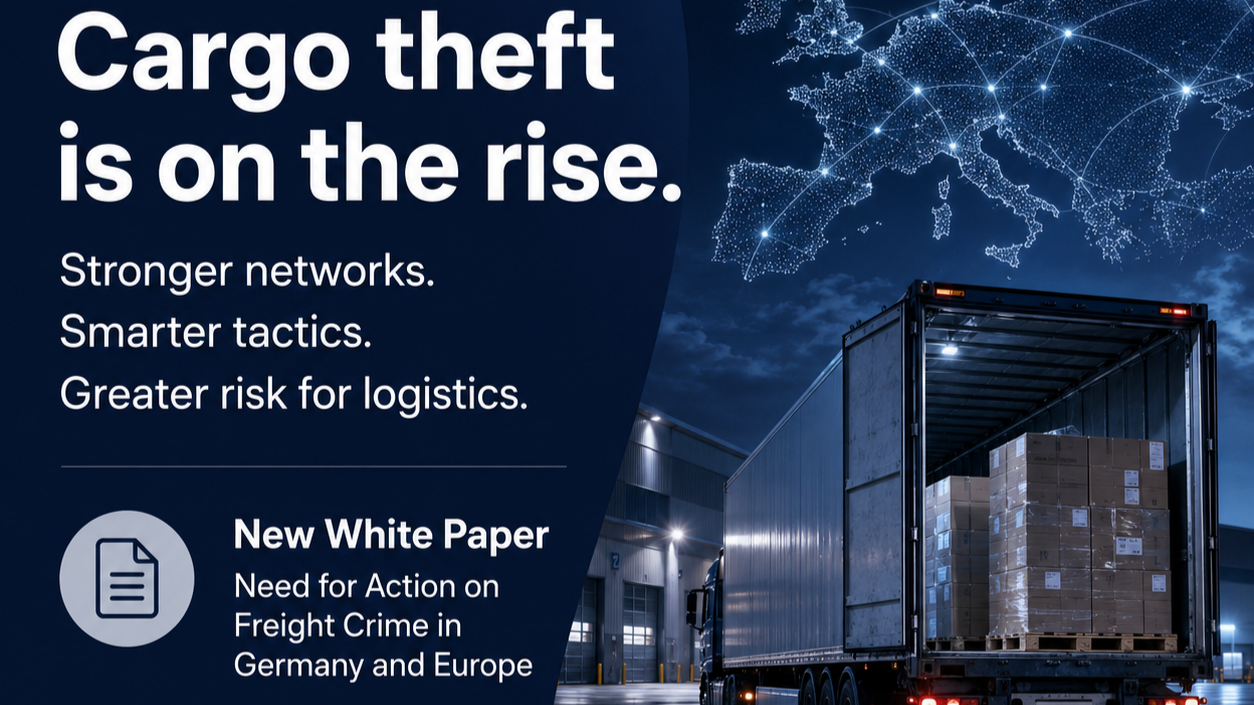
Today’s cargo thief doesn’t wear a mask. He wears an employee badge.  Pay attention, Supply Chain Risk Community. This serious problem is not on the radar of many organizations. ⚡49,366 attacks on European supply chains in just 273 days. ⚡8,2 billion euros in annual cargo theft losses across the EU. ⚡+438% increase in cargo theft across Europe within a single year. These are not numbers from a crime novel. They come from TAPA incident reports and industry analysis by trans.info.  The real problem runs deeper than the numbers themselves. When we talk about supply chain risk, we default to geopolitical, insolvency, and environmental risks.  The last mile and the human factor rarely make the priority list. That is exactly where a risk with real financial impact and long-term reputational damage is quietly building. Cargo theft: the problem isn’t the thief. It’s his invisibility. Today’s perpetrators operate from the inside, not the outside. As drivers. As warehouse staff. As dispatchers. As executives of so-called fake carriers. They show up with documentation, genuine or forged, and they know the processes. In some cases, they helped design them. 76% of cargo theft in logistics in 2024 happened directly out of vehicles. The real problem is structural. Once someone has built insider knowledge inside a supply chain, they can carry that knowledge across employer changes, carrier changes, and new identities. Site bans stay local. Background checks filter only the coarsest cases. Blacklist sharing, in its previous form, has been unlawful since GDPR. And conventional biometric one-to-one checks only confirm whether a person matches the credential they present, not whether that same person is already active in the system under a different identity. The result: repeat offenders regain access to security-sensitive positions despite prior red flags, identity changes, and employer changes. Undetected. What’s needed isn’t another document. It’s a different logic. One that starts with the person, not the paperwork, applied continuously, across company lines, and in a privacy-compliant way. The entire supply chain industry and retailers are currently working on solutions to this exact problem. Anyone looking into it should consider: Drivers Trust by Green Convenience. Established global freight carriers and retailers trust Drivers Trust ⬇️ Download the whitepaper. https://www.driver-trust.de/hubfs/whitepaper_handlungsbedarf_frachtkriminalitaet_mehrfachtaeter_identitaetsbetrug_FOGD.pdf?hsLang=en

ALERT: The next supply chain crisis is here

ALERT: The next supply chain crisis is here.

⚡The next American and Global supply chain crisis is here. 45,000 dockworkers at every major eastern and Gulf Coast port will be on strike, starting today. After weeks of fruitless negotiations and the Biden administration signaling it would not force the dockworkers back to work, the stage is set for a potentially devastating supply chain crisis. The ILA is demanding higher wages and a ban on the automation of the cranes, gates, and container movements used at 36 U.S. ports. 👉The ramifications will be significant: A strike will cause complete stoppages at all involved ports of container and bulk cargo Vessels will drop anchors outside ports and await the dockworkers coming back to work. And the impact will be global regarding vessel and container capacity and schedules. Looks like an exciting holiday season is ahead of us! 👉Some might say this situation is comparable to the COVID disruptions but it is not. The COVID challenges were caused by significant increases in cargo volumes and a lack of operational capacities to cope with the throughput – in port terminals, rail, and truck as well as warehouse capacity. 👉For more details refer to the official ILA statement issued yesterday ILA Update – Monday, September 30, 2024 at 11 am NORTH BERGEN, NJ: The International Longshoremen’s Association (ILA) reports that United States Maritime Alliance (USMX) continues to block the path toward a settlement on a new Master Contract by refusing ILA’s demands for a fair and decent contract and seems intent on causing a strike at all ports from Maine to Texas beginning in almost 12 hours. “The Ocean Carriers represented by USMX want to enjoy rich billion-dollar profits that they are making in 2024, while they offer ILA Longshore Workers an unacceptable wage package that we reject”, the ILA said. “ILA longshore workers deserve to be compensated for the important work they do keeping American commerce moving and growing. It’s disgraceful that most of these foreign-owned shipping companies are engaged in a ‘Make and Take’ operation: They want to make their billion-dollar profits at United States ports, and off the backs of American ILA longshore workers, and take those earnings out of this country and into the pockets of foreign conglomerates. Meanwhile, ILA dedicated longshore workers continue to be crippled by inflation due to USMX’s unfair wage packages. “ “In addition, the shippers are gouging their customers that result in increased costs to American consumers. They are now charging $30,000 for a full container, a whopping increase from $6,000 per container just a few weeks ago. In just a short time, they went from 6K, to 18K, then 24K and now $30,000. It’s unheard of and they are doubling their $30,000 fee stuffing the same container from multiple shippers. They are killing the customers.” 👉 Once again an excellent example of the importance of structured supply chain risk and crisis management supported by effective emergency plans and early preventive measures. We are happy to share our thoughts and experiences building robust supply chain risk management programs.

Collaboration Drives Supply Chain Stability & Integrity

Agritech Summit. The Power of Collaboration. Supply Chain Stability & Integrity

Collaboration Drives Supply Chain Stability & Integrity The 5th Agritech Summit opened its doors yesterday. Under the patronage of the two founders Hajo Drees and Josip Tomasevic, key players of the Agritech industry are meeting again in Augsburg, OEMs as well as global suppliers and SMEs. The event was opened by the Bavarian Vice Minister Tobias Gotthardt, who welcomed the guests on behalf of Bavarian Prime Minister Dr. Markus Söder. Shortly after Mr. Gotthardt, I had the great pleasure of contributing a keynote speech on: 👉“The Power of Collaboration Drives Supply Chain Stability & Integrity. Turn Uncertainty and Responsibility into a Competitive Advantage.“ At a summit where technology, innovation, business models, sustainability, and digitalization are discussed, the topic of Supply Chain Stability and Integrity should not be missing. Only the interaction of all these dimensions ensures robust deliveries and ensures sustainable economic success. One of my key messages was: In a time of countless crises and risks, new laws, and increasing customer expectations concerning sustainable, risk-optimized operations, intensifying cross-organizational cooperation is substantial for every business, but also for the entire industry. Help each other to create industry standards, jointly monitor supply chains and suppliers, identify threats, and build an AGTECH ecosystem that addresses the risks and challenges of the future across organizations. I pointed out what leadership teams should do: ✅Foster a risk culture and awareness of supply chain integrity with Humans and the environment in mind ✅Engage people, teams, and functions and make robust supply chains a corporate effort ✅Establish a comprehensive organizational integration, don’t just put task forces in place ✅Go digital and use effective supply chain tech; combine human skills with digital skills ✅Break boundaries and collaborate even with competitors ✅Stop working in silos and use all channels to exchange, support and share intelligence Thanks for the many new contacts and conversations and a high THANK YOU to Hajo and Josip for the invitation and the fantastic event. Looking forward to Day 2.      

en_USEnglish
About the company:
Joint Venture Truck OEMs
(Germany & Sweden)
Development Hydrogen fuel cell systems
approx. 500Employees, strong growth
GlobalTechnologyInnovator

Case Study

Industry: Automotive

Area: Organisation

Land: Deutschland & USA

Duration: 12 Months

Starting Point / Assignment

  • approx. EUR 400 million Procurement spend p.a. (rapidly increasing)
  • Independent joint venture between two large truck manufacturers
  • Start of series production in 2027 and development of the North American market with local production requires far-reaching development and expansion of Procurement, particularly regarding a global organization (skills, capacities, x-functional collaboration) and digitalization

Objectives

  • Creating transparency about the maturity level of the Procurement function
  • Prioritized action plan to gradually increase the maturity level regarding competencies, x-functional cooperation, productivity/efficiency, digitalization, etc.
  • Development of target organization model (2023, 2027, 2030) for production and non-production materials Procurement incl. all role descriptions and necessary capacity (FTE sizing)
  • Detailed transformation plan for the global Procurement organization aligned with the milestones "Start of series production" and "Market entry & local production North America“
  • Review of Procurement’s digital strategy and projects including future recommendations

Approach

  • Comprehensive maturity analysis of Procurement (targetP! method) with a focus on organization and digitalization based on personal interviews (all Procurement staff and top stakeholders) as well as in-depth document and data analysis (strategies, guidelines, process descriptions, digitalization initiatives, standards for category & supplier management, order & invoice volumes, etc.).
  • S/T/O analysis to determine the actual capacity utilization of all Procurement employees as part of individual interviews
  • Workshops/interviews with IT & Procurement on the Procurement system landscape and digital strategy

Results / „Deliverables“

  • Detailed maturity assessment report on Procurement (production and non-production materials) including prioritized actions and quick wins
  • Procurement digital strategy benchmark against best practices with specific recommendations for actions, risk analysis, and quick wins
  • Transparency regarding the actual use of capacity in Procurement, gap analysis of the respective profiles and stakeholder expectations
  • Role-based target Procurement organization with a step-by-step development plan (staffing, development, reallocation)
  • Tailor-made role descriptions for use in subsequent recruiting measures
About the company:
Family Owned Business with international Footprint
approx. 500 Mio.Turnover
approx. 3.000 Employees
Technology & Market Leaderin Harvesting Equipment

Case Study

Industry: Agricultural Machines

Area: Transformation

Country: Germany

Duration: ~ 18 Months

Starting Point / Assignment

  • approx. 200 million Procurement volume
  • Sole focus on operational processes (clerical function)
  • Strong focus on German plants, not prepared for internationalization and cooperation, despite of having operating units in the USA and China
  • Strong growth in turnover and increased internationalization
  • Procurement’s priority: Supply security (“keep the plants running”)
  • Digitalization not actively driven

Objectives

  • Create an understanding of Procurement’s maturity level
  • Identify potential (e.g., value contribution, efficiency, compliance), through more professional category & supplier management and digital support
  • Elaborate on alternative measures to develop Procurement and create an action plan, particularly concerning process improvements
  • If necessary, determine and argue capacity requirements
  • Optimize structures to prepare for growth and improved resource utilization

Approach

  • Comprehensive maturity analysis of Procurement (targetP! method) with a focus on organization and operational improvements (personal interviews with Procurement staff and top stakeholders) as well as in-depth document and data analysis (strategies, guidelines, process descriptions, digitalization initiatives, etc.)
  • Development of a holistic transformation plan and target organization model including roles and responsibilities, stakeholder integration, etc.
  • Early involvement of employees "future conferences to build my organization“
  • Joint creation of a practicable category structure, a Procurement Vision & Strategy


Results / „Deliverables“

  • First-time definition of a Procurement strategy with aligned objectives
  • Capacity optimization through targeted personnel expansion
  • Optimized organizational model and a more rigid category structure established
  • First system reviews with digital solution providers based on a digital action plan and precise requirements
  • Design of a customized multi-year training program for all roles
  • Implementation of Category Management training with pilots
  • Development and implementation of Procurement processes
About the company:
Leading Healthcare Provider
High reputation (Top rated Medical Care)
Site: approx. 825 Mio. Turnover
approx. 1.700employees
> 80.000 Patienten/Jahr

Case Study

Industry: Health Care/Clinic

Bereich: Interim & Entwicklung

Country: Germany

Duration: 6 Months

Starting Point / Assignment

  • approx. EUR 60 million spend p.a., complex spend structure
  • Procurement with a strong focus on processing and operational processes, no systematic spending management
  • Significant operational problems in day-to-day business led to high costs
  • Very insecure, demotivated team due to degrading treatment and extreme micromanagement by the previous Procurement Manager
  • Non-existent digitalization of core processes and tasks
  • Extensive, sometimes paralyzing bureaucracy in general and when approving requirements such as Requisitions, Purchase Orders and Contracts
  • Lack of discipline and ethics among sales reps (back-door selling, etc.)
  • Low reputation within the hospital, especially among chief physicians

Objectives

  • Main objective: Stabilization and reactivation of a highly frustrated team
  • Stabilization of day-to-day business, also due to above-average absences
  • Better distribution of the workload among the team members
  • Creating an understanding of the actual maturity level of Procurement, identifying potential (e.g., value contribution, efficiency, compliance)
  • Elaborating alternative measures to develop Procurement, and create an action plan, particularly concerning process simplifications (approvals of Requisitions, Purchase Orders, Contracts)
  • Improving customer service quality and interaction with internal customers

Approach

  • Comprehensive maturity analysis of Procurement involving stakeholders
  • Creation and coordination of a holistic development plan
  • Open door policy and individual meetings several times a week
  • Regular visits to the hospital wards to understand the needs and build trust
  • Frequent exchange with internal customers (regular personal exchange, participatory approach: Involvement of all employees, e.g. we
  • Weekly team meetings to discuss issues, improvement ideas, and solutions to ensure full commitment and involvement in improvement projects
  • Strong involvement in day-to-day business (negotiations, sourcing)
  • Process analyses, in particular, SAP optimization options & approvals

Results / „Deliverables“

  • Team stabilized, motivation increased, absences and absenteeism reduced (CEO quote: "You calmed people down very quickly with professional empathy and got them behind you")
  • First-time definition of a Procurement strategy with agreed upon targets
  • Regular coordination with internal customers (Chief physician quote: "we talk to each other now, things run faster, we finally feel well looked after")
  • Approval and implementation of moderate staff expansion with restructuring of work areas and balancing of workload
  • Redesign of framework agreements with improved commercial conditions
  • Complete processing of unfinished order processes (backlog)
  • Simplification and definition of core Procurement processes;
  • Addition of new SAP functionalities to drive automation & workload reduction
About the company:
Highly renowned Qatari company
approx. 825 mn.Turnover
approx. 3.500 Employees
Regional Market Leader
Shipping, Maritime Logistik & Services

Case Study

Industrie: Reederei & Maritim

Bereich: Organisation & Interim

Country: Qatar

Duration: ~ 12 Months

Starting Point / Assignment

  • approx. EUR 300 million Procurement spend p.a.
  • Procurement with a strong focus on processing and operational processes, no systematic spending management
  • Significant operational problems in day-to-day business led to high costs for troubleshooting, escalations, and internal conflicts with stakeholders
  • Low acceptance and appreciation of Procurement and high political pressure despite excellent company results
  • Long-term vacancy in Procurement leadership impacts performance, customer satisfaction, and insecurity and leading to high fluctuation on buyer level
  • Digitalization of core processes and tasks only marginally developed

Objectives

  • Create an understanding of the true maturity level of Procurement and gain buy-in from the Executive Board
  • Identify potential (e.g., value contribution, efficiency, compliance), through more professional category & supplier management and automation
  • Elaborate on alternative measures to develop Procurement and create an action plan, particularly concerning process simplifications
  • Improve strategic and operational reporting for the CFO
  • Implement organizational and structural optimization to improve service quality
  • After two months: additional Role as VP Ad Interim due to the dismissal of the Head of Procurement

Approach

  • Comprehensive maturity analysis of Procurement involving stakeholders
  • Creation and coordination of a holistic transformation plan with staff adjustments, digitalization, and skills requirements
  • Development of a target organization model (category management) with role descriptions, responsibilities and recruiting support
  • Highly participative approach with intensive involvement of all employees, e.g., as part of "future conferences" (for the first time in the company) and expert teams with topic champions
  • Further development of Procurement and sourcing governance, e.g., tailored Category Structure, Procurement Vision & Procurement strategy and policies

Results / „Deliverables“

  • First-time definition of a Procurement strategy with aligned objectives
  • Approval and implementation of moderate staff expansion and allocation and expansion of required skills through comprehensive training plans
  • Start of digitalization projects based on a digital action plan (Supplier Portal)
  • Implementation of a Category Management approach and process and execution of 10 category pilots to identify additional value contribution
  • Development and implementation of comprehensive Supplier Management involving a newly designed supplier qualification process (Supplier Portal)
  • Implementation of a Procurement guideline & process manual and creation of comprehensive Procurement reporting with PowerBI
  • 10-month Interim Management and stabilization of the organization