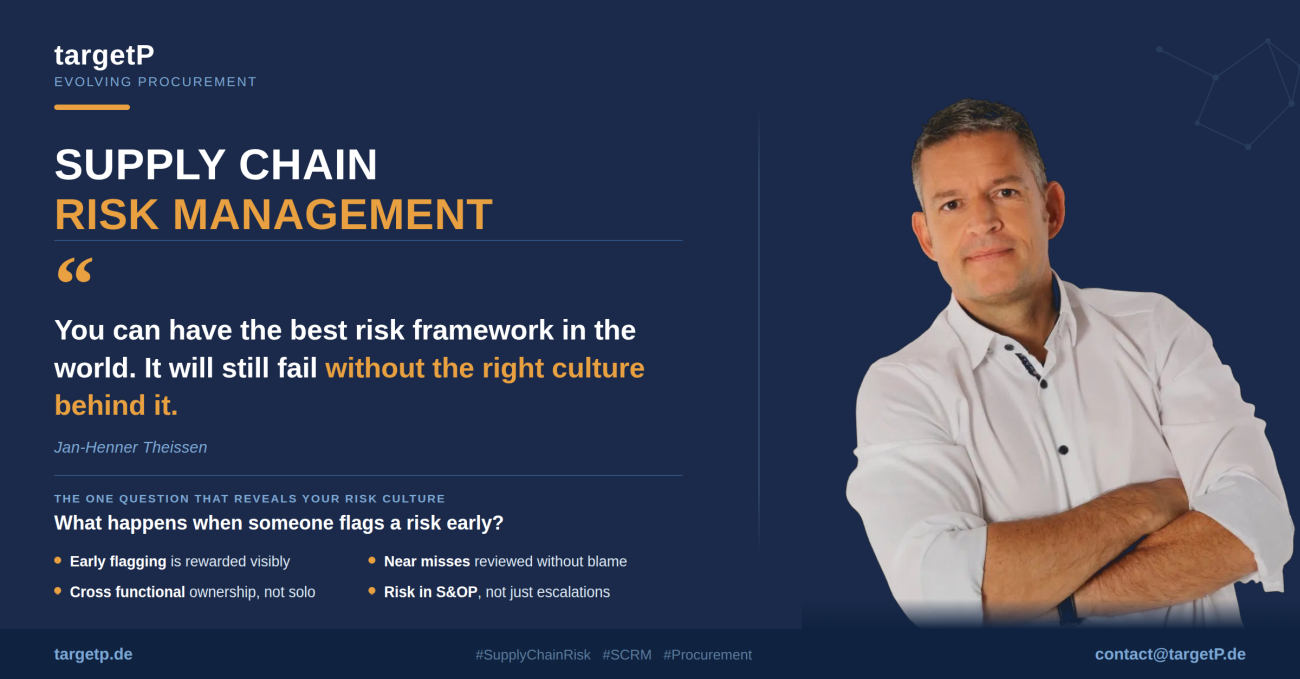
Trust is not a Soft Skill

Supply Chain Risk Management and Trust

🤝 Trust is not a Soft Skill. Responsibility is your Job.

Risk Management is all about

✅staying in business.

✅remaining solvent.

✅ continuing to provide work, income, and stability to the people who depend on the organization, whatever its size or legal form.

And preparedness is not a luxury reserved for those who can afford a risk department. It is a basic act of responsibility toward your employees, your shareholders, your customers and, ultimately, yourself. It is your job, 365/24/7!

THE factor that decides whether that responsibility actually works in practice:

➡️TRUST

If you asked me which single factor has the greatest influence on whether risk management actually works, my answer is always the same: TRUST.

Trust is the willingness to make yourself vulnerable to another party, expecting them to act with goodwill, competence, and integrity, even without a contract forcing them to. That is exactly what risk management tries to enable: cooperation under uncertainty and in crisis.

In calm times, trust is an efficiency factor. In a crisis, it is a survival factor. I once worked through a fire at one of our most critical suppliers. The potential damage ran into the hundreds of millions. The technical response worked exactly as designed. But something else changed the outcome. We sent senior leadership to the site immediately, not to make demands or cite contracts, but to ask what the supplier actually needed, and to rearrange our own production to relieve pressure on them. When production restarted, that supplier prioritized us. Not because we demanded it. Because they wanted to. Only a real relationship could produce that outcome.

What you should do:

🔹 Build trust before you need it. Crisis is the wrong moment to start. Follow contracts, solve issues in partnership, help out in a crisis. Easy & no money required.

🔹 Reward early, honest signals from your own people and your suppliers instead of punishing them for raising concerns.

🔹 Stand up for your partners when things go wrong

🔹 Stay critical even in long, comfortable relationships. Familiarity should never replace attention.

Trust can take years to grow, and it can be damaged within weeks if behavior is inconsistent. Trust is about building the conditions for honest, early, useful information to reach the people who need it, inside your organization and across your supply base.

Ask yourself: Where does trust sit in your risk management approach today?

Hi. I am Jan, your SCRM Builder. Not a consultant who theorizes about risk. A procurement leader & risk practitioner who has built 15 SCRM programs globally, trained 1,200 people, and led procurement and risk organizations through crisis. I share what works and help you build an effective SCRM. I work and train globally.

Leave a comment

Your email address will not be published. Required fields are marked *

en_USEnglish
About the company:
Joint Venture Truck OEMs
(Germany & Sweden)
Development Hydrogen fuel cell systems
approx. 500Employees, strong growth
GlobalTechnologyInnovator

Case Study

Industry: Automotive

Area: Organisation

Land: Deutschland & USA

Duration: 12 Months

Starting Point / Assignment

  • approx. EUR 400 million Procurement spend p.a. (rapidly increasing)
  • Independent joint venture between two large truck manufacturers
  • Start of series production in 2027 and development of the North American market with local production requires far-reaching development and expansion of Procurement, particularly regarding a global organization (skills, capacities, x-functional collaboration) and digitalization

Objectives

  • Creating transparency about the maturity level of the Procurement function
  • Prioritized action plan to gradually increase the maturity level regarding competencies, x-functional cooperation, productivity/efficiency, digitalization, etc.
  • Development of target organization model (2023, 2027, 2030) for production and non-production materials Procurement incl. all role descriptions and necessary capacity (FTE sizing)
  • Detailed transformation plan for the global Procurement organization aligned with the milestones "Start of series production" and "Market entry & local production North America“
  • Review of Procurement’s digital strategy and projects including future recommendations

Approach

  • Comprehensive maturity analysis of Procurement (targetP! method) with a focus on organization and digitalization based on personal interviews (all Procurement staff and top stakeholders) as well as in-depth document and data analysis (strategies, guidelines, process descriptions, digitalization initiatives, standards for category & supplier management, order & invoice volumes, etc.).
  • S/T/O analysis to determine the actual capacity utilization of all Procurement employees as part of individual interviews
  • Workshops/interviews with IT & Procurement on the Procurement system landscape and digital strategy

Results / „Deliverables“

  • Detailed maturity assessment report on Procurement (production and non-production materials) including prioritized actions and quick wins
  • Procurement digital strategy benchmark against best practices with specific recommendations for actions, risk analysis, and quick wins
  • Transparency regarding the actual use of capacity in Procurement, gap analysis of the respective profiles and stakeholder expectations
  • Role-based target Procurement organization with a step-by-step development plan (staffing, development, reallocation)
  • Tailor-made role descriptions for use in subsequent recruiting measures
About the company:
Joint Venture Truck OEMs
(Germany & Sweden)
Development Hydrogen fuel cell systems
approx. 500Employees, strong growth
GlobalTechnologyInnovator

Case Study

Industry: Automotive

Area: Organisation

Land: Deutschland & USA

Duration: 12 Months

Starting Point / Assignment

  • approx. EUR 400 million Procurement spend p.a. (rapidly increasing)
  • Independent joint venture between two large truck manufacturers
  • Start of series production in 2027 and development of the North American market with local production requires far-reaching development and expansion of Procurement, particularly regarding a global organization (skills, capacities, x-functional collaboration) and digitalization

Objectives

  • Creating transparency about the maturity level of the Procurement function
  • Prioritized action plan to gradually increase the maturity level regarding competencies, x-functional cooperation, productivity/efficiency, digitalization, etc.
  • Development of target organization model (2023, 2027, 2030) for production and non-production materials Procurement incl. all role descriptions and necessary capacity (FTE sizing)
  • Detailed transformation plan for the global Procurement organization aligned with the milestones "Start of series production" and "Market entry & local production North America“
  • Review of Procurement’s digital strategy and projects including future recommendations

Approach

  • Comprehensive maturity analysis of Procurement (targetP! method) with a focus on organization and digitalization based on personal interviews (all Procurement staff and top stakeholders) as well as in-depth document and data analysis (strategies, guidelines, process descriptions, digitalization initiatives, standards for category & supplier management, order & invoice volumes, etc.).
  • S/T/O analysis to determine the actual capacity utilization of all Procurement employees as part of individual interviews
  • Workshops/interviews with IT & Procurement on the Procurement system landscape and digital strategy

Results / „Deliverables“

  • Detailed maturity assessment report on Procurement (production and non-production materials) including prioritized actions and quick wins
  • Procurement digital strategy benchmark against best practices with specific recommendations for actions, risk analysis, and quick wins
  • Transparency regarding the actual use of capacity in Procurement, gap analysis of the respective profiles and stakeholder expectations
  • Role-based target Procurement organization with a step-by-step development plan (staffing, development, reallocation)
  • Tailor-made role descriptions for use in subsequent recruiting measures
About the company:
Family Owned Business with international Footprint
approx. 500 Mio.Turnover
approx. 3.000 Employees
Technology & Market Leaderin Harvesting Equipment

Case Study

Industry: Agricultural Machines

Area: Transformation

Country: Germany

Duration: ~ 18 Months

Starting Point / Assignment

  • approx. 200 million Procurement volume
  • Sole focus on operational processes (clerical function)
  • Strong focus on German plants, not prepared for internationalization and cooperation, despite of having operating units in the USA and China
  • Strong growth in turnover and increased internationalization
  • Procurement’s priority: Supply security (“keep the plants running”)
  • Digitalization not actively driven

Objectives

  • Create an understanding of Procurement’s maturity level
  • Identify potential (e.g., value contribution, efficiency, compliance), through more professional category & supplier management and digital support
  • Elaborate on alternative measures to develop Procurement and create an action plan, particularly concerning process improvements
  • If necessary, determine and argue capacity requirements
  • Optimize structures to prepare for growth and improved resource utilization

Approach

  • Comprehensive maturity analysis of Procurement (targetP! method) with a focus on organization and operational improvements (personal interviews with Procurement staff and top stakeholders) as well as in-depth document and data analysis (strategies, guidelines, process descriptions, digitalization initiatives, etc.)
  • Development of a holistic transformation plan and target organization model including roles and responsibilities, stakeholder integration, etc.
  • Early involvement of employees "future conferences to build my organization“
  • Joint creation of a practicable category structure, a Procurement Vision & Strategy


Results / „Deliverables“

  • First-time definition of a Procurement strategy with aligned objectives
  • Capacity optimization through targeted personnel expansion
  • Optimized organizational model and a more rigid category structure established
  • First system reviews with digital solution providers based on a digital action plan and precise requirements
  • Design of a customized multi-year training program for all roles
  • Implementation of Category Management training with pilots
  • Development and implementation of Procurement processes
About the company:
Family Owned Business with international Footprint
approx. 500 Mio.Turnover
approx. 3.000 Employees
Technology & Market Leaderin Harvesting Equipment

Case Study

Industry: Agricultural Machines

Area: Transformation

Country: Germany

Duration: ~ 18 Months

Starting Point / Assignment

  • approx. 200 million Procurement volume
  • Sole focus on operational processes (clerical function)
  • Strong focus on German plants, not prepared for internationalization and cooperation, despite of having operating units in the USA and China
  • Strong growth in turnover and increased internationalization
  • Procurement’s priority: Supply security (“keep the plants running”)
  • Digitalization not actively driven

Objectives

  • Create an understanding of Procurement’s maturity level
  • Identify potential (e.g., value contribution, efficiency, compliance), through more professional category & supplier management and digital support
  • Elaborate on alternative measures to develop Procurement and create an action plan, particularly concerning process improvements
  • If necessary, determine and argue capacity requirements
  • Optimize structures to prepare for growth and improved resource utilization

Approach

  • Comprehensive maturity analysis of Procurement (targetP! method) with a focus on organization and operational improvements (personal interviews with Procurement staff and top stakeholders) as well as in-depth document and data analysis (strategies, guidelines, process descriptions, digitalization initiatives, etc.)
  • Development of a holistic transformation plan and target organization model including roles and responsibilities, stakeholder integration, etc.
  • Early involvement of employees "future conferences to build my organization“
  • Joint creation of a practicable category structure, a Procurement Vision & Strategy


Results / „Deliverables“

  • First-time definition of a Procurement strategy with aligned objectives
  • Capacity optimization through targeted personnel expansion
  • Optimized organizational model and a more rigid category structure established
  • First system reviews with digital solution providers based on a digital action plan and precise requirements
  • Design of a customized multi-year training program for all roles
  • Implementation of Category Management training with pilots
  • Development and implementation of Procurement processes
About the company:
Leading Healthcare Provider
High reputation (Top rated Medical Care)
Site: approx. 825 Mio. Turnover
approx. 1.700employees
> 80.000 Patienten/Jahr

Case Study

Industry: Health Care/Clinic

Bereich: Interim & Entwicklung

Country: Germany

Duration: 6 Months

Starting Point / Assignment

  • approx. EUR 60 million spend p.a., complex spend structure
  • Procurement with a strong focus on processing and operational processes, no systematic spending management
  • Significant operational problems in day-to-day business led to high costs
  • Very insecure, demotivated team due to degrading treatment and extreme micromanagement by the previous Procurement Manager
  • Non-existent digitalization of core processes and tasks
  • Extensive, sometimes paralyzing bureaucracy in general and when approving requirements such as Requisitions, Purchase Orders and Contracts
  • Lack of discipline and ethics among sales reps (back-door selling, etc.)
  • Low reputation within the hospital, especially among chief physicians

Objectives

  • Main objective: Stabilization and reactivation of a highly frustrated team
  • Stabilization of day-to-day business, also due to above-average absences
  • Better distribution of the workload among the team members
  • Creating an understanding of the actual maturity level of Procurement, identifying potential (e.g., value contribution, efficiency, compliance)
  • Elaborating alternative measures to develop Procurement, and create an action plan, particularly concerning process simplifications (approvals of Requisitions, Purchase Orders, Contracts)
  • Improving customer service quality and interaction with internal customers

Approach

  • Comprehensive maturity analysis of Procurement involving stakeholders
  • Creation and coordination of a holistic development plan
  • Open door policy and individual meetings several times a week
  • Regular visits to the hospital wards to understand the needs and build trust
  • Frequent exchange with internal customers (regular personal exchange, participatory approach: Involvement of all employees, e.g. we
  • Weekly team meetings to discuss issues, improvement ideas, and solutions to ensure full commitment and involvement in improvement projects
  • Strong involvement in day-to-day business (negotiations, sourcing)
  • Process analyses, in particular, SAP optimization options & approvals

Results / „Deliverables“

  • Team stabilized, motivation increased, absences and absenteeism reduced (CEO quote: "You calmed people down very quickly with professional empathy and got them behind you")
  • First-time definition of a Procurement strategy with agreed upon targets
  • Regular coordination with internal customers (Chief physician quote: "we talk to each other now, things run faster, we finally feel well looked after")
  • Approval and implementation of moderate staff expansion with restructuring of work areas and balancing of workload
  • Redesign of framework agreements with improved commercial conditions
  • Complete processing of unfinished order processes (backlog)
  • Simplification and definition of core Procurement processes;
  • Addition of new SAP functionalities to drive automation & workload reduction
About the company:
Leading Healthcare Provider
High reputation (Top rated Medical Care)
Site: approx. 825 Mio. Turnover
approx. 1.700employees
> 80.000 Patienten/Jahr

Case Study

Industry: Health Care/Clinic

Bereich: Interim & Entwicklung

Country: Germany

Duration: 6 Months

Starting Point / Assignment

  • approx. EUR 60 million spend p.a., complex spend structure
  • Procurement with a strong focus on processing and operational processes, no systematic spending management
  • Significant operational problems in day-to-day business led to high costs
  • Very insecure, demotivated team due to degrading treatment and extreme micromanagement by the previous Procurement Manager
  • Non-existent digitalization of core processes and tasks
  • Extensive, sometimes paralyzing bureaucracy in general and when approving requirements such as Requisitions, Purchase Orders and Contracts
  • Lack of discipline and ethics among sales reps (back-door selling, etc.)
  • Low reputation within the hospital, especially among chief physicians

Objectives

  • Main objective: Stabilization and reactivation of a highly frustrated team
  • Stabilization of day-to-day business, also due to above-average absences
  • Better distribution of the workload among the team members
  • Creating an understanding of the actual maturity level of Procurement, identifying potential (e.g., value contribution, efficiency, compliance)
  • Elaborating alternative measures to develop Procurement, and create an action plan, particularly concerning process simplifications (approvals of Requisitions, Purchase Orders, Contracts)
  • Improving customer service quality and interaction with internal customers

Approach

  • Comprehensive maturity analysis of Procurement involving stakeholders
  • Creation and coordination of a holistic development plan
  • Open door policy and individual meetings several times a week
  • Regular visits to the hospital wards to understand the needs and build trust
  • Frequent exchange with internal customers (regular personal exchange, participatory approach: Involvement of all employees, e.g. we
  • Weekly team meetings to discuss issues, improvement ideas, and solutions to ensure full commitment and involvement in improvement projects
  • Strong involvement in day-to-day business (negotiations, sourcing)
  • Process analyses, in particular, SAP optimization options & approvals

Results / „Deliverables“

  • Team stabilized, motivation increased, absences and absenteeism reduced (CEO quote: "You calmed people down very quickly with professional empathy and got them behind you")
  • First-time definition of a Procurement strategy with agreed upon targets
  • Regular coordination with internal customers (Chief physician quote: "we talk to each other now, things run faster, we finally feel well looked after")
  • Approval and implementation of moderate staff expansion with restructuring of work areas and balancing of workload
  • Redesign of framework agreements with improved commercial conditions
  • Complete processing of unfinished order processes (backlog)
  • Simplification and definition of core Procurement processes;
  • Addition of new SAP functionalities to drive automation & workload reduction
About the company:
Highly renowned Qatari company
approx. 825 mn.Turnover
approx. 3.500 Employees
Regional Market Leader
Shipping, Maritime Logistik & Services

Case Study

Industrie: Reederei & Maritim

Bereich: Organisation & Interim

Country: Qatar

Duration: ~ 12 Months

Starting Point / Assignment

  • approx. EUR 300 million Procurement spend p.a.
  • Procurement with a strong focus on processing and operational processes, no systematic spending management
  • Significant operational problems in day-to-day business led to high costs for troubleshooting, escalations, and internal conflicts with stakeholders
  • Low acceptance and appreciation of Procurement and high political pressure despite excellent company results
  • Long-term vacancy in Procurement leadership impacts performance, customer satisfaction, and insecurity and leading to high fluctuation on buyer level
  • Digitalization of core processes and tasks only marginally developed

Objectives

  • Create an understanding of the true maturity level of Procurement and gain buy-in from the Executive Board
  • Identify potential (e.g., value contribution, efficiency, compliance), through more professional category & supplier management and automation
  • Elaborate on alternative measures to develop Procurement and create an action plan, particularly concerning process simplifications
  • Improve strategic and operational reporting for the CFO
  • Implement organizational and structural optimization to improve service quality
  • After two months: additional Role as VP Ad Interim due to the dismissal of the Head of Procurement

Approach

  • Comprehensive maturity analysis of Procurement involving stakeholders
  • Creation and coordination of a holistic transformation plan with staff adjustments, digitalization, and skills requirements
  • Development of a target organization model (category management) with role descriptions, responsibilities and recruiting support
  • Highly participative approach with intensive involvement of all employees, e.g., as part of "future conferences" (for the first time in the company) and expert teams with topic champions
  • Further development of Procurement and sourcing governance, e.g., tailored Category Structure, Procurement Vision & Procurement strategy and policies

Results / „Deliverables“

  • First-time definition of a Procurement strategy with aligned objectives
  • Approval and implementation of moderate staff expansion and allocation and expansion of required skills through comprehensive training plans
  • Start of digitalization projects based on a digital action plan (Supplier Portal)
  • Implementation of a Category Management approach and process and execution of 10 category pilots to identify additional value contribution
  • Development and implementation of comprehensive Supplier Management involving a newly designed supplier qualification process (Supplier Portal)
  • Implementation of a Procurement guideline & process manual and creation of comprehensive Procurement reporting with PowerBI
  • 10-month Interim Management and stabilization of the organization
About the company:
Highly renowned Qatari company
approx. 825 mn.Turnover
approx. 3.500 Employees
Regional Market Leader
Shipping, Maritime Logistik & Services

Case Study

Industrie: Reederei & Maritim

Bereich: Organisation & Interim

Country: Qatar

Duration: ~ 12 Months

Starting Point / Assignment

  • approx. EUR 300 million Procurement spend p.a.
  • Procurement with a strong focus on processing and operational processes, no systematic spending management
  • Significant operational problems in day-to-day business led to high costs for troubleshooting, escalations, and internal conflicts with stakeholders
  • Low acceptance and appreciation of Procurement and high political pressure despite excellent company results
  • Long-term vacancy in Procurement leadership impacts performance, customer satisfaction, and insecurity and leading to high fluctuation on buyer level
  • Digitalization of core processes and tasks only marginally developed

Objectives

  • Create an understanding of the true maturity level of Procurement and gain buy-in from the Executive Board
  • Identify potential (e.g., value contribution, efficiency, compliance), through more professional category & supplier management and automation
  • Elaborate on alternative measures to develop Procurement and create an action plan, particularly concerning process simplifications
  • Improve strategic and operational reporting for the CFO
  • Implement organizational and structural optimization to improve service quality
  • After two months: additional Role as VP Ad Interim due to the dismissal of the Head of Procurement

Approach

  • Comprehensive maturity analysis of Procurement involving stakeholders
  • Creation and coordination of a holistic transformation plan with staff adjustments, digitalization, and skills requirements
  • Development of a target organization model (category management) with role descriptions, responsibilities and recruiting support
  • Highly participative approach with intensive involvement of all employees, e.g., as part of "future conferences" (for the first time in the company) and expert teams with topic champions
  • Further development of Procurement and sourcing governance, e.g., tailored Category Structure, Procurement Vision & Procurement strategy and policies

Results / „Deliverables“

  • First-time definition of a Procurement strategy with aligned objectives
  • Approval and implementation of moderate staff expansion and allocation and expansion of required skills through comprehensive training plans
  • Start of digitalization projects based on a digital action plan (Supplier Portal)
  • Implementation of a Category Management approach and process and execution of 10 category pilots to identify additional value contribution
  • Development and implementation of comprehensive Supplier Management involving a newly designed supplier qualification process (Supplier Portal)
  • Implementation of a Procurement guideline & process manual and creation of comprehensive Procurement reporting with PowerBI
  • 10-month Interim Management and stabilization of the organization