
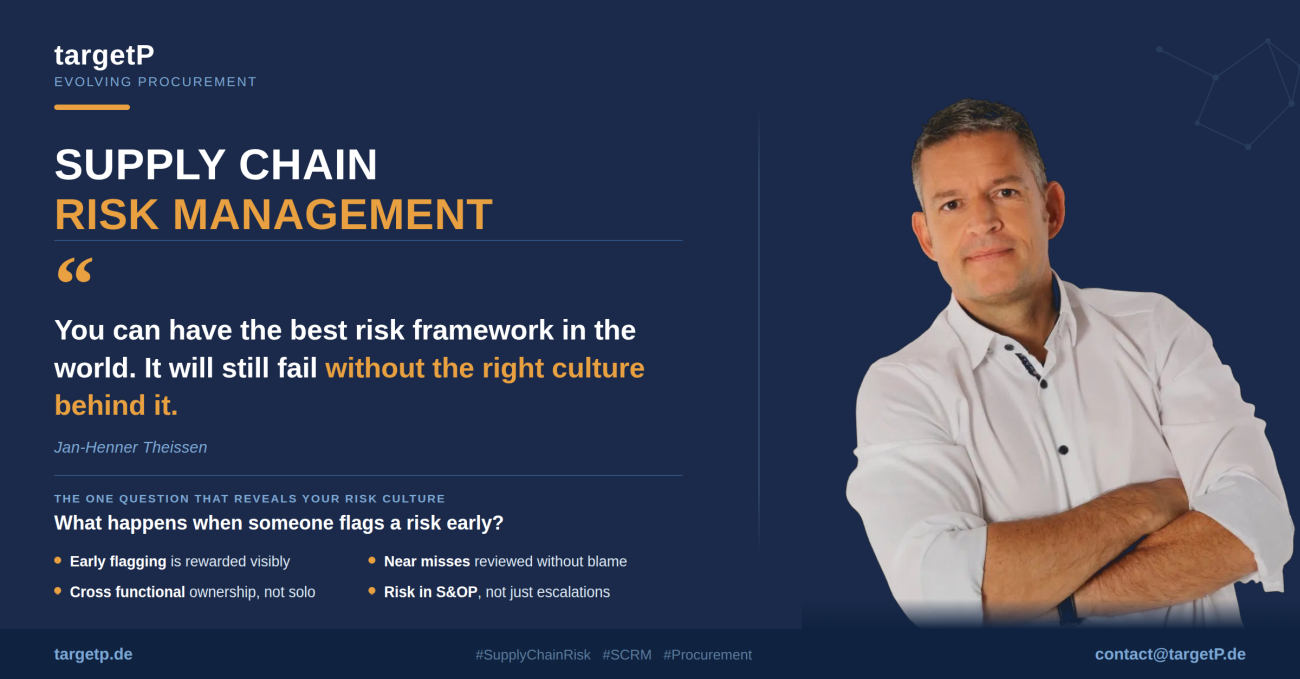
🤝 Trust is not a Soft Skill. Responsibility is your Job.
Risk Management is all about
✅staying in business.
✅remaining solvent.
✅ continuing to provide work, income, and stability to the people who depend on the organization, whatever its size or legal form.
And preparedness is not a luxury reserved for those who can afford a risk department. It is a basic act of responsibility toward your employees, your shareholders, your customers and, ultimately, yourself. It is your job, 365/24/7!
THE factor that decides whether that responsibility actually works in practice:
➡️TRUST
If you asked me which single factor has the greatest influence on whether risk management actually works, my answer is always the same: TRUST.
Trust is the willingness to make yourself vulnerable to another party, expecting them to act with goodwill, competence, and integrity, even without a contract forcing them to. That is exactly what risk management tries to enable: cooperation under uncertainty and in crisis.
In calm times, trust is an efficiency factor. In a crisis, it is a survival factor. I once worked through a fire at one of our most critical suppliers. The potential damage ran into the hundreds of millions. The technical response worked exactly as designed. But something else changed the outcome. We sent senior leadership to the site immediately, not to make demands or cite contracts, but to ask what the supplier actually needed, and to rearrange our own production to relieve pressure on them. When production restarted, that supplier prioritized us. Not because we demanded it. Because they wanted to. Only a real relationship could produce that outcome.
What you should do:
🔹 Build trust before you need it. Crisis is the wrong moment to start. Follow contracts, solve issues in partnership, help out in a crisis. Easy & no money required.
🔹 Reward early, honest signals from your own people and your suppliers instead of punishing them for raising concerns.
🔹 Stand up for your partners when things go wrong
🔹 Stay critical even in long, comfortable relationships. Familiarity should never replace attention.
Trust can take years to grow, and it can be damaged within weeks if behavior is inconsistent. Trust is about building the conditions for honest, early, useful information to reach the people who need it, inside your organization and across your supply base.
Ask yourself: Where does trust sit in your risk management approach today?
Hi. I am Jan, your SCRM Builder. Not a consultant who theorizes about risk. A procurement leader & risk practitioner who has built 15 SCRM programs globally, trained 1,200 people, and led procurement and risk organizations through crisis. I share what works and help you build an effective SCRM. I work and train globally.
 Deutsch
  English