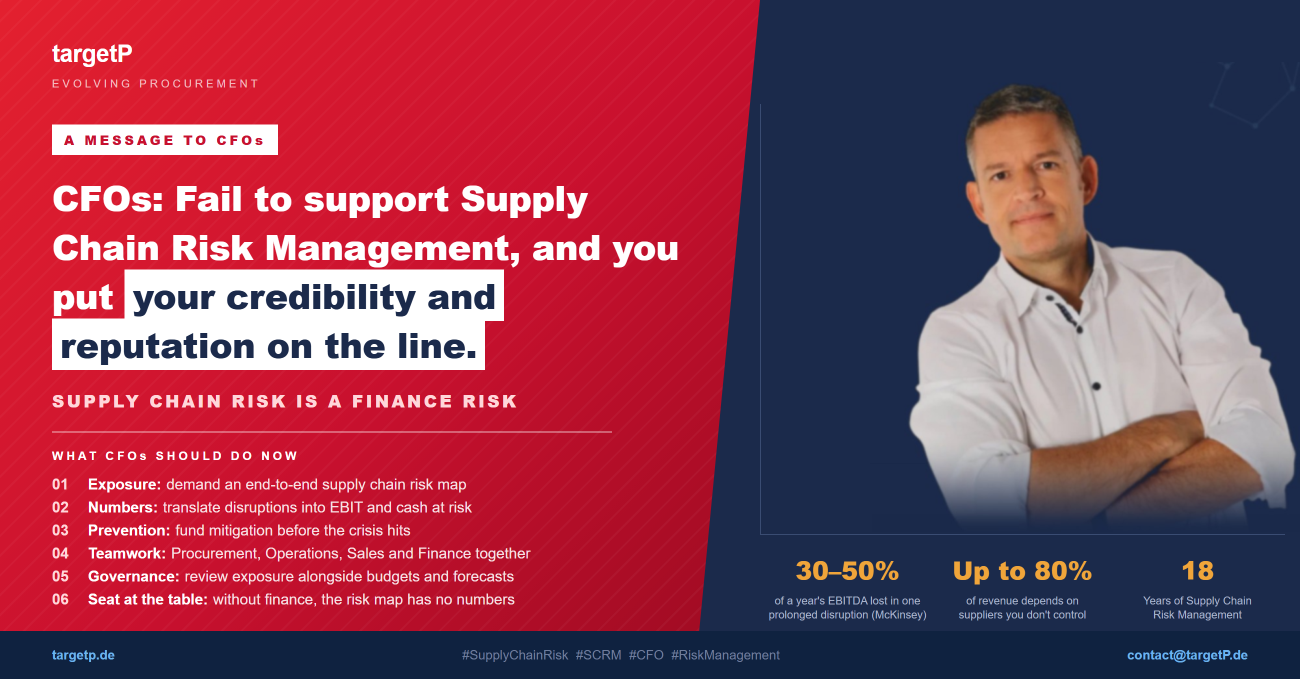
CFOs: Supply chain risk is a finance risk.

CFO Supply Chain Risk Management

CFOs: Your Supply Chain May Be Undermining Your Financial Commitments And Your Credibility! You can build a solid financial plan, commit to an EBIT target, and present a confident forecast to your board. But how much of that plan depends on a supply chain you cannot fully see, predict, or control? Supply chain risk is not just an operational problem. It directly threatens financial performance and your credibility as CFO. One supply chain disruption can erase 30-50% of a year’s EBITDA (McKinsey). Often 50-80% of your revenue depends on a supplier network you don’t control. Here is what is at stake: EBIT and profit: Expediting fees and emergency freight quietly eat the margin you promised the board. Production stoppages, lost sales, idle capacity, and unexpected sourcing costs turn planned profit into missed targets. Cash flow and working capital: Disruptions force unplanned spending, tie up cash in precautionary inventory, and delay customer payments. Regulatory failures can trigger penalties, compensation claims, and additional costs. Forecast accuracy: Every supply chain shock that hits cash flow makes your forecasts look wrong. Every unexpected revenue shortfall puts your financial plan under pressure. Your credibility & reputation are on the line: This is where the issue becomes personal. When your financial commitments repeatedly miss the mark due to supply chain issues, your credibility is on the line. What should CFOs do now? ✅Sit at the table when the risk map is built. ✅Demand a clear picture of exposure. ✅Demand a clear picture of exposure. ✅Insist on prevention, not just crisis response. ✅Make risk management cross-functional ✅Build supply chain risk into your financial governance Supply chain risk is a finance risk. Treat it like one, or keep explaining variances you could have seen coming. Supply chain risk belongs on the CFO agenda. The CFO who owns it walks into the next earnings call with answers. Now, let’s turn those insights into capability. Build people and organizations who are ready to act. My training/workshop will perfectly prepare you for it. —- Hi. I am Jan, your SCRM Builder. Not a consultant who theorizes about risk. A procurement leader and risk practitioner who has built 15 SCRM programs globally, trained 1,200 people, and led procurement and risk organizations through crisis. I share what works and help you build an effective SCRM. I work globally.

Multi-Layer-Defense Risk Management

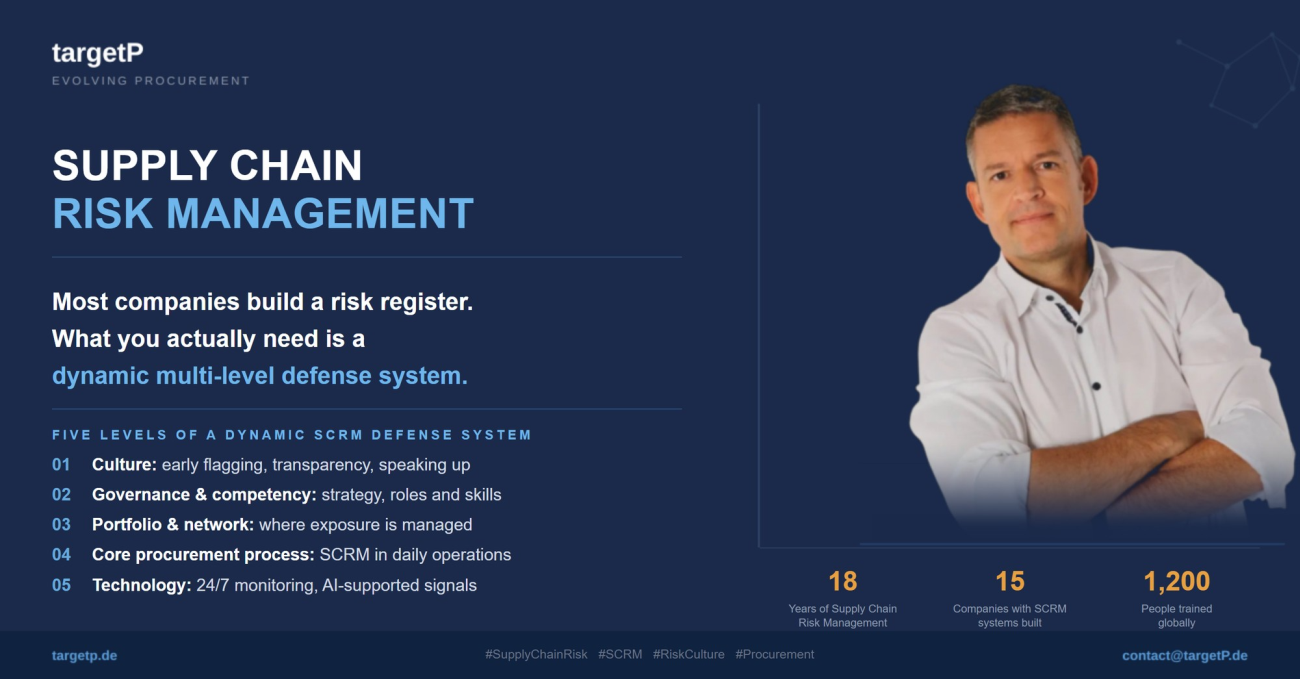
Multi-Layer-Defense Risk Management

🛡️ Most Companies Build a Risk Register. What You Actually Need Is a DYNAMIC Multi-Layer-Defense Risk Management. The well-known and widely used 3 Lines of Defense model was developed for institutional risk management in finance. Despite years of criticism, too many risk professionals still treat it as the holy grail and believe they can use it across organizations for all kinds of risk management activities. My experience: For SCRM, the model is not usable at all. However, even the big four consulting firms still bother their clients with this ineffective approach. Experienced supply chain (risk) experts never work with it. So do I, and based on 18 years of building SCRM systems across 15 companies, I developed and use a dynamic five-level risk model that translates the lines-of-defense principle into something that actually works in practice: Level 1: SCRM Culture Framework: The foundation everything else rests on. If the culture doesn’t support early flagging, transparency, speaking up, and cross-functional accountability, no process or system will compensate. Culture is not soft. It is the prerequisite. Level 2: Governance & Competency Framework: Strategy, roles, responsibilities, and the skills to execute them. Here, the CPO and procurement leadership define what SCRM means for the organization and how they operationalize it. And this is where the organization becomes agile and responsive. Level 3: Category & Supplier Portfolio/Network Management: The analytical core: category and market analysis, supplier portfolio assessment, and a risk-centered sourcing strategy. This is where procurement teams actively manage exposure. Level 4: Core Process Framework: SCRM embedded into daily procurement operations: supplier qualification and onboarding, sourcing and re-sourcing decisions, and ongoing supplier network management Level 5: Technology Framework: Digital supply chain monitoring running 24 hours a day, 365 days a year. AI-supported signal detection, automated alerts, pattern recognition, scenario modeling, impact analytics. Technology does not replace human judgment. The critical principle behind this model: These five levels are not silos. Insights from the process level feed back into portfolio strategy. The technology layer supports all operational levels simultaneously. The culture layer at the top is why it all works under pressure. SCRM is never static. The moment you treat SCRM as a project, you have already fallen behind. Forever! Now, let’s turn those lessons into capability. Build people and organizations who are ready to act. My training/workshop will perfectly prepare you for it. Hi. I am Jan, your SCRM Builder. Not a consultant who theorizes about risk. A procurement leader and risk practitioner who has built 15 SCRM programs globally, trained 1,200 people, and led procurement and risk organizations through crisis. I share what works and help you build an effective SCRM. I work globally.
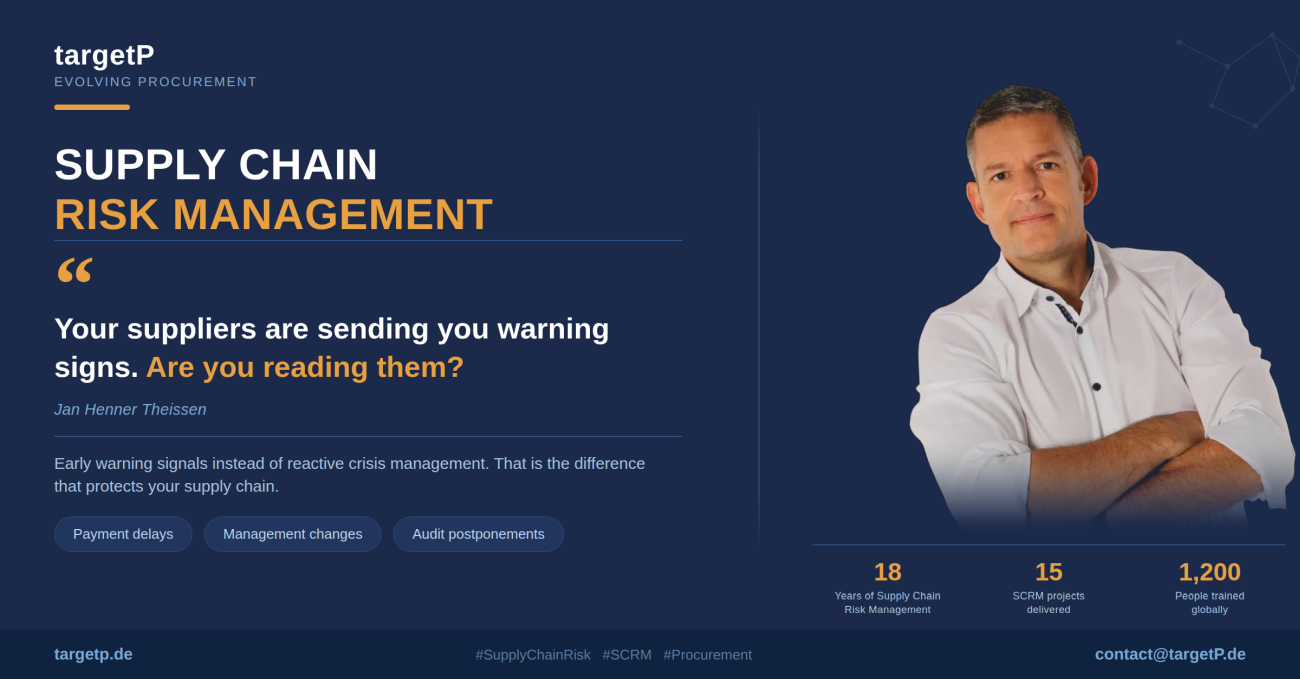
Your Suppliers Are Sending You Warning Signs. Are You Reading Them

Supply Chain Integrity

Next episode of our series: Supply Chain Risk Management done right: Supplier Risk Signals Most companies manage supply chain risk backward. They respond to events. THE MORE EFFECTIVE WAY: They should be reading signals. There is a world of difference between the two. An event is when your supplier calls to say they cannot deliver. A signal is the pattern that predicted the call weeks or months earlier. In my 18 years of building SCRM systems across industries, the same warning signs appear before almost every supplier failure: 🔴 Payment delays to their own sub-suppliers 🔴 Supplier asking for early payments 🔴 Unexplained and frequent management changes 🔴 Declining quality or rising non-conformance numbers without a clear root cause 🔴 Layoffs, high fluctuation, and strikes 🔴 Shipment and capacity excuses that keep shifting 🔴 Audit requests are being postponed again and again None of these alone is a crisis. Together, they are a pattern. Patterns are readable if you know what to look for. The problem is not that signals are invisible. It is that most organizations have never defined what a signal means for their specific supply base, and nobody is systematically looking for them. Technology might help with signal identification and pattern analysis, and so will educated, aware employees. Here is a simple starting point: Take your ten most critical suppliers. Do you have a defined set of early-warning indicators you actively monitor regularly? If not, that is exactly where your SCRM journey should begin. Next question you should ask: What signals have you seen precede a supplier failure? ————– Hi. I am Jan, your SCRM Builder. Not a consultant who theorizes about risk. A procurement leader & risk practitioner who has built 15 SCRM programs globally, trained 1,200 people, and led procurement and risk organizations through crisis. I share what works and help you build an effective SCRM. I work globally.
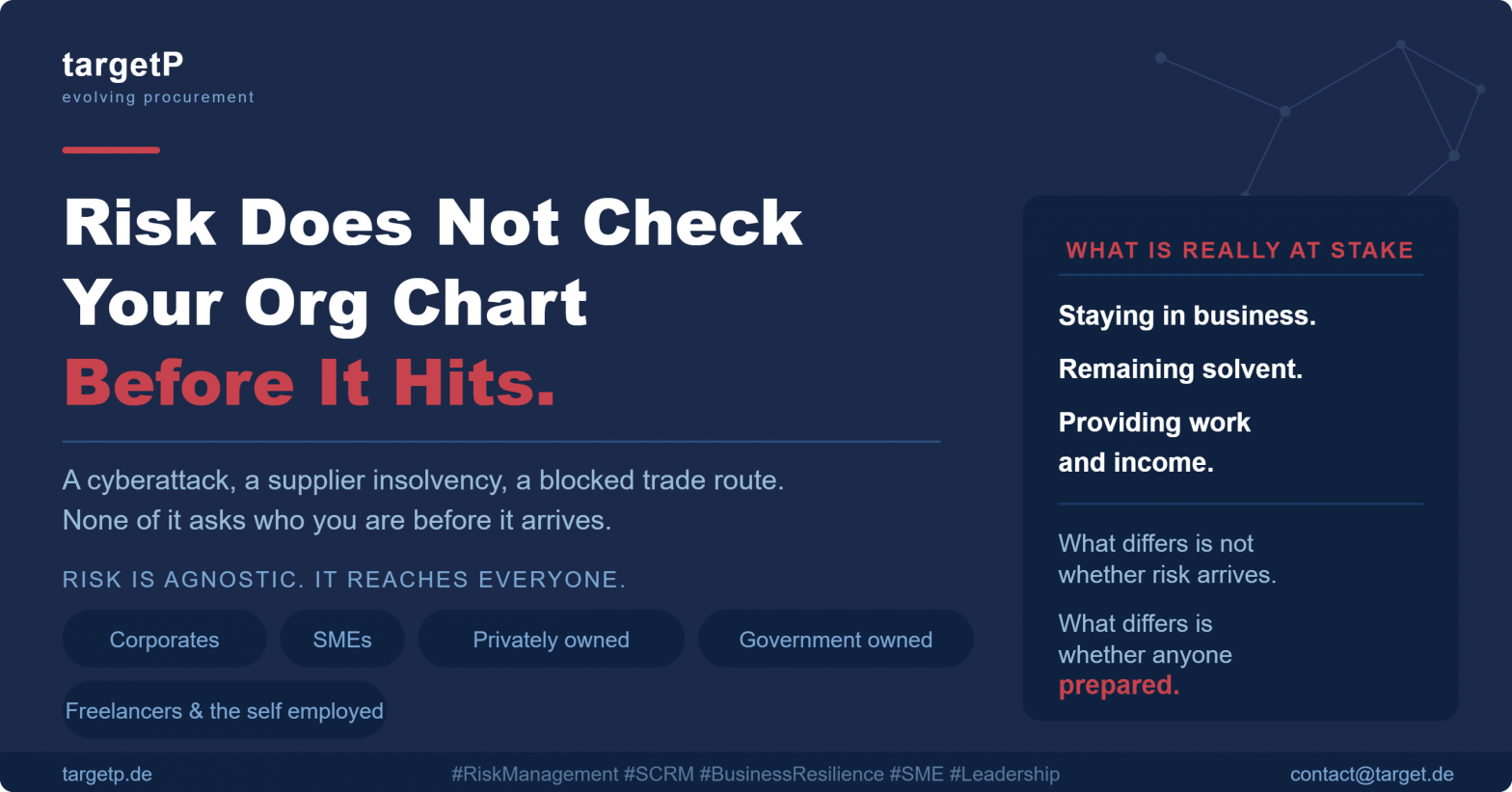
SUPPLY CHAIN RISK IS AGNOSTIC

Supply Chain Integrity

⚖️ SUPPLY CHAIN RISK Does Not Check Your Org Chart Before It Hits. A cyberattack doesn’t ask whether you are a DAX corporation or a 12-person family business. ️A key supplier insolvency doesn’t care whether you are privately owned, government-owned, or publicly listed. A flooded port, a sanctioned trade route: none of it checks your balance sheet first. ⚠️ SUPPLY CHAIN RISK IS AGNOSTIC It applies to multinational corporates with risk departments. It applies to the SME with one overworked person doing purchasing, finance, and risk at the same time. It applies to municipal utilities, hospitals, NGOs. None of these organizations are exempt simply because of their size, ownership structure, or sector. What differs is not whether risk will arrive. What differs is whether anyone is prepared. Risk is not asking whether you are in metal forming or pharmaceutical. It is not asking if you are a small or medium enterprise. I have worked inside large corporates with mature SCRM functions, and I have advised smaller, privately owned businesses with no formal risk process at all. The companies that struggled most were not always the smallest or the least sophisticated. They were the ones who quietly believed disruption happened only to other organizations. It never is!!! At the end of all the frameworks, governance models and digital monitoring tools, there is one plain truth that applies equally to all: ✅This is about staying in business. ✅About remaining solvent. ✅About continuing to provide work, income and stability to the people who depend on the organization, whatever its size or legal form. Whether you are an SME or a global corporation makes no difference. Preparation and investment are required either way; a big budget proves nothing about effectiveness, and there is no excuse for inaction or for hiding behind the excuse that this is only for „the big ones.” Preparedness is not a luxury reserved for those who can afford a risk department. ⚠️It is a basic act of responsibility toward your employees, your shareholders, your customers and, ultimately, yourself. If you run an organization of any kind, the question is not whether risk will find you. The question is whether you will be ready when it does. I am Jan, your SCRM Builder. Not a consultant who theorizes about risk. A procurement leader & risk practitioner who has built 15 SCRM programs globally, trained 1,200+ people, and led procurement and risk organizations through crisis. I share what works and help you build an effective SCRM. I work and train globally

ALERT: The next supply chain crisis is here

ALERT: The next supply chain crisis is here.

⚡The next American and Global supply chain crisis is here. 45,000 dockworkers at every major eastern and Gulf Coast port will be on strike, starting today. After weeks of fruitless negotiations and the Biden administration signaling it would not force the dockworkers back to work, the stage is set for a potentially devastating supply chain crisis. The ILA is demanding higher wages and a ban on the automation of the cranes, gates, and container movements used at 36 U.S. ports. 👉The ramifications will be significant: A strike will cause complete stoppages at all involved ports of container and bulk cargo Vessels will drop anchors outside ports and await the dockworkers coming back to work. And the impact will be global regarding vessel and container capacity and schedules. Looks like an exciting holiday season is ahead of us! 👉Some might say this situation is comparable to the COVID disruptions but it is not. The COVID challenges were caused by significant increases in cargo volumes and a lack of operational capacities to cope with the throughput – in port terminals, rail, and truck as well as warehouse capacity. 👉For more details refer to the official ILA statement issued yesterday ILA Update – Monday, September 30, 2024 at 11 am NORTH BERGEN, NJ: The International Longshoremen’s Association (ILA) reports that United States Maritime Alliance (USMX) continues to block the path toward a settlement on a new Master Contract by refusing ILA’s demands for a fair and decent contract and seems intent on causing a strike at all ports from Maine to Texas beginning in almost 12 hours. “The Ocean Carriers represented by USMX want to enjoy rich billion-dollar profits that they are making in 2024, while they offer ILA Longshore Workers an unacceptable wage package that we reject”, the ILA said. “ILA longshore workers deserve to be compensated for the important work they do keeping American commerce moving and growing. It’s disgraceful that most of these foreign-owned shipping companies are engaged in a ‘Make and Take’ operation: They want to make their billion-dollar profits at United States ports, and off the backs of American ILA longshore workers, and take those earnings out of this country and into the pockets of foreign conglomerates. Meanwhile, ILA dedicated longshore workers continue to be crippled by inflation due to USMX’s unfair wage packages. “ “In addition, the shippers are gouging their customers that result in increased costs to American consumers. They are now charging $30,000 for a full container, a whopping increase from $6,000 per container just a few weeks ago. In just a short time, they went from 6K, to 18K, then 24K and now $30,000. It’s unheard of and they are doubling their $30,000 fee stuffing the same container from multiple shippers. They are killing the customers.” 👉 Once again an excellent example of the importance of structured supply chain risk and crisis management supported by effective emergency plans and early preventive measures. We are happy to share our thoughts and experiences building robust supply chain risk management programs.

Red Sea & Panama Canal disruptions: $1.25 trillion economic loss

Red Sea & Panama Canal disruptions: $1.25 trillion economic loss

Since spring 2023, we have provided regular updates on important logistics routes such as the Panama Canal (low water level) and the Red Sea (terror). Now, the first estimates of the economic impact are available and they are frightening.  Port Technology International & Russel Group: ⚡$1.25 trillion – the economic loss caused by disruption in two of the world’s largest shipping routes, the Red Sea and Panama Canal 📌 Blockages at two of the world’s largest shipping routes have thrown shipping schedules and global supply chains in disarray, as vessels are opting for longer alternative routes adding to delays and increasing costs. 📌 Red Sea: Trade analysis from October 2023 through to May 2024, shows that the commodities most impacted are crude oil, plastic materials, telephone equipment, cars, and clothing. 📌 Panama Canal: Russell’s analysis throughout 2023, highlights the commodities most impacted are LPG, crude oil, cars and people carriers. 📌 Clearly, it highlights the potential ripple effect of any disruption within a key transit route, which plays a vital role in moving goods across the world. What to expect: ⏩Geopolitical tensions will remain high, there are no signs of ending – the opposite ⏩ Maritime supply chain disruptions will continue to impact ports with higher levels of congestion and delays and container availability ⏩ Companies increase their stocking levels with plans to order much earlier (risk of #bullwhipeffect) Time to increase your overall risk & resilience program. Source Content & Graphic: Port Technology International, September 12th, 2024

Digitale Lieferketten für Compliance und Stabilität

Von Excel zur ganzheitlichen Digitalisierung der Lieferkette. 👉So geht ein effizientes Lieferantenmanagement und ESG-Compliance. Ein Praxis- und Umsetzungsbericht aus dem Mittelstand. Aktuelle Lieferkettengesetze wie das LkSG oder die CSDDD stellen international agierende Unternehmen oft vor zahlreiche Herausforderungen. Auch das familiengeführte Hochtechnologieunternehmen ORAFOL aus Oranienburg, Weltmarktführer in der Kunststoffveredelung, nutzt die gesetzlichen Anforderungen als Chance zur Weiterentwicklung und Professionalisierung seines Einkaufs (z.B Lieferantenmanagement) und seiner digitalen Architektur und Systeme im Einkauf und den Schnittstellenbereichen. Unser Kunde ORAFOL ist ein tolles Beispiel, wie man auch im Mittelstand budgetfreundlich und zügig leistungsfähige digitale Landschaften umsetzen kann. Verantwortung für die eigene Lieferkette übernimmt, ie Vielzahl der aktuellen und kommenden Gesetze umsetzt und parallel den Einkauf digital und (!) analog nach vorne bringt Was stellten wir vor: 📌Von der Pflicht zur Kür: Warum ORAFOL von Excel zu vernetzten SaaS-Lösungen gewechselt hat und wie das Technologieunternehmen dadurch ESG-Anforderungen effizienter erfüllen konnte. 📌Single Source of Truth durch Standard-API: Wie ein zentrales Lieferanten-Management-System abteilungsübergreifende Nutzung und Transparenz ermöglicht. 📌Auswirkungen auf Richtlinien, Einkaufs- und Warengruppenstrategien sowie das Lieferanten-Onboarding. 📌Compliance und Risikomanagement: Wie vernetzte Systeme zu einem effektiven Compliance-Verbund werden und das Risiko über die gesamte Lieferkette hinweg minimieren helfen. 📌Lessons Learned: Erkenntnisse aus der Projektumsetzung, inklusive der Zusammenarbeit mit Anbietern, der Sicherstellung zukunftssicherer Systeme und der Bewältigung interner Stolpersteine. Sprechen Sie mich gerne für Ihren persönlichen Impuls an. Oder auch für eine Zusammenfassung des Webinars. Auf Basis von mehr als 30 digitalen Projekten zur Weiterenwicklung von Einkaufsorganisationen zeigen wir auch Ihnen Ihre Optionen und persönliche Roadmap auf!

en_USEnglish
About the company:
Joint Venture Truck OEMs
(Germany & Sweden)
Development Hydrogen fuel cell systems
approx. 500Employees, strong growth
GlobalTechnologyInnovator

Case Study

Industry: Automotive

Area: Organisation

Land: Deutschland & USA

Duration: 12 Months

Starting Point / Assignment

  • approx. EUR 400 million Procurement spend p.a. (rapidly increasing)
  • Independent joint venture between two large truck manufacturers
  • Start of series production in 2027 and development of the North American market with local production requires far-reaching development and expansion of Procurement, particularly regarding a global organization (skills, capacities, x-functional collaboration) and digitalization

Objectives

  • Creating transparency about the maturity level of the Procurement function
  • Prioritized action plan to gradually increase the maturity level regarding competencies, x-functional cooperation, productivity/efficiency, digitalization, etc.
  • Development of target organization model (2023, 2027, 2030) for production and non-production materials Procurement incl. all role descriptions and necessary capacity (FTE sizing)
  • Detailed transformation plan for the global Procurement organization aligned with the milestones "Start of series production" and "Market entry & local production North America“
  • Review of Procurement’s digital strategy and projects including future recommendations

Approach

  • Comprehensive maturity analysis of Procurement (targetP! method) with a focus on organization and digitalization based on personal interviews (all Procurement staff and top stakeholders) as well as in-depth document and data analysis (strategies, guidelines, process descriptions, digitalization initiatives, standards for category & supplier management, order & invoice volumes, etc.).
  • S/T/O analysis to determine the actual capacity utilization of all Procurement employees as part of individual interviews
  • Workshops/interviews with IT & Procurement on the Procurement system landscape and digital strategy

Results / „Deliverables“

  • Detailed maturity assessment report on Procurement (production and non-production materials) including prioritized actions and quick wins
  • Procurement digital strategy benchmark against best practices with specific recommendations for actions, risk analysis, and quick wins
  • Transparency regarding the actual use of capacity in Procurement, gap analysis of the respective profiles and stakeholder expectations
  • Role-based target Procurement organization with a step-by-step development plan (staffing, development, reallocation)
  • Tailor-made role descriptions for use in subsequent recruiting measures
About the company:
Family Owned Business with international Footprint
approx. 500 Mio.Turnover
approx. 3.000 Employees
Technology & Market Leaderin Harvesting Equipment

Case Study

Industry: Agricultural Machines

Area: Transformation

Country: Germany

Duration: ~ 18 Months

Starting Point / Assignment

  • approx. 200 million Procurement volume
  • Sole focus on operational processes (clerical function)
  • Strong focus on German plants, not prepared for internationalization and cooperation, despite of having operating units in the USA and China
  • Strong growth in turnover and increased internationalization
  • Procurement’s priority: Supply security (“keep the plants running”)
  • Digitalization not actively driven

Objectives

  • Create an understanding of Procurement’s maturity level
  • Identify potential (e.g., value contribution, efficiency, compliance), through more professional category & supplier management and digital support
  • Elaborate on alternative measures to develop Procurement and create an action plan, particularly concerning process improvements
  • If necessary, determine and argue capacity requirements
  • Optimize structures to prepare for growth and improved resource utilization

Approach

  • Comprehensive maturity analysis of Procurement (targetP! method) with a focus on organization and operational improvements (personal interviews with Procurement staff and top stakeholders) as well as in-depth document and data analysis (strategies, guidelines, process descriptions, digitalization initiatives, etc.)
  • Development of a holistic transformation plan and target organization model including roles and responsibilities, stakeholder integration, etc.
  • Early involvement of employees "future conferences to build my organization“
  • Joint creation of a practicable category structure, a Procurement Vision & Strategy


Results / „Deliverables“

  • First-time definition of a Procurement strategy with aligned objectives
  • Capacity optimization through targeted personnel expansion
  • Optimized organizational model and a more rigid category structure established
  • First system reviews with digital solution providers based on a digital action plan and precise requirements
  • Design of a customized multi-year training program for all roles
  • Implementation of Category Management training with pilots
  • Development and implementation of Procurement processes
About the company:
Leading Healthcare Provider
High reputation (Top rated Medical Care)
Site: approx. 825 Mio. Turnover
approx. 1.700employees
> 80.000 Patienten/Jahr

Case Study

Industry: Health Care/Clinic

Bereich: Interim & Entwicklung

Country: Germany

Duration: 6 Months

Starting Point / Assignment

  • approx. EUR 60 million spend p.a., complex spend structure
  • Procurement with a strong focus on processing and operational processes, no systematic spending management
  • Significant operational problems in day-to-day business led to high costs
  • Very insecure, demotivated team due to degrading treatment and extreme micromanagement by the previous Procurement Manager
  • Non-existent digitalization of core processes and tasks
  • Extensive, sometimes paralyzing bureaucracy in general and when approving requirements such as Requisitions, Purchase Orders and Contracts
  • Lack of discipline and ethics among sales reps (back-door selling, etc.)
  • Low reputation within the hospital, especially among chief physicians

Objectives

  • Main objective: Stabilization and reactivation of a highly frustrated team
  • Stabilization of day-to-day business, also due to above-average absences
  • Better distribution of the workload among the team members
  • Creating an understanding of the actual maturity level of Procurement, identifying potential (e.g., value contribution, efficiency, compliance)
  • Elaborating alternative measures to develop Procurement, and create an action plan, particularly concerning process simplifications (approvals of Requisitions, Purchase Orders, Contracts)
  • Improving customer service quality and interaction with internal customers

Approach

  • Comprehensive maturity analysis of Procurement involving stakeholders
  • Creation and coordination of a holistic development plan
  • Open door policy and individual meetings several times a week
  • Regular visits to the hospital wards to understand the needs and build trust
  • Frequent exchange with internal customers (regular personal exchange, participatory approach: Involvement of all employees, e.g. we
  • Weekly team meetings to discuss issues, improvement ideas, and solutions to ensure full commitment and involvement in improvement projects
  • Strong involvement in day-to-day business (negotiations, sourcing)
  • Process analyses, in particular, SAP optimization options & approvals

Results / „Deliverables“

  • Team stabilized, motivation increased, absences and absenteeism reduced (CEO quote: "You calmed people down very quickly with professional empathy and got them behind you")
  • First-time definition of a Procurement strategy with agreed upon targets
  • Regular coordination with internal customers (Chief physician quote: "we talk to each other now, things run faster, we finally feel well looked after")
  • Approval and implementation of moderate staff expansion with restructuring of work areas and balancing of workload
  • Redesign of framework agreements with improved commercial conditions
  • Complete processing of unfinished order processes (backlog)
  • Simplification and definition of core Procurement processes;
  • Addition of new SAP functionalities to drive automation & workload reduction
About the company:
Highly renowned Qatari company
approx. 825 mn.Turnover
approx. 3.500 Employees
Regional Market Leader
Shipping, Maritime Logistik & Services

Case Study

Industrie: Reederei & Maritim

Bereich: Organisation & Interim

Country: Qatar

Duration: ~ 12 Months

Starting Point / Assignment

  • approx. EUR 300 million Procurement spend p.a.
  • Procurement with a strong focus on processing and operational processes, no systematic spending management
  • Significant operational problems in day-to-day business led to high costs for troubleshooting, escalations, and internal conflicts with stakeholders
  • Low acceptance and appreciation of Procurement and high political pressure despite excellent company results
  • Long-term vacancy in Procurement leadership impacts performance, customer satisfaction, and insecurity and leading to high fluctuation on buyer level
  • Digitalization of core processes and tasks only marginally developed

Objectives

  • Create an understanding of the true maturity level of Procurement and gain buy-in from the Executive Board
  • Identify potential (e.g., value contribution, efficiency, compliance), through more professional category & supplier management and automation
  • Elaborate on alternative measures to develop Procurement and create an action plan, particularly concerning process simplifications
  • Improve strategic and operational reporting for the CFO
  • Implement organizational and structural optimization to improve service quality
  • After two months: additional Role as VP Ad Interim due to the dismissal of the Head of Procurement

Approach

  • Comprehensive maturity analysis of Procurement involving stakeholders
  • Creation and coordination of a holistic transformation plan with staff adjustments, digitalization, and skills requirements
  • Development of a target organization model (category management) with role descriptions, responsibilities and recruiting support
  • Highly participative approach with intensive involvement of all employees, e.g., as part of "future conferences" (for the first time in the company) and expert teams with topic champions
  • Further development of Procurement and sourcing governance, e.g., tailored Category Structure, Procurement Vision & Procurement strategy and policies

Results / „Deliverables“

  • First-time definition of a Procurement strategy with aligned objectives
  • Approval and implementation of moderate staff expansion and allocation and expansion of required skills through comprehensive training plans
  • Start of digitalization projects based on a digital action plan (Supplier Portal)
  • Implementation of a Category Management approach and process and execution of 10 category pilots to identify additional value contribution
  • Development and implementation of comprehensive Supplier Management involving a newly designed supplier qualification process (Supplier Portal)
  • Implementation of a Procurement guideline & process manual and creation of comprehensive Procurement reporting with PowerBI
  • 10-month Interim Management and stabilization of the organization