🤖 AI Purchase Order Confirmation

AI PO Confirmation

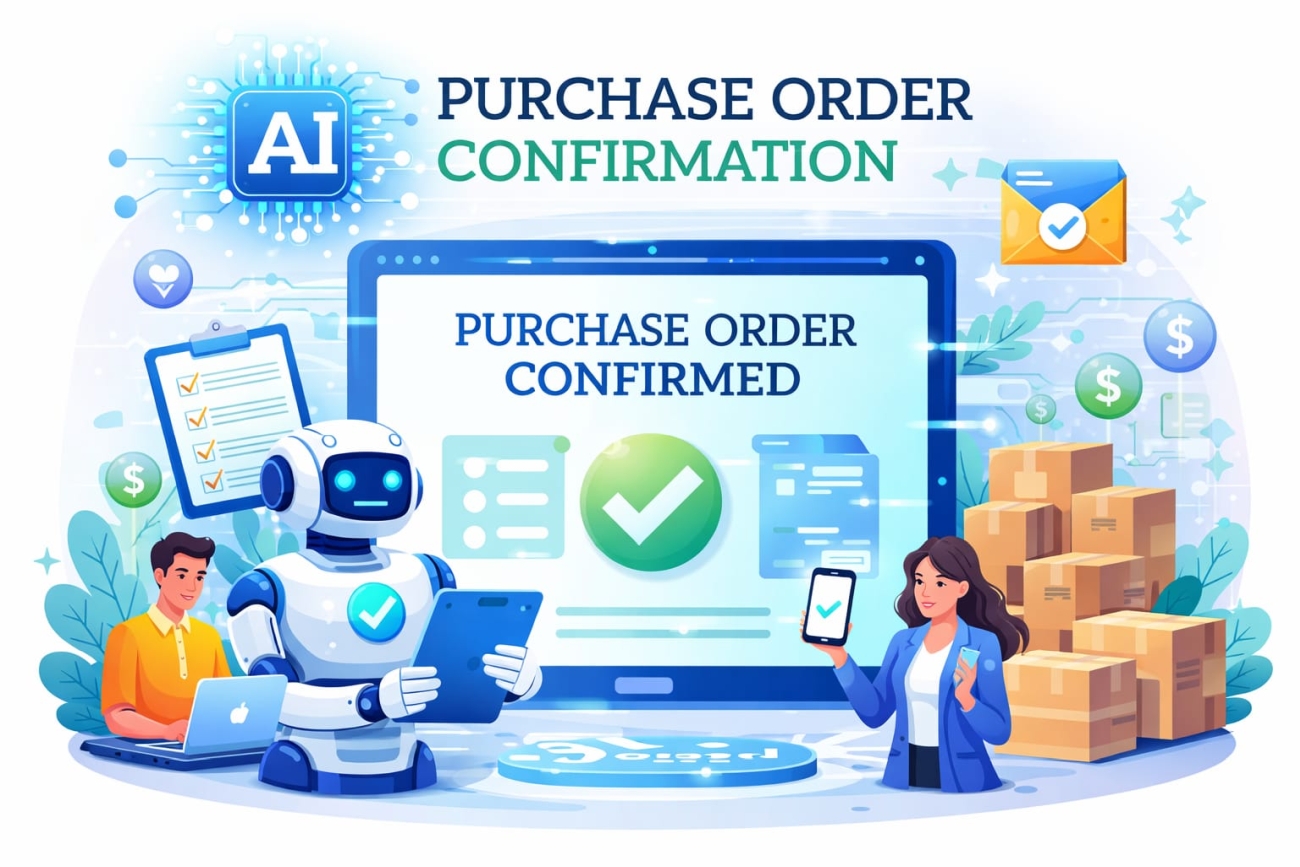
AI Purchase Order Confirmation: Report and Recommendation We invest millions in ERPs, but run our supply chains on Outlook and Excel. EDI handles our strategic partners. Portals suffer from low adoption. As a result, the messy reality of Purchase Order confirmations, date changes, and exceptions defaults right back to email. Despite having best-of-breed software systems (ERP, MRP, planning tools), most manufacturers hit the same wall when it comes to the messy reality of communicating and collaborating with suppliers. A new report from Glacis puts a hard number on what this actually costs us. 👉Their data shows buyers spend 60-70% of their time just managing confirmations. For a $1.5B manufacturer, that translates to 30 FTEs and millions tied up in safety stock and expedites just to manage the delay. 👉Read the report here (safe link): https://docsend.com/v/6snj8/a_ja ✅ I had the chance to review the Glacies solution. They frame it perfectly: AI as the „Anti-Portal.“ Instead of begging suppliers to log into yet another system, their AI agent works with the existing tools: a company’s inbox. It extracts data from emails and attachments, validates it, and updates the ERP in real time. The brilliance is that it requires zero change from the supplier. Portals failed because they demanded adoption. I highly recommend reading the report if you are a procurement leader looking to drive real operational efficiency. Thanks and Kudos to Philipp Gutheim and the Glacis team.

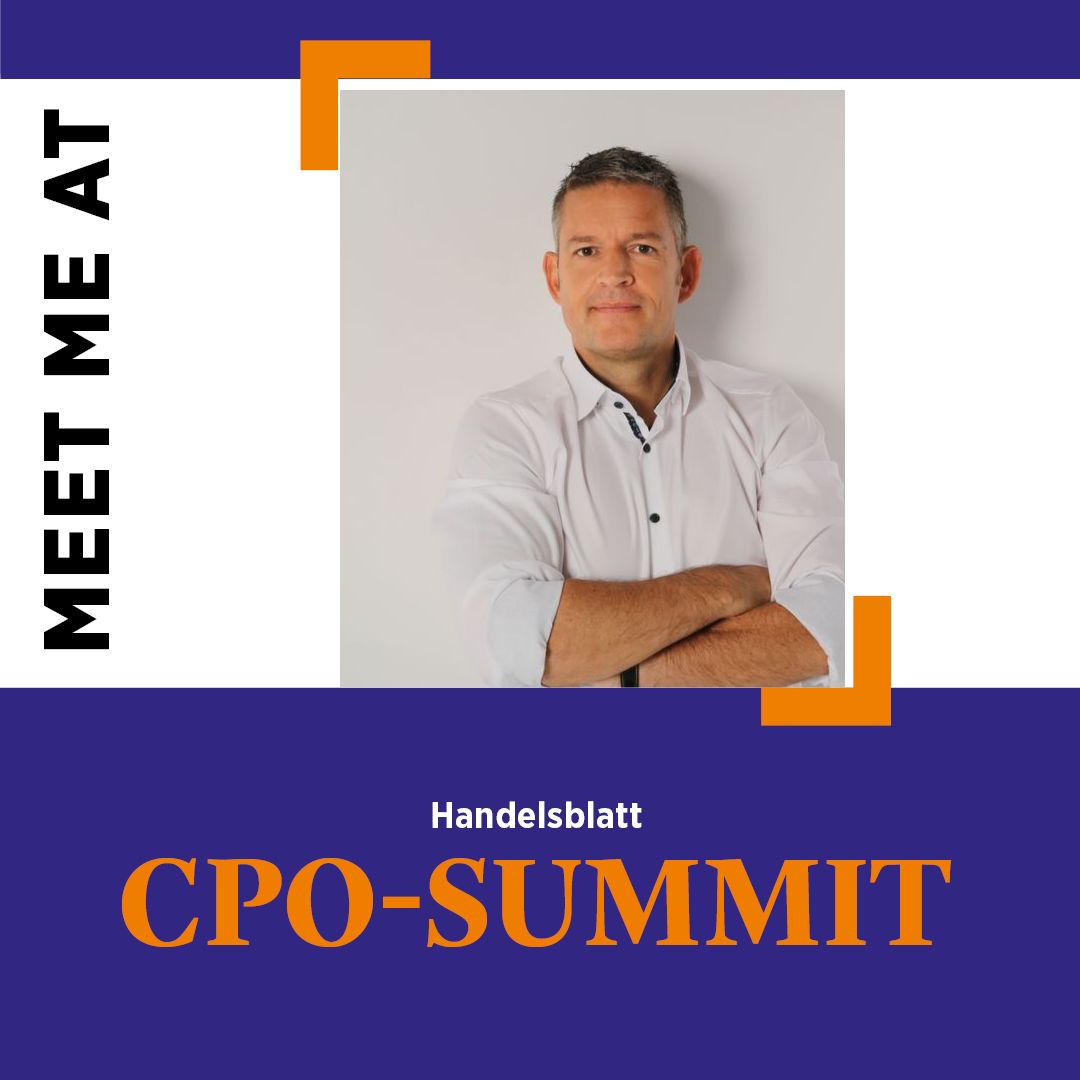
HANDELSBLATT CPO-SUMMIT 2026

Handelsblatt CPO-Summit 2026

ℹ️HANDELSBLATT CPO-SUMMIT 2026ℹ️ Der etablierte, von Einkaufsleitern und auch mir sehr geschätzte 3. Handelsblatt CPO-Summit für Einkaufs- und Procurement-Führungskräfte findet statt am: 📅 27.4 und 28.4.2026 in Düsseldorf Vom DAX-Konzern zum Mittelstand schauen wir branchenübergreifend auf die Themen, die den Einkauf bewegen. Sachlich, konstruktiv und kritisch. Insbesondere in Zeiten geopolitischer Umbrüche stehen Einkauf und CPO im Zentrum und müssen mehr denn je als strategischer Zukunftsgestalter agieren. Inhalte ✅Wie können Einkaufsstrategien widerstandsfähig und zukunftsorientiert gestaltet werden? ✅Wie wird AI zum Gamechanger für Einkaufsorganisationen? ✅Brücken bauen: Einkauf im Schulterschluss mit Vertrieb, Produktion, Entwicklung und Finance ✅Welche Rolle spielt der CPO als Treiber für Innovation und Transformation? ✅Wie gelingt der Spagat zwischen Nachhaltigkeit und Wirtschaftlichkeit? Das erwartet Sie ✔️Treffen Sie die Einkaufsentscheiderinnen und -entscheider großer und mittelständischer Unternehmen aller Branche in einem exklusiven Rahmen. ✔️ Internationale Einblicke durch Live-Schaltungen zu Handelsblatt-Korrespondentinnen und -Korrespondenten. ✔️Austausch auf Augenhöhe – tauschen Sie sich in vertraulichem Rahmen aus. ✔️ Erleben Sie mit vielen Best Practices, Powertalks, Panel-Diskussionen, Impuls-Vorträgen und unterschiedlichen Networking-Möglichkeiten Interessiert? Anmeldungen noch möglich! Über mich können Sie vergünstigt teilnehmen und 15% sparen. Einfach bei der Anmeldung den Vorteilscode 77D2502057 eingeben. https://live.handelsblatt.com/event/handelsblatt-cpo-summit/?utm_medium=ko&utm_source=77&utm_campaign=P1201199

„Successful CPOs“

Successful CPOs

📖“Successful CPOs TWO: Stories of Powerful Procurement Officers reaching for the Top“. 1️⃣At the end of 2024, I shared my experiences and perspectives on leadership in Procurement. „Successful CPOs; Stories of Powerful CPOs“ is a compelling compilation that draws on the rich experiences and insightful wisdom of over 35 global Procurement Leaders 2️⃣“Successful CPOs II“ is out now, and it’s another engaging collection of innovative articles that leverage the experiences and insights of over 30 Procurement Leaders. The book addresses a diverse array of both contemporary and timeless topics, such as leadership, sustainability, digitalization, design, competitive pricing, quality assurance, financial planning, team building, and much more. My contribution – the role of the CPO ✅The role of the CPO is fundamentally changing. The CPO of the future is no longer just a functional leader focused on sourcing and cost optimization. The role is a corporate strategist, co-creating enterprise strategy and shaping long-term value creation. However, in any case, one must earn the role through performance, innovation, courage, and value contribution. Not just demanding and complaining, and whining ✅Today’s CPO operates at the Board level, connecting market dynamics, innovation, resilience, sustainability, and digital transformation with corporate ambition. With more than half of corporate spend flowing into supply ecosystems, Procurement has a decisive influence on growth, risk exposure, ESG impact, and competitive differentiation. ✅ Future-oriented CPOs orchestrate innovation ecosystems, strengthen enterprise resilience through agile supply networks, and embed responsible growth into the core of corporate strategy. They leverage digital capabilities, AI, and data-driven governance to enable faster, smarter decisions across the organization. ✅This evolution requires Boards to rethink the role of Procurement to step beyond their traditional boundaries. It is an ambitious shift, but in an increasingly volatile and competitive global environment, it is not optional. The CPO is no longer executing the strategy. The CPO is co-creating the future. A rethinking of the role is therefore more than necessary. An excellent read for anyone aspiring a career in Procurement, as well as (Supervisory) Board members who are (re-) considering the positioning of their Procurement organization.Happy reading and discussing. Contact me for further discussions.

The 2025 AI Implementation Report

The 2025 AI Implementation Report

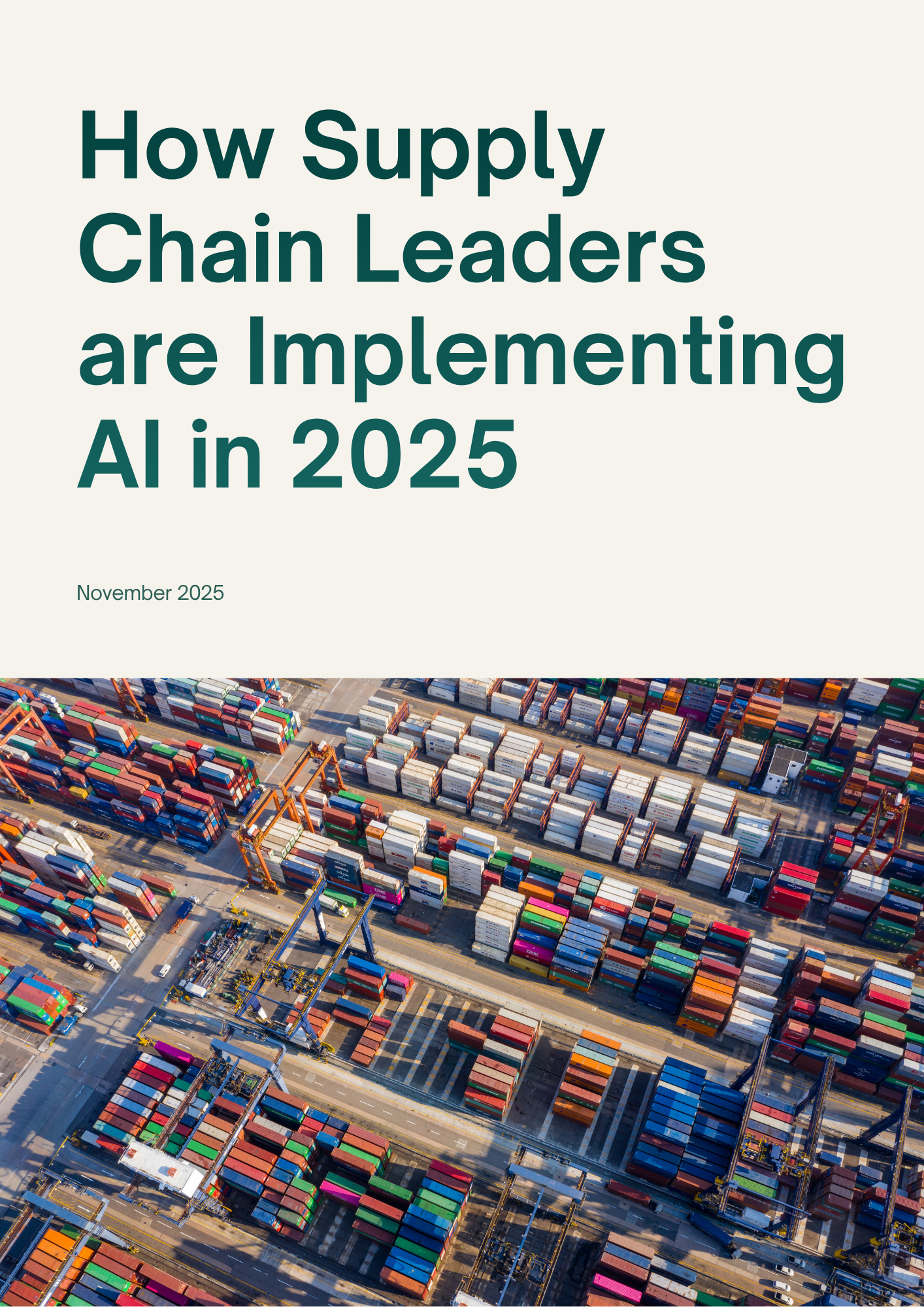
The 2025 AI Implementation Report – not just another AI report AI is definitely THE hype topic of 2025. It’s often misused as a buzzword or sales pitch without substance. However, several companies are creating AI projects, achieving significant increases in effectiveness and efficiency. Even the smallest approaches might generate significant added value. ⏩So, what is the current state of affairs? I got an early look at Philipp Gutheim’s „2025 AI Implementation Report,“ and the section on workforce transformation is eye-opening. Philipp has synthesized insights from 100+ leaders and 25+ talks into this document. It covers the tech, but more importantly, it covers the organizational design required to make the tech work. If you are struggling to get your team on board with new tools, give this a read. ✅Philipp analyzed talks from leaders at Toyota and Renault, and the consensus is clear: The days of passive monitoring are ending. The next phase is about Decision Intelligence systems that proactively flag issues and suggest trade-offs (e.g., cost vs. SLA) before the problem hits the P&L. ✅The insight from Kearney really hit home: we need to stop thinking about employees as users of software, and start training them to be „managers of agents.“ Imagine a structure where every person manages a team of ~20 digital agents handling the repetitive data crunching, allowing the human to focus purely on strategy and exceptions. ✅There is a great case study inside from Microsoft and Colgate-Palmolive about „psychological safety.“ If your teams think AI is there to replace them, the pilot will fail. If they see it as a tool to remove the „boring“ 90% of their job so they can focus on the strategic 10%, adoption skyrockets. Read the report here: https://docsend.com/view/7j4qysu44f4kcrhj

Interim Procurement Summit 2025

Interim Management Summit 2025 Theissen

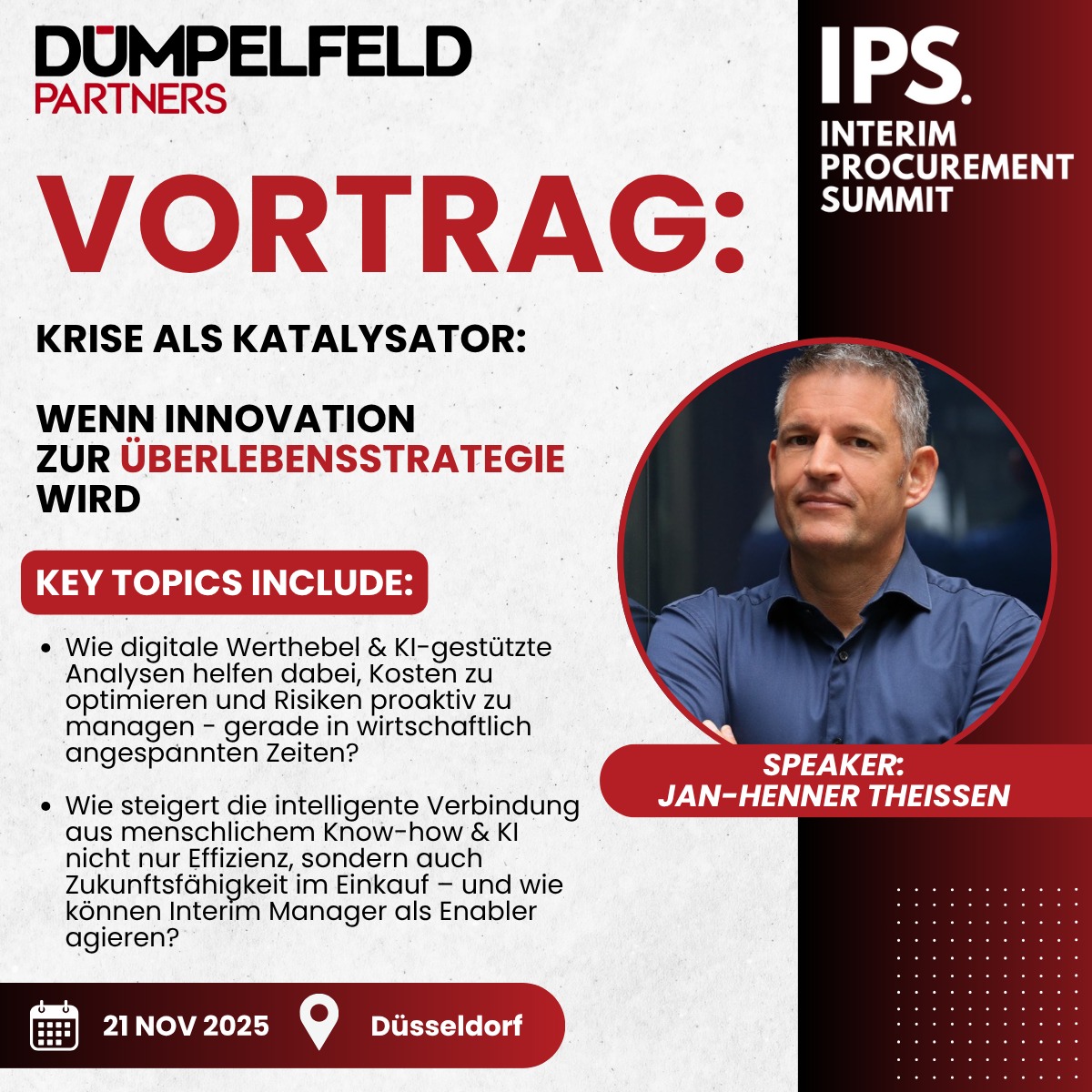
Das 2. 𝗜𝗡𝗧𝗘𝗥𝗜𝗠 𝗣𝗥𝗢𝗖𝗨𝗥𝗘𝗠𝗘𝗡𝗧 𝗦𝗨𝗠𝗠𝗜𝗧 am 📅21.11 und 22.11.2025 in Düsseldorf, nähert sich. Ende nächster Woche treffen sich führende Köpfe des Interim Management im Einkauf in Düsseldorf mit einem Ziel: Wissen teilen, Perspektiven öffnen, Zukunft gestalten. Das Interim Procuremen Summit2025 ist das Gipfeltreffen für alle, die Einkauf, Transformation und Interim Management wirklich leben. Wir alle haben den Einkauf aus vielen Blickwinkeln erlebt: Als CPOs, Interim Manager, Rechtsanwälte, Unternehmer, Marketing-Strategen und Vermittler. Das 1. Summit in 2024 war perfekt organisiert, mit der notwendigen inhaltlichen Tiefe und zahlreichen Möglichkeiten zum Austausch. Endlich eine Plattform für Interim Manager im Einkauf. Ich freue mich geschätzte Kollegen zu treffen und meine Gedanken in einem Vortrag zu teilen. ⏩ Krise als Katalysator: Wenn Innovation zur Überlebensstrategie wird. ➡️Wie digitale Werthebel und KI-gestützte Analysen helfen dabei, Kosten zu optimieren und Risiken proaktiv zu managen ➡️Wie steigert die intelligente Verbindung aus menschlichem Know-how und Künstlicher Intelligenz nicht nur Effizienz, sondern auch Zukunftsfähigkeit im Einkauf – und wie können Interim Manager als Enabler agieren? Es gibt wieder Herausforderndes aus dem Kasperletheater der Geopolitik und weitere Absurditäten. Einer muss ja auch mal konstruktiv schwarzmalen, natürlich mit Lösungsansätzen. KI als Lösung aller Probleme kommt auch drin vor (muss ja heutzutage, aber darum geht’s es nur bedingt). Weitere Speaker und Themen: 🟥 Ramon Romero Perez // Thema: Realitäts-Check: Einkauf 2025 🟥 Dr. Thomas Leister // Thema: Rechtssicherer Einsatz von Interim Managern: Vermeidung von Scheinselbstständigkeit 🟥 Tobias Uding // Thema: Benchmarkdaten statt Bauchgefühl – Sofort Einsparpotenziale heben im Interim Procurement 🟥 Marie-Cecil Aufmkolk, Serge Van Vooren // Thema: Real Talk Einkauf: Was CPOs jetzt wirklich brauchen 🟥 Daisuke Spielvogel, Dr. Daniel Steinberg // Thema: „Oh Gott, schon wieder KI…“ 🟥 Joerg Weidenfeld // Thema: Krisen-Intensiv – Zwischen Auftrag und Ausnahmezustand 🟥 Marc-Sven Kopka // Thema: Personal Branding – Wie will ich wahrgenommen werden und wie schaffe ich das? 🟥 Nora Maria Ferfers, Joerg Weidenfeld // Thema: Einsparungen ohne Risiko – SAVIFY AG

New Interim Management Assignment – CPO Meyer Werft

Interim CPO Meyer Werft

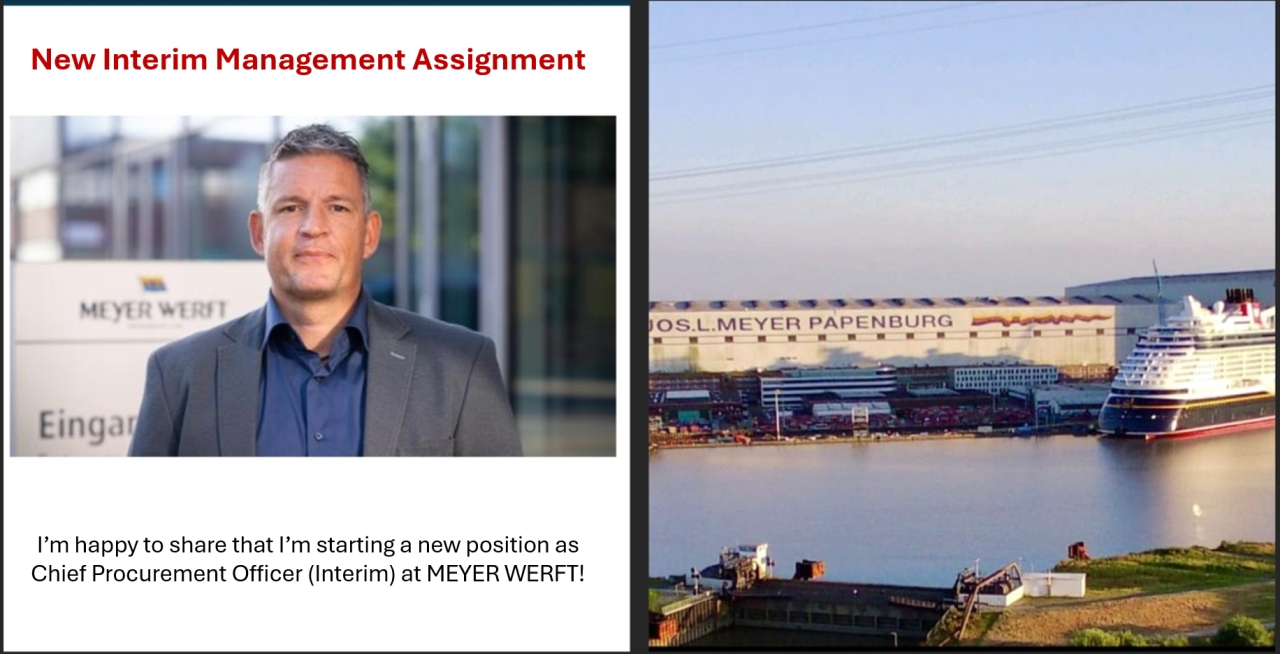
Jan-Henner Theißen resumes the role of Chief Procurement Officer (a.i.) I’m happy to share that I’m starting a new position as Chief Procurement Officer (Interim) at MEYER WERFT! MEYER WERFT is one of the largest and most modern shipyards in the world. Cruise ships for international shipping companies have been built for several decades. To this day, 58 of these luxury liners have left the shipyard – and the next ones are already under construction. I will be responsible for leading the continued transformation of the Procurement function, with a focus on enhancing strategic value contribution, strengthening global supplier collaboration, advancing digitalization, and supporting MEYER WERFT’s long-term business objectives. By the way. We are expanding our Procurement team and offering a range of exciting career opportunities. Visit the Meyer Werft website to explore current openings and follow me to stay informed about future opportunities.

Insolvenzrisiken Osteuropa

Insolvenzrisiko Osteuropa

⚡Insolvenzrisiken nicht nur in Deutschland – Insolvenzrisiko Osteuropa Aktuell laufen in vielen Unternehmen Kosten- und Resilienzprogramme, die oftmals auch Produktionsverlagerungen bzw. Lieferantenwechsel in Richtung Osteuropa einplanen. Sei es aus Kostengründen oder aufgrund der Risikominimierung fragiler Lieferketten (z.B. Rückverlagerung aus Asien) ⚠️Dabei ist jedoch Vorsicht geboten, auch Mittel- und Osteuropa 2024 ist von zunehmenden Insolvenzrisiken betroffen! 📌Creditrefrom berichtete bereits im Juni, dass nur auf den ersten Blick die Insolvenzen in Mittel- und Osteuropa 2024 gesunken sind. Aber ein tieferer Blick offenbart: In 9 von 12 Ländern stiegen die Pleiten. Nur Ungarn, Bulgarien und Tschechien zeigen Rückgänge – wobei die ungarischen Zahlen vor allem statistisch geschönt sein dürften. 📌Von den 39.681 Unternehmenspleiten kommen über die Hälfte (20.854 Fälle) aus Ungarn. Ungarn wiederum hat mit einem Minus von 56,2 Prozent gegenüber 2023 das Insolvenzaufkommen mehr als halbiert (2023: 47.625 Fälle). Dabei ist allerdings in Rechnung zu stellen, dass die offizielle ungarische Statistik zu den Insolvenzen die Liquidationsverfahren zählt. 📌Die östlichen Staaten der EU weisen starke Ähnlichkeiten mit Westeuropa auf. 2020 & 2021 waren die Insolvenzzahlen aufgrund des Erliegens der wirtschaftlichen Tätigkeit und der Hilfsmaßnahmen zunächst gesunken, um dann schließlich 2022 wieder mehr oder weniger deutlich anzusteigen. 📌Der Anteil der vier Hauptwirtschaftsbereiche am Insolvenzaufkommen insgesamt sieht den Handel mit 35,5 Prozent an der Spitze der Branchen. Es folgen die Dienstleister mit 28,9 Prozent, das Baugewerbe mit gut 19,4 Prozent und das Verarbeitende Gewerbe mit 16,3 Prozent ABER: 📌Das Verarbeitende Gewerbe spielt im Westen der EU bei den Insolvenzen eine deutlich geringere Rolle, dagegen ist der Dienstleistungssektor stärker vertreten. 📌Das Verarbeitende Gewerbe 2024 in Polen mit 25,3 Prozent und in Tschechien stellte mit 25,1 Prozent aller Unternehmensinsolvenzen einen überdurchschnittlich hohen Anteil. 📌Trotz wirtschaftlichem Aufholprozess bleiben die Probleme im Bereich der Industrieproduktion, die gerade in Ländern mit starker Abhängigkeit von der Automobilbranche schwächelt. Hinzu kommt die Abhängigkeit von Deutschland, die sich negativ für die Exporte in vielen osteuropäischen Ländern zeigte. Fazit: Auch wenn gleichzeitig der private Konsum boomt, die Reallöhne steigen und das BIP stärker als im Westen Europas wächst, bröckelt in vielen Branchen die Basis: Industrie, Bau, Dienstleistungen. Kaum ein Bereich bleibt verschont. targetP Risk is Our Business Quelle: Creditreform, Juni 2025

Digitalisierung Einkauf steigert Wirksamkeit

v

🔮Kristallkugel Einkauf – Teil 2 Gemeinsam mit Stephan Chassaing de Bourdeille diskutierte ich im Video der letzten Woche über die Zukunft des Einkaufs, über Trends, den Sinn oder Unsinn derselbigen und die aktuellen Herausforderungen. Ergänzend dazu durfte ich für einen weiteren Ausblick zur Digitalisierung im Einkauf alleine ran. Die Zukunft des Einkaufs ist digital – und sie beginnt spätestens jetzt! Das Video ist zeitgemäß auf Tik Tok Aufnahmefähigkeit zugeschnitten, daher nur eine kurze Zusammenfassung der EINEN Minute: ✅ Digitalisierung, besonders durch Automatisierung und Künstliche Intelligenz, eröffnet heutzutage völlig neue Wachstumsmöglichkeiten. ✅ Digitalisierung bedeutet nicht nur Effizienzsteigerung, sondern auch EFFEKTIVITÄT (gerade im Mittelstand oftmals viel wichtiger als Effizienz) Nachhaltigkeit und Resilienz in globalen Märkten. ✅ Unternehmen, die jetzt handeln, sichern sich einen entscheidenden Wettbewerbsvorteil. ✅ Ansätze, wie man die im Einkauf meistern kann und wie wichtig transparente Lieferketten sind Mein Angebot: Auf Basis von mehr als 30+ erfolgreichen digitalen Projekten stehe ich gerne für einen unverbindlichen Austausch oder einen kurzen Quick-Check Ihrer Pläne zur Verfügung. Das Video gibt es hier (sichere Seite von targetP): https://targetp.de/wp-content/uploads/2024/11/AB_Video2_Digitalisierung_in_der_Beschaffung_Final.mp4

🏎️𝐓𝐡𝐞 𝐄𝐯𝐨𝐥𝐮𝐭𝐢𝐨𝐧 𝐨𝐟 𝐃𝐞𝐬𝐢𝐠𝐧 – 𝐀 𝐋𝐞𝐬𝐬𝐨𝐧 𝐟𝐫𝐨𝐦 𝐇𝐨𝐭 𝐖𝐡𝐞𝐞𝐥𝐬

Design Evolution - Cost Engineering

𝐄𝐯𝐨𝐥𝐮𝐭𝐢𝐨𝐧 𝐨𝐟 𝐃𝐞𝐬𝐢𝐠𝐧 Between 1997 and 2016, Hot Wheels underwent a visible transformation in design quality. What began in the late 90s as highly detailed, realistic miniatures with intricate undercarriages, chrome parts, and multi-piece builds slowly gave way to more simplified forms. 𝐖𝐡𝐲? A shift in priorities. As costs rose in the 2000s, complexity and realism were traded for affordability and playability. By the 2010s, designs became more basic. Still fun, but less detailed. While premium collector editions preserved some of the original craftsmanship, the mainstream shifted to meet the needs of younger, cost-sensitive audiences. 🔍 A reminder: Product evolution often reflects strategic choices that balance cost, target group, and perceived value. Whether you’re in manufacturing, product development, or procurement, it’s worth asking: What are we optimizing for? What do we risk losing in the process?

Digitaler Einkauf – Ein Zwischenfazit

Digitaler Einkauf 2025

🔮Die Kristallkugeln des Einkaufs haben gesprochen:  Digitaler Einkauf 2025. Es war absehbar: 2025 ist für viele Unternehmen vornehmlich das Jahr des Kostenmanagements und der Risikovorsorge. Aber auch das Jahr von KI im Einkauf (zumindest in den Diskussionen) und das Jahr schmaler Digitalisierungsbudgets. Diese vorhersehbare Entwicklung besprachen Stephan Chassaing de Bourdeille und ich bereits Ende 2024. ➡️ Wir haben 1.5 Minuten zur Zukunft des Einkaufs philosophiert und unsere Gedanken zur Zukunft des Einkaufs geteilt. Danke an Amazon Business für die Plattform und Stephan für die kurzweilige Unterhaltung. Das Video gibt es hier (sichere Seite von targetP): https://targetp.de/wp-content/uploads/2024/10/AB_Video_1_StephaneJan.mp4 👉Was geht 2025: Geopolitische, wirtschaftliche und gesellschaftliche Veränderungen halten den Einkauf auch 2025 auf Trab. Flächendeckend wurden Kostensenkungsprogramme gestartet und aus vielen Industrien hört man wieder von „unverschämten“ Forderungen und Druck. Digitale Projekte wurden dagegen -nach Rücksprache mit diversen Anbietern und Netzwerkpartnern oft weniger stark priorisiert, teilweise gestoppt. Die „Degradierung“ von gesetzlichen Anforderungen hat auch bei vielen Unternehmen zu einer Neupriorisierung von Nachhaltigkeitsinitiativen geführt. Fazit: 2025 hat bisher eindeutig zu einer weiteren Rückbesinnung auf die klassische Daseinsberechtigung des Einkaufs geführt. Ich selber habe noch nie eine deartige Diskrepanz zwischen Einzelgesprächen und Präsentationen/Diskussionen auf Events erlebt. 👉 Trends im Einkauf. Wir waren und 2024 einig: Den EINEN Trend wird es auch 2025 und danach nicht geben. Auch wenn aktuell überall KI als Lösung aller Probleme suggeriert wird und die Diskussionen dazu fast religiöse Züge angenommen haben. Aktuell ist vor allem der „Werthebel Mensch“ – noch flächendeckend ohne KI- der entscheidende Faktor bei der Umsetzung der Ziele. Das ist (leider) die Realität. Gerade auch im Kostenmanagement gibt es starke KI-gestützte Lösungen zur Kostenoptimierung. Und beim Risikomanagement sowieso. 🥕Teaser: Weitere Kurzvideos zum Digitalen Einkauf folgen in den nächsten 2 Wochen. Mit Impulsen für eine pragmatische und budgetfreundliche Umsetzung. Auf Basis der Erfahrung aus mehr als 30 digitalen Projekten von Digitaler Strategie & Architektur, bis zur Lösungsauswahl und ganzheitlichen Implementierung (inkl. intensiver Diskussionen mit Betriebsräten) Das Video gibt es hier (sichere Seite von targetP): https://targetp.de/wp-content/uploads/2024/10/AB_Video_1_StephaneJan.mp4

en_USEnglish
About the company:
Joint Venture Truck OEMs
(Germany & Sweden)
Development Hydrogen fuel cell systems
approx. 500Employees, strong growth
GlobalTechnologyInnovator

Case Study

Industry: Automotive

Area: Organisation

Land: Deutschland & USA

Duration: 12 Months

Starting Point / Assignment

  • approx. EUR 400 million Procurement spend p.a. (rapidly increasing)
  • Independent joint venture between two large truck manufacturers
  • Start of series production in 2027 and development of the North American market with local production requires far-reaching development and expansion of Procurement, particularly regarding a global organization (skills, capacities, x-functional collaboration) and digitalization

Objectives

  • Creating transparency about the maturity level of the Procurement function
  • Prioritized action plan to gradually increase the maturity level regarding competencies, x-functional cooperation, productivity/efficiency, digitalization, etc.
  • Development of target organization model (2023, 2027, 2030) for production and non-production materials Procurement incl. all role descriptions and necessary capacity (FTE sizing)
  • Detailed transformation plan for the global Procurement organization aligned with the milestones "Start of series production" and "Market entry & local production North America“
  • Review of Procurement’s digital strategy and projects including future recommendations

Approach

  • Comprehensive maturity analysis of Procurement (targetP! method) with a focus on organization and digitalization based on personal interviews (all Procurement staff and top stakeholders) as well as in-depth document and data analysis (strategies, guidelines, process descriptions, digitalization initiatives, standards for category & supplier management, order & invoice volumes, etc.).
  • S/T/O analysis to determine the actual capacity utilization of all Procurement employees as part of individual interviews
  • Workshops/interviews with IT & Procurement on the Procurement system landscape and digital strategy

Results / „Deliverables“

  • Detailed maturity assessment report on Procurement (production and non-production materials) including prioritized actions and quick wins
  • Procurement digital strategy benchmark against best practices with specific recommendations for actions, risk analysis, and quick wins
  • Transparency regarding the actual use of capacity in Procurement, gap analysis of the respective profiles and stakeholder expectations
  • Role-based target Procurement organization with a step-by-step development plan (staffing, development, reallocation)
  • Tailor-made role descriptions for use in subsequent recruiting measures
About the company:
Joint Venture Truck OEMs
(Germany & Sweden)
Development Hydrogen fuel cell systems
approx. 500Employees, strong growth
GlobalTechnologyInnovator

Case Study

Industry: Automotive

Area: Organisation

Land: Deutschland & USA

Duration: 12 Months

Starting Point / Assignment

  • approx. EUR 400 million Procurement spend p.a. (rapidly increasing)
  • Independent joint venture between two large truck manufacturers
  • Start of series production in 2027 and development of the North American market with local production requires far-reaching development and expansion of Procurement, particularly regarding a global organization (skills, capacities, x-functional collaboration) and digitalization

Objectives

  • Creating transparency about the maturity level of the Procurement function
  • Prioritized action plan to gradually increase the maturity level regarding competencies, x-functional cooperation, productivity/efficiency, digitalization, etc.
  • Development of target organization model (2023, 2027, 2030) for production and non-production materials Procurement incl. all role descriptions and necessary capacity (FTE sizing)
  • Detailed transformation plan for the global Procurement organization aligned with the milestones "Start of series production" and "Market entry & local production North America“
  • Review of Procurement’s digital strategy and projects including future recommendations

Approach

  • Comprehensive maturity analysis of Procurement (targetP! method) with a focus on organization and digitalization based on personal interviews (all Procurement staff and top stakeholders) as well as in-depth document and data analysis (strategies, guidelines, process descriptions, digitalization initiatives, standards for category & supplier management, order & invoice volumes, etc.).
  • S/T/O analysis to determine the actual capacity utilization of all Procurement employees as part of individual interviews
  • Workshops/interviews with IT & Procurement on the Procurement system landscape and digital strategy

Results / „Deliverables“

  • Detailed maturity assessment report on Procurement (production and non-production materials) including prioritized actions and quick wins
  • Procurement digital strategy benchmark against best practices with specific recommendations for actions, risk analysis, and quick wins
  • Transparency regarding the actual use of capacity in Procurement, gap analysis of the respective profiles and stakeholder expectations
  • Role-based target Procurement organization with a step-by-step development plan (staffing, development, reallocation)
  • Tailor-made role descriptions for use in subsequent recruiting measures
About the company:
Family Owned Business with international Footprint
approx. 500 Mio.Turnover
approx. 3.000 Employees
Technology & Market Leaderin Harvesting Equipment

Case Study

Industry: Agricultural Machines

Area: Transformation

Country: Germany

Duration: ~ 18 Months

Starting Point / Assignment

  • approx. 200 million Procurement volume
  • Sole focus on operational processes (clerical function)
  • Strong focus on German plants, not prepared for internationalization and cooperation, despite of having operating units in the USA and China
  • Strong growth in turnover and increased internationalization
  • Procurement’s priority: Supply security (“keep the plants running”)
  • Digitalization not actively driven

Objectives

  • Create an understanding of Procurement’s maturity level
  • Identify potential (e.g., value contribution, efficiency, compliance), through more professional category & supplier management and digital support
  • Elaborate on alternative measures to develop Procurement and create an action plan, particularly concerning process improvements
  • If necessary, determine and argue capacity requirements
  • Optimize structures to prepare for growth and improved resource utilization

Approach

  • Comprehensive maturity analysis of Procurement (targetP! method) with a focus on organization and operational improvements (personal interviews with Procurement staff and top stakeholders) as well as in-depth document and data analysis (strategies, guidelines, process descriptions, digitalization initiatives, etc.)
  • Development of a holistic transformation plan and target organization model including roles and responsibilities, stakeholder integration, etc.
  • Early involvement of employees "future conferences to build my organization“
  • Joint creation of a practicable category structure, a Procurement Vision & Strategy


Results / „Deliverables“

  • First-time definition of a Procurement strategy with aligned objectives
  • Capacity optimization through targeted personnel expansion
  • Optimized organizational model and a more rigid category structure established
  • First system reviews with digital solution providers based on a digital action plan and precise requirements
  • Design of a customized multi-year training program for all roles
  • Implementation of Category Management training with pilots
  • Development and implementation of Procurement processes
About the company:
Family Owned Business with international Footprint
approx. 500 Mio.Turnover
approx. 3.000 Employees
Technology & Market Leaderin Harvesting Equipment

Case Study

Industry: Agricultural Machines

Area: Transformation

Country: Germany

Duration: ~ 18 Months

Starting Point / Assignment

  • approx. 200 million Procurement volume
  • Sole focus on operational processes (clerical function)
  • Strong focus on German plants, not prepared for internationalization and cooperation, despite of having operating units in the USA and China
  • Strong growth in turnover and increased internationalization
  • Procurement’s priority: Supply security (“keep the plants running”)
  • Digitalization not actively driven

Objectives

  • Create an understanding of Procurement’s maturity level
  • Identify potential (e.g., value contribution, efficiency, compliance), through more professional category & supplier management and digital support
  • Elaborate on alternative measures to develop Procurement and create an action plan, particularly concerning process improvements
  • If necessary, determine and argue capacity requirements
  • Optimize structures to prepare for growth and improved resource utilization

Approach

  • Comprehensive maturity analysis of Procurement (targetP! method) with a focus on organization and operational improvements (personal interviews with Procurement staff and top stakeholders) as well as in-depth document and data analysis (strategies, guidelines, process descriptions, digitalization initiatives, etc.)
  • Development of a holistic transformation plan and target organization model including roles and responsibilities, stakeholder integration, etc.
  • Early involvement of employees "future conferences to build my organization“
  • Joint creation of a practicable category structure, a Procurement Vision & Strategy


Results / „Deliverables“

  • First-time definition of a Procurement strategy with aligned objectives
  • Capacity optimization through targeted personnel expansion
  • Optimized organizational model and a more rigid category structure established
  • First system reviews with digital solution providers based on a digital action plan and precise requirements
  • Design of a customized multi-year training program for all roles
  • Implementation of Category Management training with pilots
  • Development and implementation of Procurement processes
About the company:
Leading Healthcare Provider
High reputation (Top rated Medical Care)
Site: approx. 825 Mio. Turnover
approx. 1.700employees
> 80.000 Patienten/Jahr

Case Study

Industry: Health Care/Clinic

Bereich: Interim & Entwicklung

Country: Germany

Duration: 6 Months

Starting Point / Assignment

  • approx. EUR 60 million spend p.a., complex spend structure
  • Procurement with a strong focus on processing and operational processes, no systematic spending management
  • Significant operational problems in day-to-day business led to high costs
  • Very insecure, demotivated team due to degrading treatment and extreme micromanagement by the previous Procurement Manager
  • Non-existent digitalization of core processes and tasks
  • Extensive, sometimes paralyzing bureaucracy in general and when approving requirements such as Requisitions, Purchase Orders and Contracts
  • Lack of discipline and ethics among sales reps (back-door selling, etc.)
  • Low reputation within the hospital, especially among chief physicians

Objectives

  • Main objective: Stabilization and reactivation of a highly frustrated team
  • Stabilization of day-to-day business, also due to above-average absences
  • Better distribution of the workload among the team members
  • Creating an understanding of the actual maturity level of Procurement, identifying potential (e.g., value contribution, efficiency, compliance)
  • Elaborating alternative measures to develop Procurement, and create an action plan, particularly concerning process simplifications (approvals of Requisitions, Purchase Orders, Contracts)
  • Improving customer service quality and interaction with internal customers

Approach

  • Comprehensive maturity analysis of Procurement involving stakeholders
  • Creation and coordination of a holistic development plan
  • Open door policy and individual meetings several times a week
  • Regular visits to the hospital wards to understand the needs and build trust
  • Frequent exchange with internal customers (regular personal exchange, participatory approach: Involvement of all employees, e.g. we
  • Weekly team meetings to discuss issues, improvement ideas, and solutions to ensure full commitment and involvement in improvement projects
  • Strong involvement in day-to-day business (negotiations, sourcing)
  • Process analyses, in particular, SAP optimization options & approvals

Results / „Deliverables“

  • Team stabilized, motivation increased, absences and absenteeism reduced (CEO quote: "You calmed people down very quickly with professional empathy and got them behind you")
  • First-time definition of a Procurement strategy with agreed upon targets
  • Regular coordination with internal customers (Chief physician quote: "we talk to each other now, things run faster, we finally feel well looked after")
  • Approval and implementation of moderate staff expansion with restructuring of work areas and balancing of workload
  • Redesign of framework agreements with improved commercial conditions
  • Complete processing of unfinished order processes (backlog)
  • Simplification and definition of core Procurement processes;
  • Addition of new SAP functionalities to drive automation & workload reduction
About the company:
Leading Healthcare Provider
High reputation (Top rated Medical Care)
Site: approx. 825 Mio. Turnover
approx. 1.700employees
> 80.000 Patienten/Jahr

Case Study

Industry: Health Care/Clinic

Bereich: Interim & Entwicklung

Country: Germany

Duration: 6 Months

Starting Point / Assignment

  • approx. EUR 60 million spend p.a., complex spend structure
  • Procurement with a strong focus on processing and operational processes, no systematic spending management
  • Significant operational problems in day-to-day business led to high costs
  • Very insecure, demotivated team due to degrading treatment and extreme micromanagement by the previous Procurement Manager
  • Non-existent digitalization of core processes and tasks
  • Extensive, sometimes paralyzing bureaucracy in general and when approving requirements such as Requisitions, Purchase Orders and Contracts
  • Lack of discipline and ethics among sales reps (back-door selling, etc.)
  • Low reputation within the hospital, especially among chief physicians

Objectives

  • Main objective: Stabilization and reactivation of a highly frustrated team
  • Stabilization of day-to-day business, also due to above-average absences
  • Better distribution of the workload among the team members
  • Creating an understanding of the actual maturity level of Procurement, identifying potential (e.g., value contribution, efficiency, compliance)
  • Elaborating alternative measures to develop Procurement, and create an action plan, particularly concerning process simplifications (approvals of Requisitions, Purchase Orders, Contracts)
  • Improving customer service quality and interaction with internal customers

Approach

  • Comprehensive maturity analysis of Procurement involving stakeholders
  • Creation and coordination of a holistic development plan
  • Open door policy and individual meetings several times a week
  • Regular visits to the hospital wards to understand the needs and build trust
  • Frequent exchange with internal customers (regular personal exchange, participatory approach: Involvement of all employees, e.g. we
  • Weekly team meetings to discuss issues, improvement ideas, and solutions to ensure full commitment and involvement in improvement projects
  • Strong involvement in day-to-day business (negotiations, sourcing)
  • Process analyses, in particular, SAP optimization options & approvals

Results / „Deliverables“

  • Team stabilized, motivation increased, absences and absenteeism reduced (CEO quote: "You calmed people down very quickly with professional empathy and got them behind you")
  • First-time definition of a Procurement strategy with agreed upon targets
  • Regular coordination with internal customers (Chief physician quote: "we talk to each other now, things run faster, we finally feel well looked after")
  • Approval and implementation of moderate staff expansion with restructuring of work areas and balancing of workload
  • Redesign of framework agreements with improved commercial conditions
  • Complete processing of unfinished order processes (backlog)
  • Simplification and definition of core Procurement processes;
  • Addition of new SAP functionalities to drive automation & workload reduction
About the company:
Highly renowned Qatari company
approx. 825 mn.Turnover
approx. 3.500 Employees
Regional Market Leader
Shipping, Maritime Logistik & Services

Case Study

Industrie: Reederei & Maritim

Bereich: Organisation & Interim

Country: Qatar

Duration: ~ 12 Months

Starting Point / Assignment

  • approx. EUR 300 million Procurement spend p.a.
  • Procurement with a strong focus on processing and operational processes, no systematic spending management
  • Significant operational problems in day-to-day business led to high costs for troubleshooting, escalations, and internal conflicts with stakeholders
  • Low acceptance and appreciation of Procurement and high political pressure despite excellent company results
  • Long-term vacancy in Procurement leadership impacts performance, customer satisfaction, and insecurity and leading to high fluctuation on buyer level
  • Digitalization of core processes and tasks only marginally developed

Objectives

  • Create an understanding of the true maturity level of Procurement and gain buy-in from the Executive Board
  • Identify potential (e.g., value contribution, efficiency, compliance), through more professional category & supplier management and automation
  • Elaborate on alternative measures to develop Procurement and create an action plan, particularly concerning process simplifications
  • Improve strategic and operational reporting for the CFO
  • Implement organizational and structural optimization to improve service quality
  • After two months: additional Role as VP Ad Interim due to the dismissal of the Head of Procurement

Approach

  • Comprehensive maturity analysis of Procurement involving stakeholders
  • Creation and coordination of a holistic transformation plan with staff adjustments, digitalization, and skills requirements
  • Development of a target organization model (category management) with role descriptions, responsibilities and recruiting support
  • Highly participative approach with intensive involvement of all employees, e.g., as part of "future conferences" (for the first time in the company) and expert teams with topic champions
  • Further development of Procurement and sourcing governance, e.g., tailored Category Structure, Procurement Vision & Procurement strategy and policies

Results / „Deliverables“

  • First-time definition of a Procurement strategy with aligned objectives
  • Approval and implementation of moderate staff expansion and allocation and expansion of required skills through comprehensive training plans
  • Start of digitalization projects based on a digital action plan (Supplier Portal)
  • Implementation of a Category Management approach and process and execution of 10 category pilots to identify additional value contribution
  • Development and implementation of comprehensive Supplier Management involving a newly designed supplier qualification process (Supplier Portal)
  • Implementation of a Procurement guideline & process manual and creation of comprehensive Procurement reporting with PowerBI
  • 10-month Interim Management and stabilization of the organization
About the company:
Highly renowned Qatari company
approx. 825 mn.Turnover
approx. 3.500 Employees
Regional Market Leader
Shipping, Maritime Logistik & Services

Case Study

Industrie: Reederei & Maritim

Bereich: Organisation & Interim

Country: Qatar

Duration: ~ 12 Months

Starting Point / Assignment

  • approx. EUR 300 million Procurement spend p.a.
  • Procurement with a strong focus on processing and operational processes, no systematic spending management
  • Significant operational problems in day-to-day business led to high costs for troubleshooting, escalations, and internal conflicts with stakeholders
  • Low acceptance and appreciation of Procurement and high political pressure despite excellent company results
  • Long-term vacancy in Procurement leadership impacts performance, customer satisfaction, and insecurity and leading to high fluctuation on buyer level
  • Digitalization of core processes and tasks only marginally developed

Objectives

  • Create an understanding of the true maturity level of Procurement and gain buy-in from the Executive Board
  • Identify potential (e.g., value contribution, efficiency, compliance), through more professional category & supplier management and automation
  • Elaborate on alternative measures to develop Procurement and create an action plan, particularly concerning process simplifications
  • Improve strategic and operational reporting for the CFO
  • Implement organizational and structural optimization to improve service quality
  • After two months: additional Role as VP Ad Interim due to the dismissal of the Head of Procurement

Approach

  • Comprehensive maturity analysis of Procurement involving stakeholders
  • Creation and coordination of a holistic transformation plan with staff adjustments, digitalization, and skills requirements
  • Development of a target organization model (category management) with role descriptions, responsibilities and recruiting support
  • Highly participative approach with intensive involvement of all employees, e.g., as part of "future conferences" (for the first time in the company) and expert teams with topic champions
  • Further development of Procurement and sourcing governance, e.g., tailored Category Structure, Procurement Vision & Procurement strategy and policies

Results / „Deliverables“

  • First-time definition of a Procurement strategy with aligned objectives
  • Approval and implementation of moderate staff expansion and allocation and expansion of required skills through comprehensive training plans
  • Start of digitalization projects based on a digital action plan (Supplier Portal)
  • Implementation of a Category Management approach and process and execution of 10 category pilots to identify additional value contribution
  • Development and implementation of comprehensive Supplier Management involving a newly designed supplier qualification process (Supplier Portal)
  • Implementation of a Procurement guideline & process manual and creation of comprehensive Procurement reporting with PowerBI
  • 10-month Interim Management and stabilization of the organization