The Importance of Analytics

The Importance of Analytics

In today’s environment, Procurement is no longer just about cost savings (we all know that, and I don’t want to bother you with more typical and hollow LinkedIn Procurefluencer and S. Sinek statements). The Importance of Analytics: As a strategic function, it requires a deep understanding of risk, market, and geopolitical factors. Risk analysis helps identify vulnerabilities in supply chains, from financial instability to natural disasters. Market analysis ensures organizations anticipate price fluctuations, emerging trends, and shifts in supply-demand dynamics. Geopolitical analysis adds a critical layer, considering global events such as trade wars, sanctions, or political unrest that can disrupt operations. Plenty of tools, such as PESTEL, STEEPLE, or Porter 5 Forces, make it easy for everyone to improve the quality of every Procurement strategy. Start with it and then grow; no one needs to be a Macroeconomics Professor. 💣Here is the problem: This is not happening in many organizations. Skills are missing, teams face time and resource constraints, or a lack of understanding about Procurement’s role in the 2020ies. However, Procurement and Supply Chain Teams must grasp how global and local dynamics impact supply chains to make better decisions. Understanding the world ensures: ✅resilience, adaptability, and strategic foresight, ✅enabling organizations to seize opportunities (cost down – hot topic for 2025) and mitigate risks (another hot topic), ✅businesses are better positioned to secure sustainable, competitive advantages in an increasingly volatile landscape 👉Here is an outstanding example of what Procurement Leaders need to know about their sourcing markets: Last Friday, I found an excellent publication (A Reflection on German Economic Policies) by Bingxin Pang on LinkedIn about the Challenges in the German Economy and Industry Politics, which I am happy to share with my network. It is very eye-opening and, at the same time, reminds Procurement and Supply chain professionals of what we have to observe and analyze daily and what information and data we have to gather, enabling us to make solid strategies and decisions. And what added value we can provide to our stakeholders. But it also reminds us how political decisions and social trends undermine the economy and future readiness of a country formerly known as an economic powerhouse. „Germany, long known for its industrial prowess and economic stability, is facing significant challenges threatening its position as a leading global economy. Issues such as declining innovation competitiveness, productivity stagnation, and soaring energy costs are increasingly undermining Germany’s economic strength. Understanding the root causes of these problems is essential for charting a path forward.“ 👉 Click the link to read the entire article. Time well spent: https://www.linkedin.com/pulse/reflection-german-economic-policies-from-third-party-view-pang-pwbof/

👉 Risk Management Impacts Inventory and Cash-Flow

Risk Management impacts Inventory and Cash-Flow

Due to numerous delivery risks and delivery disruptions, one particular approach that had almost become obsolete has enjoyed a new renaissance in recent years: 💣Inventory Building and Increasing Safety Stocks (CFOs have been in great pain ever since) Times are changing: A 2024 McKinsey survey revealed that this approach has changed in recent months, and companies have become increasingly confident in their markets, suppliers, investments, and resilience projects to minimize risks in their supply chains. ✅46% expect to reduce or eliminate risk buffers, with inventories falling back to or below prepandemic levels. ✅47% say they plan to keep their overall inventories current. ✅73% of leaders report progress on dual-sourcing strategies. ✅60% acting to regionalize their supply chains. ✅60% show comprehensive visibility of their tier-one suppliers. For those supply chain leaders who are still hoping for the mercy of the supply chain gods, here are a few practical tips for building effective tools to start their supply chain risk approach: 💡Foster a risk culture and awareness of supply chain integrity with Humans and the environment in mind 💡Engage people, teams, and functions and make robust supply chains a corporate effort 💡Establish a comprehensive organizational integration; don’t just put task forces in place 💡Go digital and use effective supply chain tech; combine human skills with digital skills 💡Break boundaries and collaborate even with competitors 💡Stop working in silos and use all channels to exchange, support and share intelligence 👉 Most Procurement teams will focus on cost-down management for 2025. Robust supply chain (risk) management avoids unplanned costs and is an elementary component of holistic and successful cost management.

KI im Einkauf – Einsatzfelder und kritische Betrachtung

KI im Einkauf. Einsatzfelder

🔮Kristallkugel Einkauf Teil 3 ⏩Im Oktober habe mit Stephan Chassaing de Bourdeille -auf Einladung von Amazon Business- 1.5 Minuten über die Zukunft des Einkaufs zu philosophieren und dabei auch konkret in das Jahr 2025 zu schauen. 👉 Wir waren uns einig: Den EINEN Trend wird es auch 2025 und danach nicht geben. ⏩Im November durfte ich für einen weiteren Ausblick zur Digitalisierung im Einkauf ran. 👉Die Zukunft des Einkaufs ist digital. (kein Beratergelaber). Digitalisierung, eröffnet völlig neue Wachstumsmöglichkeiten. Sie bedeutet nicht nur Effizienzsteigerung, sondern auch EFFEKTIVITÄT, Nachhaltigkeit und Resilienz in globalen Märkten. Funktioniert auch in der Praxis! Schauen Sie unser Webinar mit ORAFOL an. ⏩ Dezember: Den glorreichen Abschluß bietet das aktuell vollkommen überhypte Thema KI. Jede Einkaufskonferenz, jeder Vortrag, jede Podiumdiskussion, überall wird KI als Lösung aller Probleme suggeriert und die Diskussionen dazu fast religiöse Züge angenommen haben. Wenn es für viele Unternehmen relevant wird, haben wir es totgequatscht. Unverantwortlich! Worum gehts im Kurzvideo ✅ Was sind konkrete KI-Einsatzfelder, die auch durch die steigende Regulatorik und gesellschaftliche Anforderungen an Stellenwert gewinnen. ✅Einblicke, wie passende KI-Anwendungen die Neugestaltung von Prozessen, Interaktionen und Analytik vereinfachen können. ✅Künstliche Intelligenz kann überall dort eingesetzt werden, wo Daten, Fakten und Informationen gebraucht werden, um bessere Entscheidungen zu fällen. Sicherer Link zum Video: https://targetp.de/wp-content/uploads/2024/12/AB_Video3_KI_und_die_Zukunft_des_Einkaufs_Final-1.mp4 Nutzen Sie KI bereits in der Beschaffung? Welche Bedenken und Herausforderungen sehen Sie? Schreiben Sie IhreErfahrungen in die Kommentare. Mein Angebot: Auf Basis von mehr als 30+ erfolgreichen Projekten in Mittelstand und Konzern, In- und Ausland durfte ich seit 2002 viel Erfahrung sammeln. In den letzten Wochen haben wir für einen mittelständisches Unternehmen (ca. 1.4 Mrd. Umsatz) eine Digitalstrategie für den Einkauf entwickelt und gehen im Januar in die Umsetzung. Gerne stehe ich für einen Austausch zur Verfügung oder einen kurzen Quick-Check Ihrer Pläne. Sicherer Link zum Video: https://targetp.de/wp-content/uploads/2024/12/AB_Video3_KI_und_die_Zukunft_des_Einkaufs_Final-1.mp4

🏁Das 1. Interim Procurement Summit fand statt, mein Fazit

Interim Procurement Summit

Am 22. November 2024 fand das 1. Interim Procurement Summit statt. Es sollte das Gipfeltreffen für Interim Manager im Einkauf werden und das wurde es! Meine Erwartungen waren hoch, wohlwissend wer die Initiatoren und Planer der Veranstaltung waren. Um es vorwegzunehmen, die Veranstaltung hat meine Erwartungen klar übertroffen. Einige Gründe: ✅Familiärer Rahmen vieler Menschen (ca. 50), die sich oftmals schon lange, aber nur virtuell kannten. ✅Persönliche Ebene: Atmosphäre eines Klassentreffens alter Bekannter. Viele Gesprächsmöglichkeiten zum fachlichen Austausch, persönlichem Kennenlernen und gemeinsamen Ideen generieren Ideen zur Zusammenarbeit wurden geschmiedet. Kein Gegeneinander, sondern ein Miteinander! ✅Professionelle Organisation (Ablauf, Location, Essen 😊) und erstklassige Moderation ✅Sorgfältige Auswahl an Themen, die zur generellen und aktuellen Situation der Unternehmen und den Interim Managern passt. Dabei sehr interaktiv! Ich hatte gleich die Freude zwei Formate zu unterstützen: 👉 In meinem Vortrag sprach ich darüber, wie der Interim Manager als Krisenmanager den Einkauf und die Lieferkette stärken und stützen kann. 📌Welche Risiken & Gesetze wirken auf Unternehmen ein 📌Wie ich strategisch und taktisch darauf reagiere und Themen verknüpfe 📌Krisenvorbereitung und -steuerung: Handlungsfelder für Unternehmen und Interim Manager 📌Die Rolle des Interim Manager als Krisenmanager Den Rückfragen und anschließenden vielen Einzelgesprächen war zu entnehmen, dass das Thema den Nerv der Zeit traf. Ich erwarte für 2025 eine verstärkte Nachfrage nach erfahrenen Krisenexperten. Geopolitische und ökonomische Herausforderungen auf allen Ebenen der Lieferketten werden zu zahlreichen unerfreulichen und ggf. unerwarteten Situationen führen. In solchen Fällen brauchen Unternehmen Profis, die sowohl die Kapazitäts- wie Kompetenzlücke abdecken. 👉 In der anschließenden Podiumsdiskussion mit Marie-Cecil Aufmkolk (RWE), Stefan Middelhauve (Meyer Werft) und Matthias Krause-Uhrmann (Uhrmann Consulting) diskutierten wir über den Einsatz von Interim Managern. 📌Erwartungen an den Interim Manager und an das Unternehmen 📌Aufgabenbereiche und Mehrwert 📌Themen/Inhalte für Interim Manager 📌Wichtige Eigenschaften, Do’s und Don’ts und so einiges mehr 📌hervorzuheben: Noch immer scheint in vielen Unternehmen das Konzept des Interim Management unbekannt bzw. unklar über mögliche Einsatzfelder Vier Klartext-Sprecher, Einkaufsleiter/in & Ex-Einkaufsleiter in launiger Runde. Den Reaktionen und Fragen aus dem Plenum nach, hatten nicht nur wir vier Spaß. 👉 Fazit: Exzellente Veranstaltung mit Mehrwert, viel Zeit für Gespräche und perfekt moderiert und organisiert. Danke and Patrick, Deniz, Iuliia und dem ganzen Dümpelfeld & Partners Team für diese lange überfällige Idee und die erstklassige Umsetzung. Das 2. Summit ist eine Pflicht!

Digitaler Einkauf 2025 – Meine Gedanken in einer Minute

Digitaler Einkauf 2025

  🔮Kristallkugel Einkauf Teil 2 Vor wenigen Wochen hatte ich die Freude gemeinsam mit Stephan Chassaing de Bourdeille -auf Einladung von Amazon Business- 1.5 Minuten über die Zukunft des Einkaufs zu philosophieren und dabei auch konkret in das Jahr 2025 zu schauen (Link zum Video in den Kommentaren). 👉 Wir waren uns einig: Den EINEN Trend wird es auch 2025 und danach nicht geben. Auch wenn aktuell überall KI als Lösung aller Probleme suggeriert wird und die Diskussionen dazu fast religiöse Züge angenommen haben. Sei es auf Einkaufskonferenzen oder die zum Jahresende üblichen Trendprognosen. Aber dazu äußerte ich mich ja schon umfassend in der letzten Woche. Nun durfte ich für einen weiteren Ausblick zur Digitalisierung im Einkauf alleine ran: Die Zukunft des Einkaufs ist digital – und sie beginnt jetzt! LINK ZUM VIDEO HIER: https://targetp.de/wp-content/uploads/2024/11/AB_Video2_Digitalisierung_in_der_Beschaffung_Final.mp4 Das Video ist zeitgemäß auf Tik Tok Aufnahmefähigkeit zugeschnitten, daher nur eine sehr kurze Zusammenfassung der EINEN Minute: ✅ Digitalisierung, besonders durch Automatisierung und Künstliche Intelligenz, eröffnet heutzutage völlig neue Wachstumsmöglichkeiten. ✅ Digitalisierung bedeutet nicht nur Effizienzsteigerung, sondern auch EFFEKTIVITÄT (gerade im Mittelstand oftmals viel wichtiger als Effizienz) ,Nachhaltigkeit und Resilienz in globalen Märkten. ✅ Unternehmen, die jetzt handeln, sichern sich einen entscheidenden Wettbewerbsvorteil. ✅ Ansätze, wie man die im Einkauf meistern kann und wie wichtig transparente Lieferketten sind Wie schreitet die Digitalisierung bei Ihnen voran? Welche Herausforderungen und Chancen sehe Sie?  Meinungen dazu gerne in die Kommentare. Mein Angebot: Auf Basis von mehr als 30+ erfolgreichen Projekten in Mittelstand und Konzern, In- und Ausland durfte ich seit 2002 viel Erfahrung sammeln. In den letzten Wochen haben wir für einen mittelständisches Unternehmen (ca. 1.4 Mrd. Umsatz) eine Digitalstrategie für den Einkauf entwickelt und gehen im Januar in die Umsetzung. Wie ein anderes Mittelstandstandunternehmen die Herausforderung LkSG, Risikomanagement und ganzheitliches Lieferantenmanagement umgesetzt hat, haben wir vor einigen Wochen in einem Webinar gezeigt und dieses ist auch in der Beschaffung Aktuell online nachzulesen. Gerne stehe ich für einen Austausch zur Verfügung oder einen kurzen Quick-Check Ihrer Pläne. 🥕Teaser: Ein weiteres Kurzvideo zu einem weiteren wichtigen Thema im Einkauf folgt dann im Dezember. LINK ZUM VIDEO HIER: https://targetp.de/wp-content/uploads/2024/11/AB_Video2_Digitalisierung_in_der_Beschaffung_Final.mp4

📢 Your 2025 Procurement Trends Generator is Available

Procurement Trends Generator

  Yaay, year-end is close, and yet another 2025 Procurement Trend & Prediction Season has started. Plenty of consulting firms (mainly the big ones) and procurement tech companies („Procurement is just tech“) began to tell or persuade experienced procurement leaders (fighting challenges) about what to expect from the next 12 months. Okay, such predictions also have their raison d’être and may give some people guidance, but they are mostly just (deleted for legal reasons). I have been very critical of these recurring predictions about “trends” for years.  Why? 📌they look the same every year; only the ranking changes yearly 📌they rarely match the real challenges and pain points of the majority 📌they often represent the wishful thinking of those who want to earn money There is no trend or trends. It’s about further development, strengthening, and taking the right and most effective measures to respond to market developments and challenges. I read one just yesterday: it was all about Digital and KI. There were no words about economic or geopolitical challenges, market changes, or industry transformation. It was as hollow as a German Laternenpfahl. 🏁 So, instead of wasting your time, here is my DIY Procurement Trend Generator. It never expires and can be used again every year (sustainability first). 👉For experienced Procurement Warriors on the front line: ( ) Cost Management, Savings, Working Capital (hint: there is a reason why this is at the top) ( ) Supply Chain Risk Management ( ) Strategic Sourcing & Category Management ( ) Supplier Relationship Management ( ) Sustainability / Green Procurement ( ) Digitalization (including AI -of course- and MS Office updates or a new e-mail software) ( ) Customer Service & Stakeholder Integration ( ) Placeholder for your expertise as a Procurement Veteran 👉For Consultants with no practical experience and Tech companies: ( ) Transformation (whatever that is) ( ) Digitalization ( ) Trend Reports (2010-2024), just in a different order ( ) KI ( ) KI & Digitalization (and vice versa) ( ) Something with KI and/or Digitalization Save time and enjoy building your 2025 Trends. Feel free to get in touch for a more realistic view of how to prepare for 2025 and my expectations on what to expect.  

Unsicherheit in einen Wettbewerbsvorteil verwandeln

Unsicherheit in einen Wettbewerbsvorteil verwandeln

📢 Die Kraft der Zusammenarbeit in der Lieferkette stärkt Robustheit und Integrität der Supply Chain🌍 Im Rahmen des Masterprogramms Digital Sustainable Procurement & Supply Management an der Hochschule München hatte ich die Freude mal wieder ein paar praktische Einblicke zu geben, wie Unsicherheiten durch gezielte Zusammenarbeit in Wettbewerbsvorteile verwandelt werden können. Und wie Unternehmen und Einkaufsabteilungen dieses zielorientiert, pragmatisch und erfolgreich Umsetzen können. Wie in jedem Jahr auch für mich ein lehrreicher Austausch. Worüber sprachen wir: 📌 Die Welt um uns herum – Risiken und Chancen: Multipolarität, globale Risiken, geopolitische Spannungen, Rohstoffknappheit, Fachkräftemangel und Cybersicherheit beeinflussen die Lieferketten der Zukunft. 📌 Aufbau von Risikomanagement-Organisationen: Nachhaltige und risikobasierte Maßnahmen schaffen faire, resiliente Wertschöpfungsketten und stärken die Krisenfestigkeit. 📌 Supply Chain Integrity: Eine Kultur der Risikobewusstheit und Integrität fördern – Verantwortung übernehmen, Bedrohungen kommunizieren und gemeinsam handeln. Organisationen müssen Silos aufbrechen, Agilität entwickeln und die unternehmensweite Zusammenarbeit stärken. 📌 Digitalisierung: Moderne Technologie gestaltet die Partnerzusammenarbeit neu. Digitale Supply Chains und „Risk Control Towers“ vernetzen interne und externe Daten für höhere Transparenz und frühzeitige Risikoerkennung. Vielen Dank an Ines Gebetsberger und den Studierenden für die Möglichkeit und die Diskussion. Hat mir großen Spass gemacht und gleichzeitig Hoffnung gegeben, dass wir Schritt für Schritt Risikokultur und ein Verantwortungsbewusstsein weiterentwickeln und damit Widerstandsfähigkeit aufbauen.

Insolvenzen und Insolvenzgefahren steigen

Insolvenzen und Insolvenzgefahren steigen

❗Langes Warten auf eine neue Bundesregierung wird zu noch mehr Insolvenzen führen❗ Seit einigen Jahren zeigen wir von targetP evolving procurement auf, wenn Medien, Kreditversicherer und Analysten sich verstärkt Insolvenzen, Instabilitäten und der Notwendigkeit von Risikomanagement widmen. Nach 16 Jahren Risikomanagement ein zuverlässiger Indikator um aktiv zu werden. In den letzten Wochen haben diverse Medien wieder intensiv berichtet, zahlreiche Studien wurden dazu veröffentlicht. Insolvenzen und Insolvenzgefahren steigen! Welt 8.11.24: 📌Deutschlands Insolvenzverwalter drängen auf schnelle Neuwahlen. Ein langes Warten auf eine neue Bundesregierung wird zu noch mehr Insolvenzen führen 📌2024 rechnet der Kreditversicherer Allianz Trade mit rund 22.200 Firmenpleiten, +25 Prozent zum Vorjahr 📌2025 ist nach Ansicht von Experten keine Beruhigung zu erwarten. Allianz sagt einen weiteren Anstieg der Unternehmensinsolvenzen voraus auf rund 23.000. ⚠️Gründe: Anhaltende Konjunkturschwäche und Konsumflaute in Verbindung mit Transformationsproblemen, demografischer Wandel und überholte Geschäftsmodelle. Die meisten insolventen Unternehmen haben kein tragfähiges Geschäftsmodell oder sind nicht durchfinanziert. ⚠️Nach wie vor seien zwei Drittel der Fälle auf Managementfehler zurückzuführen. ❓Kennen Sie Ihre Lieferanten, das wirklich?   GN Online, 11.11.24 – Insolvenzen in der Region OS-EL-NOH auf Rekordhoch seit 2012 Und hier noch bemerkenswerter Bericht aus meiner alten Heimat, einer Region die in den letzten Jahren eher für Erfolgsmeldungen bekannt war: 📌Die schlechten Nachrichten aus der regionalen Wirtschaft haben sich in den vergangenen Wochen überschlagen. Insgesamt 226 Unternehmen haben im IHK-Bezirk Osnabrück, Emsland Grafschaft Bentheim in den ersten drei Quartalen dieses Jahres Insolvenz anmelden müssen. 93,2 Prozent mehr als im gleichen Zeitraum 2023: 📌Landkreis Osnabrück 51 (+70 Prozent), 📌Landkreis Emsland 77 (+92,5 Prozent) 📌Landkreis Grafschaft Bentheim 39 (+116,7 Prozent). ⚠️Bemerkenswert: Insbesondere vertreten sind die Bereiche Bau, Handel und vor allem der Dienstleistungssektor – obwohl laut jüngster Konjunkturumfrage der IHK noch nicht so negativ gestimmt wie andere Wirtschaftszweige. 👉Was sagen wir: Kein Grund zur Panik, aber erhöhte Aufmerksamkeit und Ausbau der Insolvenz- und Risikoprävention.  Und Zeit für ein Lieferantemanagement! Ergänzen wir die Risiken um die steigenden Anforderungen an die Integrität von Lieferketten (Lieferkettengesetze) wird die Notwendigkeit eines schlagkräftigen Risikomanagements deutlich. Insbesondere ein professionelles Insolvenzmanagement mit geschulten Mitarbeitenden, Checklisten und geregelten Abläufen (wer macht was wann).

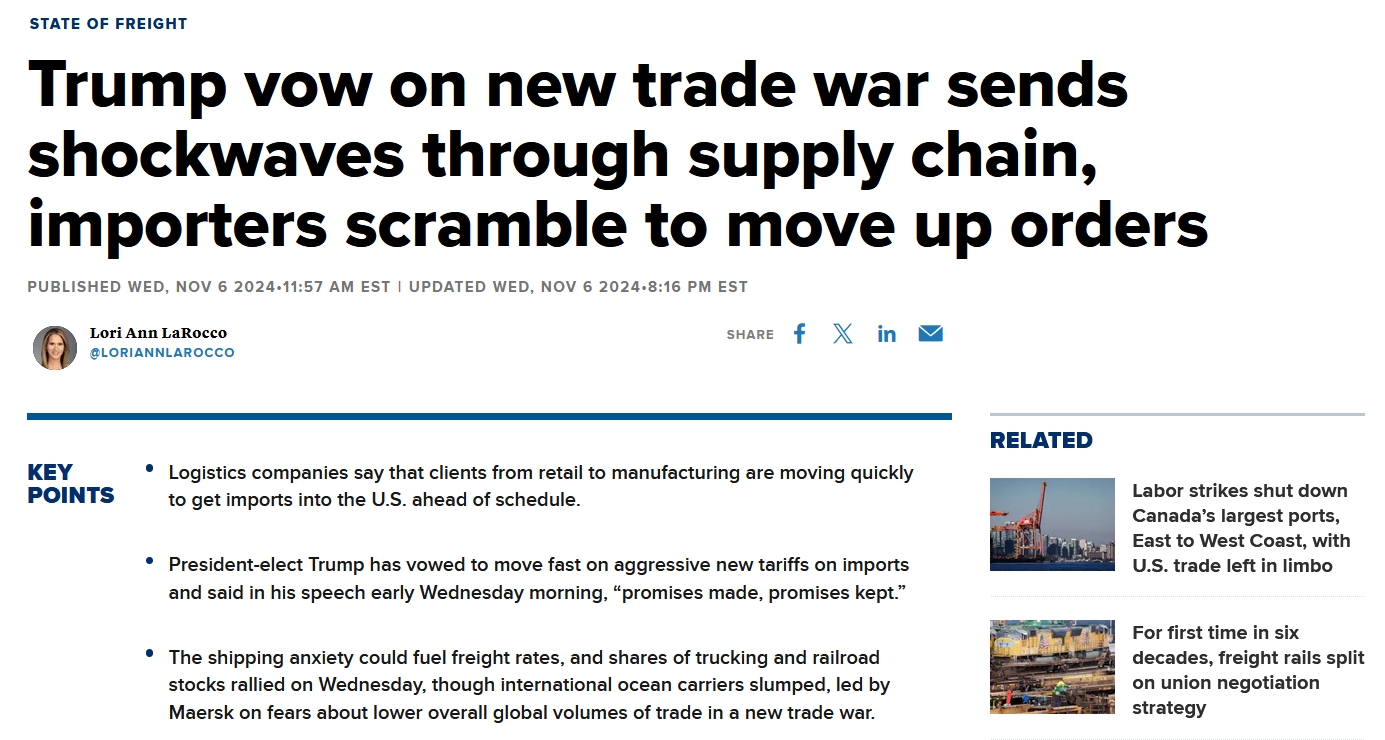
US Election Results Already Impact Supply Chains & Sourcing

new trade war sends shockwaves through supply chain

  Enough opinions are shared. Therefore, the following thoughts are not of a political nature. Let’s get down to business and see if this has already possible effects on today’s supply chains & sourcing activities. But also, let’s learn from the past and consider previous decisions made during the first term in office as they still impact us today. CNBC provided an excellent summary on November 6th: 📌Retailers & manufacturing companies have been increasingly calling logistics partners, both in the days leading up to the presidential election and on Election Night, about front-loading shipments ahead of any changes in tariff policy to be pursued by President-elect Trump, who campaigned on an aggressive expansion of existing U.S. tariffs on cross-border trade 📌There will be a surge in import demand for containerized goods as U.S. companies stock up ahead of new tariffs. Especially related to goods that are not time-sensitive and will create upward pressure on freight rates in the coming months 📌Front-loading of shipping contributed to the 70% inflation in freight rates, according to data from 2018. Potential tariffs provide cost risk on global supply chains 📌 Proposed tariffs would cause companies to delay further their investment in Mexico and uncertainty around USMCA renegotiation in 2026, potentially impacting trading My observation: Overall, we see great similarities to the past. Trump’s policies notably impacted global supply chains, reshaping trade flows, manufacturing trends, and sourcing strategies. Here are some key ways his policies influenced (and probably will in the future) supply chains: ⏩Trade Wars & Tariffs. Trump initiated a trade war with China, imposing tariffs on billions of dollars of Chinese goods -> Diversification of Sourcing to countries in Southeast Asia ⏩Renegotiation of Trade Deals. Trump renegotiated NAFTA into the US-Mexico-Canada Agreement (USMCA), impacting North American supply chains -> This influenced U.S. companies to source more materials domestically or from Canada and Mexico. ⏩Push for Domestic Manufacturing. Trump’s administration promoted an „America First“ approach-> Pressure on companies to invest in U.S. production facilities ⏩Impact on Technology and Semiconductor Supply Chains. Trump’s administration placed restrictions on Chinese tech giants like Huawei, impacting the semiconductor supply chain -> Push for Domestic Semiconductor Production ⏩Trump’s earlier policies set the stage for a trend toward „de-globalization,“ with companies increasingly evaluating supply chain resilience, diversity, and national security in their sourcing decisions. While Biden has taken a different approach, some of Trump’s policies, especially on China, remain influential, as supply chain resilience and domestic production remain priorities in U.S. policy. Summary: Uncertainty and political decisions will keep us Supply Chain people busy. Your thoughts?

Kostenanalyse im Einkauf: Ein unzureichend genutztes Werkzeug

Kostenanalyse im Einkauf

Vor einigen Wochen habe ich mich über Post meines geschätzten ehemaligen Kollegen Manuel Lutz gefreut. Manuel war einer der Key Player beim Aufbau einer weltweiten Kostenanalyse im Einkauf und hat dieses mit Bravour für die USA geführt und dazu nun promoviert. 2024 bedeutet für viele Einkaufsteams eine Rückbesinnung auf die alten Tugenden Kostensenkung, Verhandlung und rigides Ausgabenmanagement. Wo in den letzten Jahren Themen wie Nachhaltigkeit, Lieferkettengesetz, Verfügbarkeit, Digitaler Einkauf auf der Prioritätenliste standen, ist nun wieder Kostensenkung Hauptaufgabe. Man muss dieses kritisch sehen, schließlich geht es im Einkauf um einen ganzheitlichen Wertbeitrag und nicht nur um Kostensenkung. Aber Notwendigkeiten und Prioritäten ändern sich kontinuierlich. 🔥 2025 wird ein effektives Kosten- und Komplexitätsmanagement ganz oben auf der Unternehmens- und Einkaufsagenda stehen. Wetten? Eine Kostenanalyse im Einkauf kann dabei helfen. Ich durfte für globale Unternehmen Kostenanalysen im Einkauf aufbauen und führen. Zudem noch ein unternehmensweites Cost Engineering zu entwickeln und zu starten, in dem eine dreistellige Anzahl an Mitarbeitenden aus unterschiedlichen Bereichen gebündelt wurden. Unterstützt durch digitale Lösungen zur optimierten Analyse und Kalkulation von Kostenstrukturen. Somit war ich auf das kürzlich veröffentlichte Werk umso gespannter. 🚀Der Autor: Es entwickelt ein Modell zur organisatorischen Gestaltung der Kostenanalyse in produzierenden Unternehmen. Durch eine empirische Untersuchung, die auf quantitativen und qualitativen Daten basiert, werden für typenspezifische Unternehmen spezifische organisatorische Gestaltungen der Kostenanalyse aufgezeigt. ⏩Mein Urteil als Praktiker: 📌Dem Buch ist anzumerken, dass es von einem Macher geschrieben wurde. Ein must-read Umsetzungsleitfaden für Fach- und Führungskräfte in den Bereichen Einkauf, Produktentwicklung/Engineering, Finanzen und für alle, die die Wettbewerbsfähigkeit ihrer Unternehmen durch ein Kosten- und Komplexitätsmanagement ausbauen wollen. 📌Eine praktische Hilfestellung für alle, die sich inhaltlich tief und dennoch pragmatisch mit dem Thema befassen wollen, aber kein Buch für Menschen, die eine Grundlagenausbildung in Kostenanalyse suchen. 📌Die Wechselbeziehung von Kosten und Komplexität wird hier immer wieder sorgfältig herausgearbeitet und mit entsprechenden Lösungsmodellen versehen 📌Es werden für alle Ansätze/Hypothesen konkrete und greifbare Beispiele genannt. So verbindet es gekonnt Wissenschaft und Praxis gestützt durch Fallstudien. Insbesondere, wenn es um den Aufbau und die organisatorische und prozessuale Integration geht. 📌Es gibt präzise Handlungsempfehlungen für eine Umsetzung auf strategischer wie taktischer Ebene, die sich auch mit meinen Erfahrungen aus zahlreichen Transformations- und Aufbauprojekten decken Fragen zum Aufbau? Sprechen Sie mich an!

en_USEnglish
About the company:
Joint Venture Truck OEMs
(Germany & Sweden)
Development Hydrogen fuel cell systems
approx. 500Employees, strong growth
GlobalTechnologyInnovator

Case Study

Industry: Automotive

Area: Organisation

Land: Deutschland & USA

Duration: 12 Months

Starting Point / Assignment

  • approx. EUR 400 million Procurement spend p.a. (rapidly increasing)
  • Independent joint venture between two large truck manufacturers
  • Start of series production in 2027 and development of the North American market with local production requires far-reaching development and expansion of Procurement, particularly regarding a global organization (skills, capacities, x-functional collaboration) and digitalization

Objectives

  • Creating transparency about the maturity level of the Procurement function
  • Prioritized action plan to gradually increase the maturity level regarding competencies, x-functional cooperation, productivity/efficiency, digitalization, etc.
  • Development of target organization model (2023, 2027, 2030) for production and non-production materials Procurement incl. all role descriptions and necessary capacity (FTE sizing)
  • Detailed transformation plan for the global Procurement organization aligned with the milestones "Start of series production" and "Market entry & local production North America“
  • Review of Procurement’s digital strategy and projects including future recommendations

Approach

  • Comprehensive maturity analysis of Procurement (targetP! method) with a focus on organization and digitalization based on personal interviews (all Procurement staff and top stakeholders) as well as in-depth document and data analysis (strategies, guidelines, process descriptions, digitalization initiatives, standards for category & supplier management, order & invoice volumes, etc.).
  • S/T/O analysis to determine the actual capacity utilization of all Procurement employees as part of individual interviews
  • Workshops/interviews with IT & Procurement on the Procurement system landscape and digital strategy

Results / „Deliverables“

  • Detailed maturity assessment report on Procurement (production and non-production materials) including prioritized actions and quick wins
  • Procurement digital strategy benchmark against best practices with specific recommendations for actions, risk analysis, and quick wins
  • Transparency regarding the actual use of capacity in Procurement, gap analysis of the respective profiles and stakeholder expectations
  • Role-based target Procurement organization with a step-by-step development plan (staffing, development, reallocation)
  • Tailor-made role descriptions for use in subsequent recruiting measures
About the company:
Joint Venture Truck OEMs
(Germany & Sweden)
Development Hydrogen fuel cell systems
approx. 500Employees, strong growth
GlobalTechnologyInnovator

Case Study

Industry: Automotive

Area: Organisation

Land: Deutschland & USA

Duration: 12 Months

Starting Point / Assignment

  • approx. EUR 400 million Procurement spend p.a. (rapidly increasing)
  • Independent joint venture between two large truck manufacturers
  • Start of series production in 2027 and development of the North American market with local production requires far-reaching development and expansion of Procurement, particularly regarding a global organization (skills, capacities, x-functional collaboration) and digitalization

Objectives

  • Creating transparency about the maturity level of the Procurement function
  • Prioritized action plan to gradually increase the maturity level regarding competencies, x-functional cooperation, productivity/efficiency, digitalization, etc.
  • Development of target organization model (2023, 2027, 2030) for production and non-production materials Procurement incl. all role descriptions and necessary capacity (FTE sizing)
  • Detailed transformation plan for the global Procurement organization aligned with the milestones "Start of series production" and "Market entry & local production North America“
  • Review of Procurement’s digital strategy and projects including future recommendations

Approach

  • Comprehensive maturity analysis of Procurement (targetP! method) with a focus on organization and digitalization based on personal interviews (all Procurement staff and top stakeholders) as well as in-depth document and data analysis (strategies, guidelines, process descriptions, digitalization initiatives, standards for category & supplier management, order & invoice volumes, etc.).
  • S/T/O analysis to determine the actual capacity utilization of all Procurement employees as part of individual interviews
  • Workshops/interviews with IT & Procurement on the Procurement system landscape and digital strategy

Results / „Deliverables“

  • Detailed maturity assessment report on Procurement (production and non-production materials) including prioritized actions and quick wins
  • Procurement digital strategy benchmark against best practices with specific recommendations for actions, risk analysis, and quick wins
  • Transparency regarding the actual use of capacity in Procurement, gap analysis of the respective profiles and stakeholder expectations
  • Role-based target Procurement organization with a step-by-step development plan (staffing, development, reallocation)
  • Tailor-made role descriptions for use in subsequent recruiting measures
About the company:
Family Owned Business with international Footprint
approx. 500 Mio.Turnover
approx. 3.000 Employees
Technology & Market Leaderin Harvesting Equipment

Case Study

Industry: Agricultural Machines

Area: Transformation

Country: Germany

Duration: ~ 18 Months

Starting Point / Assignment

  • approx. 200 million Procurement volume
  • Sole focus on operational processes (clerical function)
  • Strong focus on German plants, not prepared for internationalization and cooperation, despite of having operating units in the USA and China
  • Strong growth in turnover and increased internationalization
  • Procurement’s priority: Supply security (“keep the plants running”)
  • Digitalization not actively driven

Objectives

  • Create an understanding of Procurement’s maturity level
  • Identify potential (e.g., value contribution, efficiency, compliance), through more professional category & supplier management and digital support
  • Elaborate on alternative measures to develop Procurement and create an action plan, particularly concerning process improvements
  • If necessary, determine and argue capacity requirements
  • Optimize structures to prepare for growth and improved resource utilization

Approach

  • Comprehensive maturity analysis of Procurement (targetP! method) with a focus on organization and operational improvements (personal interviews with Procurement staff and top stakeholders) as well as in-depth document and data analysis (strategies, guidelines, process descriptions, digitalization initiatives, etc.)
  • Development of a holistic transformation plan and target organization model including roles and responsibilities, stakeholder integration, etc.
  • Early involvement of employees "future conferences to build my organization“
  • Joint creation of a practicable category structure, a Procurement Vision & Strategy


Results / „Deliverables“

  • First-time definition of a Procurement strategy with aligned objectives
  • Capacity optimization through targeted personnel expansion
  • Optimized organizational model and a more rigid category structure established
  • First system reviews with digital solution providers based on a digital action plan and precise requirements
  • Design of a customized multi-year training program for all roles
  • Implementation of Category Management training with pilots
  • Development and implementation of Procurement processes
About the company:
Family Owned Business with international Footprint
approx. 500 Mio.Turnover
approx. 3.000 Employees
Technology & Market Leaderin Harvesting Equipment

Case Study

Industry: Agricultural Machines

Area: Transformation

Country: Germany

Duration: ~ 18 Months

Starting Point / Assignment

  • approx. 200 million Procurement volume
  • Sole focus on operational processes (clerical function)
  • Strong focus on German plants, not prepared for internationalization and cooperation, despite of having operating units in the USA and China
  • Strong growth in turnover and increased internationalization
  • Procurement’s priority: Supply security (“keep the plants running”)
  • Digitalization not actively driven

Objectives

  • Create an understanding of Procurement’s maturity level
  • Identify potential (e.g., value contribution, efficiency, compliance), through more professional category & supplier management and digital support
  • Elaborate on alternative measures to develop Procurement and create an action plan, particularly concerning process improvements
  • If necessary, determine and argue capacity requirements
  • Optimize structures to prepare for growth and improved resource utilization

Approach

  • Comprehensive maturity analysis of Procurement (targetP! method) with a focus on organization and operational improvements (personal interviews with Procurement staff and top stakeholders) as well as in-depth document and data analysis (strategies, guidelines, process descriptions, digitalization initiatives, etc.)
  • Development of a holistic transformation plan and target organization model including roles and responsibilities, stakeholder integration, etc.
  • Early involvement of employees "future conferences to build my organization“
  • Joint creation of a practicable category structure, a Procurement Vision & Strategy


Results / „Deliverables“

  • First-time definition of a Procurement strategy with aligned objectives
  • Capacity optimization through targeted personnel expansion
  • Optimized organizational model and a more rigid category structure established
  • First system reviews with digital solution providers based on a digital action plan and precise requirements
  • Design of a customized multi-year training program for all roles
  • Implementation of Category Management training with pilots
  • Development and implementation of Procurement processes
About the company:
Leading Healthcare Provider
High reputation (Top rated Medical Care)
Site: approx. 825 Mio. Turnover
approx. 1.700employees
> 80.000 Patienten/Jahr

Case Study

Industry: Health Care/Clinic

Bereich: Interim & Entwicklung

Country: Germany

Duration: 6 Months

Starting Point / Assignment

  • approx. EUR 60 million spend p.a., complex spend structure
  • Procurement with a strong focus on processing and operational processes, no systematic spending management
  • Significant operational problems in day-to-day business led to high costs
  • Very insecure, demotivated team due to degrading treatment and extreme micromanagement by the previous Procurement Manager
  • Non-existent digitalization of core processes and tasks
  • Extensive, sometimes paralyzing bureaucracy in general and when approving requirements such as Requisitions, Purchase Orders and Contracts
  • Lack of discipline and ethics among sales reps (back-door selling, etc.)
  • Low reputation within the hospital, especially among chief physicians

Objectives

  • Main objective: Stabilization and reactivation of a highly frustrated team
  • Stabilization of day-to-day business, also due to above-average absences
  • Better distribution of the workload among the team members
  • Creating an understanding of the actual maturity level of Procurement, identifying potential (e.g., value contribution, efficiency, compliance)
  • Elaborating alternative measures to develop Procurement, and create an action plan, particularly concerning process simplifications (approvals of Requisitions, Purchase Orders, Contracts)
  • Improving customer service quality and interaction with internal customers

Approach

  • Comprehensive maturity analysis of Procurement involving stakeholders
  • Creation and coordination of a holistic development plan
  • Open door policy and individual meetings several times a week
  • Regular visits to the hospital wards to understand the needs and build trust
  • Frequent exchange with internal customers (regular personal exchange, participatory approach: Involvement of all employees, e.g. we
  • Weekly team meetings to discuss issues, improvement ideas, and solutions to ensure full commitment and involvement in improvement projects
  • Strong involvement in day-to-day business (negotiations, sourcing)
  • Process analyses, in particular, SAP optimization options & approvals

Results / „Deliverables“

  • Team stabilized, motivation increased, absences and absenteeism reduced (CEO quote: "You calmed people down very quickly with professional empathy and got them behind you")
  • First-time definition of a Procurement strategy with agreed upon targets
  • Regular coordination with internal customers (Chief physician quote: "we talk to each other now, things run faster, we finally feel well looked after")
  • Approval and implementation of moderate staff expansion with restructuring of work areas and balancing of workload
  • Redesign of framework agreements with improved commercial conditions
  • Complete processing of unfinished order processes (backlog)
  • Simplification and definition of core Procurement processes;
  • Addition of new SAP functionalities to drive automation & workload reduction
About the company:
Leading Healthcare Provider
High reputation (Top rated Medical Care)
Site: approx. 825 Mio. Turnover
approx. 1.700employees
> 80.000 Patienten/Jahr

Case Study

Industry: Health Care/Clinic

Bereich: Interim & Entwicklung

Country: Germany

Duration: 6 Months

Starting Point / Assignment

  • approx. EUR 60 million spend p.a., complex spend structure
  • Procurement with a strong focus on processing and operational processes, no systematic spending management
  • Significant operational problems in day-to-day business led to high costs
  • Very insecure, demotivated team due to degrading treatment and extreme micromanagement by the previous Procurement Manager
  • Non-existent digitalization of core processes and tasks
  • Extensive, sometimes paralyzing bureaucracy in general and when approving requirements such as Requisitions, Purchase Orders and Contracts
  • Lack of discipline and ethics among sales reps (back-door selling, etc.)
  • Low reputation within the hospital, especially among chief physicians

Objectives

  • Main objective: Stabilization and reactivation of a highly frustrated team
  • Stabilization of day-to-day business, also due to above-average absences
  • Better distribution of the workload among the team members
  • Creating an understanding of the actual maturity level of Procurement, identifying potential (e.g., value contribution, efficiency, compliance)
  • Elaborating alternative measures to develop Procurement, and create an action plan, particularly concerning process simplifications (approvals of Requisitions, Purchase Orders, Contracts)
  • Improving customer service quality and interaction with internal customers

Approach

  • Comprehensive maturity analysis of Procurement involving stakeholders
  • Creation and coordination of a holistic development plan
  • Open door policy and individual meetings several times a week
  • Regular visits to the hospital wards to understand the needs and build trust
  • Frequent exchange with internal customers (regular personal exchange, participatory approach: Involvement of all employees, e.g. we
  • Weekly team meetings to discuss issues, improvement ideas, and solutions to ensure full commitment and involvement in improvement projects
  • Strong involvement in day-to-day business (negotiations, sourcing)
  • Process analyses, in particular, SAP optimization options & approvals

Results / „Deliverables“

  • Team stabilized, motivation increased, absences and absenteeism reduced (CEO quote: "You calmed people down very quickly with professional empathy and got them behind you")
  • First-time definition of a Procurement strategy with agreed upon targets
  • Regular coordination with internal customers (Chief physician quote: "we talk to each other now, things run faster, we finally feel well looked after")
  • Approval and implementation of moderate staff expansion with restructuring of work areas and balancing of workload
  • Redesign of framework agreements with improved commercial conditions
  • Complete processing of unfinished order processes (backlog)
  • Simplification and definition of core Procurement processes;
  • Addition of new SAP functionalities to drive automation & workload reduction
About the company:
Highly renowned Qatari company
approx. 825 mn.Turnover
approx. 3.500 Employees
Regional Market Leader
Shipping, Maritime Logistik & Services

Case Study

Industrie: Reederei & Maritim

Bereich: Organisation & Interim

Country: Qatar

Duration: ~ 12 Months

Starting Point / Assignment

  • approx. EUR 300 million Procurement spend p.a.
  • Procurement with a strong focus on processing and operational processes, no systematic spending management
  • Significant operational problems in day-to-day business led to high costs for troubleshooting, escalations, and internal conflicts with stakeholders
  • Low acceptance and appreciation of Procurement and high political pressure despite excellent company results
  • Long-term vacancy in Procurement leadership impacts performance, customer satisfaction, and insecurity and leading to high fluctuation on buyer level
  • Digitalization of core processes and tasks only marginally developed

Objectives

  • Create an understanding of the true maturity level of Procurement and gain buy-in from the Executive Board
  • Identify potential (e.g., value contribution, efficiency, compliance), through more professional category & supplier management and automation
  • Elaborate on alternative measures to develop Procurement and create an action plan, particularly concerning process simplifications
  • Improve strategic and operational reporting for the CFO
  • Implement organizational and structural optimization to improve service quality
  • After two months: additional Role as VP Ad Interim due to the dismissal of the Head of Procurement

Approach

  • Comprehensive maturity analysis of Procurement involving stakeholders
  • Creation and coordination of a holistic transformation plan with staff adjustments, digitalization, and skills requirements
  • Development of a target organization model (category management) with role descriptions, responsibilities and recruiting support
  • Highly participative approach with intensive involvement of all employees, e.g., as part of "future conferences" (for the first time in the company) and expert teams with topic champions
  • Further development of Procurement and sourcing governance, e.g., tailored Category Structure, Procurement Vision & Procurement strategy and policies

Results / „Deliverables“

  • First-time definition of a Procurement strategy with aligned objectives
  • Approval and implementation of moderate staff expansion and allocation and expansion of required skills through comprehensive training plans
  • Start of digitalization projects based on a digital action plan (Supplier Portal)
  • Implementation of a Category Management approach and process and execution of 10 category pilots to identify additional value contribution
  • Development and implementation of comprehensive Supplier Management involving a newly designed supplier qualification process (Supplier Portal)
  • Implementation of a Procurement guideline & process manual and creation of comprehensive Procurement reporting with PowerBI
  • 10-month Interim Management and stabilization of the organization
About the company:
Highly renowned Qatari company
approx. 825 mn.Turnover
approx. 3.500 Employees
Regional Market Leader
Shipping, Maritime Logistik & Services

Case Study

Industrie: Reederei & Maritim

Bereich: Organisation & Interim

Country: Qatar

Duration: ~ 12 Months

Starting Point / Assignment

  • approx. EUR 300 million Procurement spend p.a.
  • Procurement with a strong focus on processing and operational processes, no systematic spending management
  • Significant operational problems in day-to-day business led to high costs for troubleshooting, escalations, and internal conflicts with stakeholders
  • Low acceptance and appreciation of Procurement and high political pressure despite excellent company results
  • Long-term vacancy in Procurement leadership impacts performance, customer satisfaction, and insecurity and leading to high fluctuation on buyer level
  • Digitalization of core processes and tasks only marginally developed

Objectives

  • Create an understanding of the true maturity level of Procurement and gain buy-in from the Executive Board
  • Identify potential (e.g., value contribution, efficiency, compliance), through more professional category & supplier management and automation
  • Elaborate on alternative measures to develop Procurement and create an action plan, particularly concerning process simplifications
  • Improve strategic and operational reporting for the CFO
  • Implement organizational and structural optimization to improve service quality
  • After two months: additional Role as VP Ad Interim due to the dismissal of the Head of Procurement

Approach

  • Comprehensive maturity analysis of Procurement involving stakeholders
  • Creation and coordination of a holistic transformation plan with staff adjustments, digitalization, and skills requirements
  • Development of a target organization model (category management) with role descriptions, responsibilities and recruiting support
  • Highly participative approach with intensive involvement of all employees, e.g., as part of "future conferences" (for the first time in the company) and expert teams with topic champions
  • Further development of Procurement and sourcing governance, e.g., tailored Category Structure, Procurement Vision & Procurement strategy and policies

Results / „Deliverables“

  • First-time definition of a Procurement strategy with aligned objectives
  • Approval and implementation of moderate staff expansion and allocation and expansion of required skills through comprehensive training plans
  • Start of digitalization projects based on a digital action plan (Supplier Portal)
  • Implementation of a Category Management approach and process and execution of 10 category pilots to identify additional value contribution
  • Development and implementation of comprehensive Supplier Management involving a newly designed supplier qualification process (Supplier Portal)
  • Implementation of a Procurement guideline & process manual and creation of comprehensive Procurement reporting with PowerBI
  • 10-month Interim Management and stabilization of the organization