(Supply Chain) Risiken in Auslandsgeschäften minimieren

Auslandsgeschäfte verlangen ein Risikomanagement. In 2024 mehr denn je! Corona-Pandemie, Ukrainekrieg, Red Sea Shipping Crisis, Energiekrise, Folgen des Klimawandels: Die vergangenen Jahre haben gezeigt, wie schnell sich die Risikolandschaft entwickeln kann. Die meisten Unternehmen wurden von Bedrohungen dieser Größenordnung und ihren Kettenreaktionen, zum Beispiel in den globalen Lieferketten, unvorbereitet getroffen. Ein Grund: Nur wenige verfügen über ein Frühwarnsystem, um auf kritische Situationen sofort reagieren zu können. Zeitgleich werden die Risikolandkarten und globale Interaktionen immer komplexer und schwerer vorhersehbar. Ich hatte in 2023 die Freude meine Gedanken zu einem effektiven Risikomanagement in der Lieferkette mit den Auslandsexperten der Volksbank Raiffeisenbank zu teilen. Der Artikel hat an Aktualität nicht verloren. U.a sprachen wir über: ✅Risikobewusstsein ✅Frühwarnsysteme (z.B. Digitale Plattformen) ✅Monitoring von Märkten und Rohstoffquellen ✅Task-Forces sind kein Risikomanagement ✅Vom reaktiven zum proaktiven Risikomanagement Nachzulesen in der VR International Nummer 5, der digitalen Informations- und Kommunikationsplattform der Volksbank Raiffeisenbank eG für internationalen Geschäfte. Download des vollständigen Artikels und weiterer erstklassiger Infos für Ihr Auslandsgeschäft (Usbekistan Ländersteckbrief, Zentralasien im Aufbruch und Weltweite Chancen für Energy Solutions) über die Seiten der Volkbanken Raiffeisenbanken. Sprechen Sie mich an und erfahren Sie von unseren Projekten, mehrfach prämiert, im Forbes Magazin gewürdigt und auf Konzern wie Mittelstand ausgelegt. Besonderen Dank an Volker Haßmann für das Interview und den Beitrag.

Digitaler Einkauf im Mittelstand – so geht es!

Digitaler Einkauf – Effektive Werthebel für den erfolgreichen Einkauf Ein digitaler Einkauf liefert Mehrwert mit weiteren effektiven Werthebeln, sichert Lieferketten, bindet Talente und steigert Effektivität. Insbesondere in Zeiten von Versorgungsunsicherheiten, Risiken, Cash Flow und Kostenstrukturoptimierungen. Das ist Fakt und daher sehen wir aktuelle die aus diversen Quellen bestätigte Zurückhaltung bei der Umsetzung digitaler Projekte kritisch. Seien Sie anders und lassen Sie sich von uns motivieren! Maßgeschneidert, mittelstandsgerecht und mit bewährten Lösungen bauen wir Ihren Einkauf der Zukunft. Von Praktikern für Praktiker: Schritt für Schritt führen wir Sie von einer soliden Strategie in die Umsetzung und helfen Ihnen Ihr digitales Ökosystem aufzubauen, egal ob best of breed oder andere Architekturen. Zeigen budgetfreundliche und zügig umsetzbare Optionen auf. Inklusive Umsetzungsplan und Technologie-Roadmap. Und unterstützen Sie bei der Implementierung – bis es läuft! Hands-On & 100% individuell. Lesen Sie auch unseren Leitfaden auf Basis zahlreicher Umsetzungsprojekte ✨Digitaler Einkauf im Mittelstand – Ein Leitfaden für digitale Einkaufsprofis und jene, die es werden wollen. Praxisnah mit sofort umsetzbaren Impulsen. ISBN: 978-3-347-37984-8 ✅ WIR SAGEN IHNEN WARUM es keine Ausreden mehr gibt und wie Sie auch Ihr Management überzeugen ✅ WIR ZEIGEN AUF, welche innovativen, bewährten Werkzeuge & Technologien Ihnen helfen ✅ WIR VERRATEN TIPPS & TRICKS, sagen wie Sie typische Stolperfallen vermeiden und Stakeholder erfolgreich einbinden ⏩ Praxisorientiert und mit kritischer Distanz, unterstützt durch zahlreiche Beispiele ⏩ Klar, pointiert und meinungsstark ⏩ Grafiken mit QR Code und für Sie digital abrufbar

Interim Management in Procurement

🔊Interim Management – Driving Procurement forward From October 2021 until October 2022, I had the pleasure of supporting a large corporation in Qatar as a Consultant and Interim Procurement Head to transform and restructure their Procurement organization. It started as a consulting project to identify improvement opportunities and initiate but the scope quickly expanded to a comprehensive Interim Management mandate. What was done: ✅Full-scale maturity and potential analysis from a practitioner’s perspective ✅Establish a comprehensive transformation plan to improve customer service, value contribution, and organizational effectiveness ✅Lead Procurement Team with day-to-day business ✅Search/selection of the new CPO and other key functions ✅Execute the transformation plan (organizational structure, processes, training, category management pilots, supplier relationship management program, and overall communication and change management activities) ✅Comprehensive digitalization roadmap to increase efficiency and supplier interaction (portal, catalogs, automation) ✍I love the mix. Interim Management mandates are excellent additions to my consulting projects. They allow me to continue working directly with people on projects, to coach, lead, and shape future organizations, and to stay close to day-to-day operations. Interim Management is part of my portfolio, which goes far beyond InterimManagement ✅Transformation & Development and Restructuring of Procurement ✅Digital Procurement (Strategy, Architecture, Implementation) ✅Supplier and Supply Chain Risk Management erm and SCRM) ✅Regulatory Compliance (e.g. lksg csddd) ✅Sustainability (CBAM, scope3, etc.) This combination of implementation-oriented consulting projects and Interim Management assignments guarantees eye-level communication while simultaneously „staying on top“ of all the exciting developments and technologies in Procurement. I can’t imagine just doing one (consulting) or the other (interim). Thanks to the German Best In Procurement Magazine and Tobias Anslinger for this excellent article about Interim Managers (Katrin R. Feldner) in Procurement.

Improve Performance & Risk Exposure with Supplier Quality Management

What is Supplier Quality Management? Supplier quality management (SQM) stands as the cornerstone of operational excellence for businesses across industries. It encompasses the processes and systems necessary to ensure that the products and services delivered by suppliers meet the required standards and specifications. ✅ The significance of SQM cannot be overstated, as it directly impacts product quality, customer satisfaction, and the overall reputation of a company. First and foremost, effective SQM ⏩ mitigates the risks associated with poor-quality materials or components entering the production process. By implementing stringent quality control measures, businesses can proactively identify and address issues before they escalate, thereby safeguarding their brand image and customer trust. ⏩Moreover, SQM fosters long-term partnerships with suppliers based on mutual trust and collaboration. By setting clear quality expectations and providing feedback on performance, companies can work hand in hand with suppliers to continuously improve processes and drive innovation. This collaborative approach not only enhances product quality but also promotes efficiency and cost-effectiveness throughout the supply chain. 👉Several tools and methodologies are instrumental in achieving effective SQM: ✅Supplier audits enable companies to evaluate supplier capabilities, assess compliance with quality standards, and identify areas for improvement. ✅Quality scorecards provide a structured framework for tracking supplier performance over time, allowing for data-driven decision-making and performance benchmarking. ✅A robust supplier qualification process ensures that only reputable and reliable suppliers are onboarded, reducing the likelihood of quality issues down the line. ✅Advanced technologies such as AI and data analytics can be leveraged to analyze vast amounts of supplier data in real-time, enabling proactive identification of quality trends and predictive maintenance of supplier relationships. 👉In conclusion, supplier quality management is not merely a reactive measure to address quality issues; it is a proactive strategy that drives continuous improvement, fosters collaboration, and enhances competitiveness in today’s dynamic business landscape. 👉By prioritizing SQM, businesses can optimize their supply chain operations, deliver superior products and services, and ultimately, achieve sustained success in the marketplace. targetP brings vast experience in establishing and stabilizing supplier relationships and robust supply chains. Talk to practitioners with 80+ years of Supplier Management expertise.

Talente in den Einkauf – sind wir nicht sexy genug?

🚀 Personalprobleme oder wie kann 𝗱𝗲𝗿 𝗘𝗶𝗻𝗸𝗮𝘂𝗳 𝘄𝗲𝘁𝘁𝗯𝗲𝘄𝗲𝗿𝗯𝘀𝗳ä𝗵𝗶𝗴 im umkämpften Markt für Fachkräfe 𝗯𝗹𝗲𝗶𝗯𝗲𝗻 ? In den letzten Monaten wurden wir so umfassend wie nie von Kunden und Menschen aus unserem Netzwerk auf Unterstützung bei der Gewinnung von Talenten für spannende Aufgaben im Einkauf angesprochen. Egal, ob Warengruppenmanager, Teamleiter, Risikoexperten oder Einkaufsexzellenz. Trotz (oder gerade weil?) schwächelnder Wirtschaft sind diese -auch nachdem zahlreiche Unternehmen einen Stellenabbau verkündet haben- schwierig bis gar nicht zu finden. Dabei ist #talentmanagement eine zentrale Aufgabe der Einkaufsleitung / #CPO und der HR Business Partner. Einkauf war, ist und bleibt people business. Im Zeitalter der Digitaliserung mehr denn je. 📈 Erfolgreiche, wertstiftende Einkaufsteams zeichnen sich bereits heute und zukünftig durch eine enge Verzahnung von Mensch und Maschine aus. Die lückenlose Integration von Analytik und digitaler Entscheidungsunterstützung sowie Empathie, Netzwerkmanagement und Vertrauensbildung aus. ⏩Bei unseren Risikomanagement Projekten stellen wir oftmals eines fest: Die EXTERNEN Risiken werden umfassend, auch digital, teils 24/7 beobachtet und professionell bearbeitet. Die INTERNEN Risiken (wenig agile Strukturen, lange Entscheidungswege, Krisenteams ohne Kompetenzen) jedoch werden zu oft ignoriert. Faktor Mensch für ein erfolgreiches Krisenmanagement bleibt oft unbeachtet. ⏩ Bei Organisationsprojekten werden oftmals „erfahrene“ Mitarbeitende eingebunden, weniger aufstrebende Nachwuchskräfte mit anderen Perspektiven. ⏩ Gleichzeitig wird das Thema Digitalisierung im Mittelstand (erleben wir auch gerade in 2024) wieder kritisch hinterfragt und gerne verschoben. Ist es wirklich sexy einem Bewerber -wie mir in 2001 passiert- zu erzählen, dass er Lineal, Listen und Telefon braucht um seinen Job zu machen. Und keinen Computer. Hört sich lustig an? Nö, ist leider oftmals immer noch Realität. Einen digital Native ohne Beschaffungsplattform, Analytiklösungen, Lieferkettenmonitoring für den Einkauf zu begeistern..nun ja. Dabei ist Fachkräftemangel & #talentattraction bzw. #talentretention eines der größten Risiken der kommenden Jahre. Der Einkauf war noch nie sonderlich hipp bei Nachwuchskräften. Dabei, das wissen wir doch alle, ist der Einkauf spannender als je zuvor. Nirgendwo ist die Vielfalt der Aufgaben so gross (Analoge wie digitale Netzwerke aufbauen, steuern und entwickeln, globales arbeiten, Kulturen/Länder kennenlernen, Beziehungen und Vertrauen aufbauen, disruptive digitale Projekte/Technologien, Stakeholder managen, Strategien erarbeiten, Verhandeln und Erfolge erzielen und und….) 💡 In 2023 hatte ich hierzu in im Podcast #ProcurementUnplugged mit Fabian Heinrich, CEO von Mercanis über die Emanzipierung des Einkaufs gesprochen. Und über Beispiele wie der Einkauf sich für Talente attraktiv machen kann. Offensichtlich ist das Thema seitdem dringlicher denn je.

Krisensichere Jobs im Einkauf, trotzdem Personalmangel

🚀 Personalprobleme? Jobsuche? Der Einkauf bietet zukunftsfähige, sichere und SPANNENDE Jobs. Eine Chance für beide Seiten. 🚀 „In diesen Jobs sind Sie in der Krise sicher“ Vor einigen Wochen sprach ich über Personalprobleme, Talentmanagement und die typischen Fehler bei der Personalgewinnung im Einkauf. Aber auch davon, wie spannend und vielfältig ein Job im Einkauf ist. Selten hat ein Posting in den letzten Monaten für soviel Feedback per PN gesorgt. Danke dafür. Parallel fiel mir kurz nach der Veröffentlichung ein Artikel aus dem Handelsblatt, März 2024 in die Hände. Titel siehe oben. Zehntausende Jobs vor dem Abbau, aber u.a. 3 Berufsgruppen sind ausgenommen. Ich kann dem Handelsblatt zur zustimmen Also, lasst uns was daraus machen. Talentmanagement eine zentrale Aufgabe der Einkaufsleitung / CPO und der HR Business Partner. Einkauf war, ist und bleibt people business. Im Zeitalter der Digitaliserung sind gut ausgebildete Mitarbeitende wichtiger denn je. 📈 Erfolgreiche, wertstiftende Einkaufsteams zeichnen sich bereits heute und zukünftig durch eine enge Verzahnung von Mensch und Maschine aus. Die lückenlose Integration von Analytik und digitaler Entscheidungsunterstützung sowie Empathie, Netzwerkmanagement und Vertrauensbildung aus. Daher, liebe Führungskräfte, traut Euch was. Digitale Projekte abermals zu verschieben hilft nicht bei der Begeisterung von Talenten. Digitalisierung des Einkaufs erhöht Effektivität und Effizienz, macht Spass, liefert Mehrwert und zieht Talente an. 📈 Nirgendwo ist die Vielfalt der Aufgaben so gross (Analoge wie digitale Netzwerke aufbauen, steuern und entwickeln, globales arbeiten, Kulturen/Länder kennenlernen, Beziehungen und Vertrauen aufbauen, disruptive digitale Projekte/Technologien, Stakeholder managen, Strategien erarbeiten, Verhandeln und Erfolge erzielen und und….). Daher, liebe Studierende und Jobsuchende, Einkauf ist mehr als nur Bestellungen schreiben und verhandeln, traut Euch was zu. Der Artikel bestätigt übrigens unsere Erfahrungen: In den letzten Monaten wurden wir so umfassend wie nie von Kunden und Menschen aus unserem Netzwerk auf Unterstützung bei der Gewinnung von Talenten für spannende Aufgaben im Einkauf angesprochen. Egal, ob Warengruppenmanager, Teamleiter, Risikoexperten oder Einkaufsexzellenz. 💡 Gerne stehen wir mit Rat und Tat zur Seite bzgl. Aufbau effektiver Einkaufsorganisationen, Digitalisierung des Einkaufs, AssessmentCenter und Auswahlverfahren, Personalentwicklungsprogramme und Einkaufsakademien. Unzählige Male in weltweit agierenden Konzern und im Mittelstand erfolgreich praktiziert.

Guided Buying, eigentlich eine tolle Sache, aber….

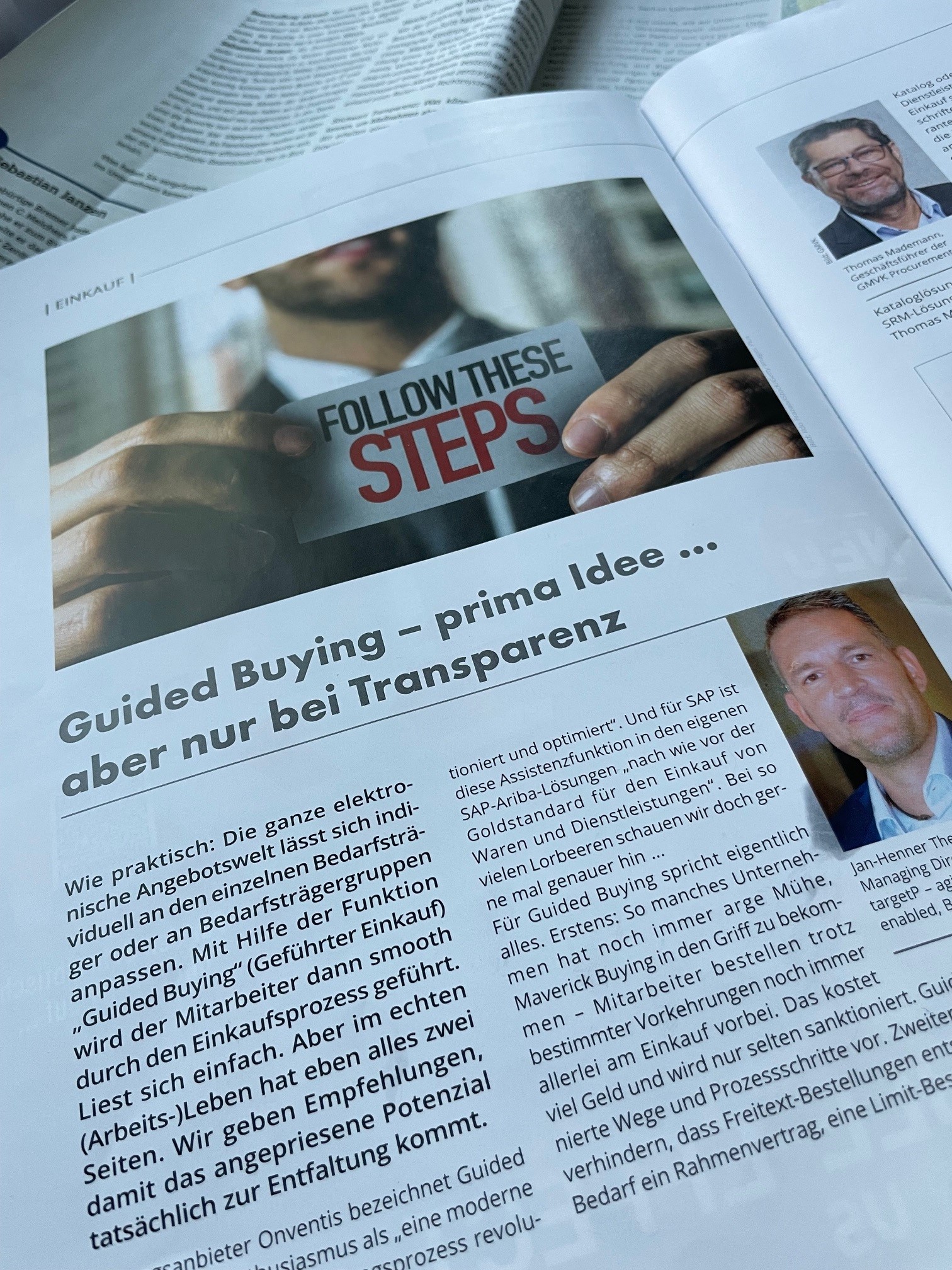
👉 Guided Buying – Prima Idee……..aber nur bei Transparenz… und dem richtigen Ansatz & Partner…und dem Verständnis was man erreichen will….und…und…. Danke an Sabine Ursel für einen spannenden Artikel und die richtigen Fragen zu einem sehr aktuellen Thema und die Möglichkeit ein paar Gedanken beitragen zu können. ⏩Die ganze elektronische Angebotswelt lässt sich individuell an den einzelnen Bedarfsträger oder an Bedarfsträgergruppen anpassen. Mit Hilfe der Funktion „Guided Buying“ (Geführter Einkauf) wird der Mitarbeiter dann smooth durch den Einkaufsprozess geführt. Liest sich einfach, oder? ⏩Im echten (Arbeits-)Leben hat – wie immer – alles zwei Seiten. Für das Magazin C.ebra (Wiesbaden) hat Sabine recherchiert und nach Empfehlungen gefragt. Schließlich soll das angepriesene Potenzial ja hinreichend zur Entfaltung kommen. ⏩ Meine Gedanken gibt es dann im Artikel. Link zum vollständigen Artikel in den Kommentaren. Lust es näher zu beleuchten, Vorteile und Grenzen zu verstehen und es umzusetzen? 👉Dann sprechen Sie mich gerne an. Bei weit über 30 digitalen Projekten trennen wir Hype und Blabla von Funktionierendem und setzen es um. Von Digitalstrategie (inkl. was heisst es für uns eigentlich, was wollen wir damit erreichen und was nicht), über Digitalarchitektur, Systemauswahl und die Implementierung bis es läuft. Quelle: Artikel von Sabine Ursel, in: C.ebra (1/2 2024, Seiten 6-8) Foto: Sabine Ursel

Transformation: Substanz versus Buzzword, eine kritische Betrachtung

👉Transformation im Einkauf – was ist das überhaupt? Der Begriff Transformation ist allgegenwärtig und eines DER Buzzwords seit geraumer Zeit. Jede Weiterentwicklung, jede Restrukturierung von Organisationen oder jede Einführung digitaler Lösungen wird heutzutage gerne als Transformation geadelt. Da werden auf dem Organigramm 3 Boxen verschoben – Transformation, eSourcing Plattformen, wie in 2005, eingeführt -Digitale Transformation. Klingt schick, ändert aber oftmals Arbeitsabläufe, Geschäftsmodelle und vor allem den Wertbeitrag zum Unternehmenserfolg nur bedingt. Fragen wir doch mal die künstliche Intelligenz, was sie zu „Transformation in Unternehmen“ sagt. 💡„In Bezug auf Unternehmen bedeutet Transformation die strategische Neuausrichtung und Anpassung an veränderte Marktbedingungen, Technologien oder Kundenbedürfnisse. Es beinhaltet oft die Umstrukturierung von Prozessen, Produkten oder Geschäftsmodellen, um wettbewerbsfähig zu bleiben und langfristigen Erfolg zu sichern. Es geht darum, agil zu sein und Innovationen voranzutreiben, um mit den sich ständig verändernden Anforderungen des Marktes Schritt zu halten. Passt durchaus und ist definitiv mehr als oft passiert, oder? Das Team von targetP hatte die Chance zahlreiche Einkaufsorganisationen ganzheitlich zu entwickeln (Spend zwischen 6 Mrd. und 250 Mio.). Waren alle diese intensiven und thematisch vielfältigen mehrmonatigen bzw. mehrjährigen Reisen Transformationen? Einige ja, Andere wahrscheinlich nicht. ⏩ Ein Ziel hatten alle Projekte gemeinsam: Den Einkauf den (neuen) Gegebenheiten anzupassen, Kompetenzen auszubauen und ein Bündel von Mehrwert für das jeweilige Unternehmen nachweisbar und messbar zu realisieren. Aber auch in Einzelfällen das bestehende Geschäftsmodell und die Daseinsberechtigung des Einkaufs zu hinterfragen. Dazu wurden zahlreiche Werthebel gezogen: Organisationsstrukturen angepasst, die Art und Kultur von Kollaboration anders gestaltet, grundlegende Arbeitsweisen, Prozesse und auch digitale Lösungen neu eingeführt oder optimiert, Menschen entwickelt und vieles mehr. 💡Dennoch sind wir zurückhaltend und haben für uns gewisse Standards, die ein erfolgreicher Einkauf als Bündel von Maßnahmen zu leisten wie zu liefern hat und die für uns elementare Bestandteile einer Transformation darstellen, definiert. Das dahinter oftmals ein vielschichtiger und mehrstufiger (Transformations-) Fahrplan steht, der Zeit, Energie, (kulturelle) Veränderungen und Ressourcen (Geld und Mensch) wie ein kritisches Hinterfragen der eigenen „Existenz“ als Bereich erfordert, versteht sich von selbst.

📌RISK ALERT: Vietnam’s political turmoil may impact the economy and relationships with Western companies

Risk Managers pay attention In recent years, Vietnam has been the focus of many companies looking for alternatives to China. Vietnam was at the top of the list – also due to Vietnam’s clever behavior. As a sales market, but also as a production location with lower costs and less political influence. 👉However, a few things have significantly changed lately. Again without proper attention in the Western hemisphere. A recent publication of the Chatham House helps to understand the new developments. Highlights of the Chatham House Article, dated May 9th: ⏩“In just a few weeks, the Communist Party of Vietnam (CPV) has shredded its reputation for boring political stability ⏩The new-look Vietnamese leadership appears more focused on regime survival than further liberalization. The country now appears to be a much riskier bet. It seems the CPV leadership is willing to sacrifice some economic growth in the interests of tighter political control. ⏩…..the tendency towards repression and ever-greater control will be baked into the system. This will make it harder for democratic countries to work with Vietnam. The CPV leadership will find greater acceptance in Russia and China. ⏩Although this power struggle is not about foreign policy, it will result in a turn towards China and away from the West. ⏩What we are seeing is a takeover. The winners of this power struggle are the hardliners: the police generals and the dogmatic Leninists. A recent instruction (Directive 24) instructs officials and party members to limit contacts with foreign organizations. ⏩📌The CPV has successfully ‘played’ Western expectations on this score for some time. With the new leadership in place, the CPV’s affinity with its Chinese political counterparts will be harder to disguise. ⏩Fear of being ensnared in the anti-corruption campaign has caused officials to avoid taking decisions, delaying job-creating investments. 📌An economic slowdown may cause popular discontent and it is not clear how the CPV will manage mass disaffection.“ 👉 For the entire article see the link in the comment section In Summary 📌“Internationally, Vietnam will continue to trumpet what it calls ‘bamboo diplomacy’, bending with the wind while remaining firmly rooted. Behind the slogan, however, Vietnam is turning away from the West and towards like-minded authoritarian partners.“ The aim is NOT to denigrate Vietnam or business relations with Vietnam. On the contrary, however, increased attention is essential. Source Graphic & Text: Chatham House, May 9th, 2024

The Crucial Role of People Development in Procurement

For 10 years now, Silvia Hamann (Best Practice Institute GmbH) and I have been working together to continuously train and develop Procurement Teams. Together, we have conducted dozens of trainings worldwide for my teams and my clients, whether in Europe, the USA, South America, Qatar, or Asia. A few weeks ago, we met for a “strategy meeting” on the rooftops of Berlin. We talked about new ideas and further activities to increase Procurement performance and value contribution but also to retain and develop talent. It was a great pleasure to meet again. And to enjoy a few drinks and talk about the good old days (whenever they were) and why we believe people development is more important than ever. 👉 In the intricate world of Procurement, where decisions can have substantial impacts on an organization’s bottom line, the significance of people development is more than obvious. ⏩Procurement is about relationships, negotiation, and strategic decision-making. Therefore, investing in the development of procurement professionals is paramount for success. ⏩First and foremost, people development ensures a skilled workforce capable of navigating the complexities of procurement. And development programs help retain talent. ⏩Moreover, as technology continues to reshape the procurement landscape, upskilling becomes imperative. Professionals need to adapt to new digital tools and analytics to enhance efficiency and decision-making. Whether it’s mastering e-procurement platforms or leveraging data analytics for market insights, ongoing development ensures procurement stays ahead in an ever-evolving environment. ⏩People development also cultivates leadership and innovation within Procurement teams. By nurturing talent and providing growth opportunities, organizations empower individuals to take ownership and drive initiatives that drive value. ⏩Furthermore, investing in people development boosts employee morale and retention. Talents who feel valued and supported in their growth are more likely to stay loyal to their organization. This reduces turnover costs and ensures continuity in Procurement operations, preserving institutional knowledge and (market & category & supplier) expertise. 📌In conclusion, people development is not just a nice-to-have but a strategic imperative in Procurement. It builds the foundation for a skilled, adaptable, and innovative workforce capable of driving value and maintaining a competitive edge.

en_USEnglish
About the company:
Joint Venture Truck OEMs
(Germany & Sweden)
Development Hydrogen fuel cell systems
approx. 500Employees, strong growth
GlobalTechnologyInnovator

Case Study

Industry: Automotive

Area: Organisation

Land: Deutschland & USA

Duration: 12 Months

Starting Point / Assignment

  • approx. EUR 400 million Procurement spend p.a. (rapidly increasing)
  • Independent joint venture between two large truck manufacturers
  • Start of series production in 2027 and development of the North American market with local production requires far-reaching development and expansion of Procurement, particularly regarding a global organization (skills, capacities, x-functional collaboration) and digitalization

Objectives

  • Creating transparency about the maturity level of the Procurement function
  • Prioritized action plan to gradually increase the maturity level regarding competencies, x-functional cooperation, productivity/efficiency, digitalization, etc.
  • Development of target organization model (2023, 2027, 2030) for production and non-production materials Procurement incl. all role descriptions and necessary capacity (FTE sizing)
  • Detailed transformation plan for the global Procurement organization aligned with the milestones "Start of series production" and "Market entry & local production North America“
  • Review of Procurement’s digital strategy and projects including future recommendations

Approach

  • Comprehensive maturity analysis of Procurement (targetP! method) with a focus on organization and digitalization based on personal interviews (all Procurement staff and top stakeholders) as well as in-depth document and data analysis (strategies, guidelines, process descriptions, digitalization initiatives, standards for category & supplier management, order & invoice volumes, etc.).
  • S/T/O analysis to determine the actual capacity utilization of all Procurement employees as part of individual interviews
  • Workshops/interviews with IT & Procurement on the Procurement system landscape and digital strategy

Results / „Deliverables“

  • Detailed maturity assessment report on Procurement (production and non-production materials) including prioritized actions and quick wins
  • Procurement digital strategy benchmark against best practices with specific recommendations for actions, risk analysis, and quick wins
  • Transparency regarding the actual use of capacity in Procurement, gap analysis of the respective profiles and stakeholder expectations
  • Role-based target Procurement organization with a step-by-step development plan (staffing, development, reallocation)
  • Tailor-made role descriptions for use in subsequent recruiting measures
About the company:
Joint Venture Truck OEMs
(Germany & Sweden)
Development Hydrogen fuel cell systems
approx. 500Employees, strong growth
GlobalTechnologyInnovator

Case Study

Industry: Automotive

Area: Organisation

Land: Deutschland & USA

Duration: 12 Months

Starting Point / Assignment

  • approx. EUR 400 million Procurement spend p.a. (rapidly increasing)
  • Independent joint venture between two large truck manufacturers
  • Start of series production in 2027 and development of the North American market with local production requires far-reaching development and expansion of Procurement, particularly regarding a global organization (skills, capacities, x-functional collaboration) and digitalization

Objectives

  • Creating transparency about the maturity level of the Procurement function
  • Prioritized action plan to gradually increase the maturity level regarding competencies, x-functional cooperation, productivity/efficiency, digitalization, etc.
  • Development of target organization model (2023, 2027, 2030) for production and non-production materials Procurement incl. all role descriptions and necessary capacity (FTE sizing)
  • Detailed transformation plan for the global Procurement organization aligned with the milestones "Start of series production" and "Market entry & local production North America“
  • Review of Procurement’s digital strategy and projects including future recommendations

Approach

  • Comprehensive maturity analysis of Procurement (targetP! method) with a focus on organization and digitalization based on personal interviews (all Procurement staff and top stakeholders) as well as in-depth document and data analysis (strategies, guidelines, process descriptions, digitalization initiatives, standards for category & supplier management, order & invoice volumes, etc.).
  • S/T/O analysis to determine the actual capacity utilization of all Procurement employees as part of individual interviews
  • Workshops/interviews with IT & Procurement on the Procurement system landscape and digital strategy

Results / „Deliverables“

  • Detailed maturity assessment report on Procurement (production and non-production materials) including prioritized actions and quick wins
  • Procurement digital strategy benchmark against best practices with specific recommendations for actions, risk analysis, and quick wins
  • Transparency regarding the actual use of capacity in Procurement, gap analysis of the respective profiles and stakeholder expectations
  • Role-based target Procurement organization with a step-by-step development plan (staffing, development, reallocation)
  • Tailor-made role descriptions for use in subsequent recruiting measures
About the company:
Family Owned Business with international Footprint
approx. 500 Mio.Turnover
approx. 3.000 Employees
Technology & Market Leaderin Harvesting Equipment

Case Study

Industry: Agricultural Machines

Area: Transformation

Country: Germany

Duration: ~ 18 Months

Starting Point / Assignment

  • approx. 200 million Procurement volume
  • Sole focus on operational processes (clerical function)
  • Strong focus on German plants, not prepared for internationalization and cooperation, despite of having operating units in the USA and China
  • Strong growth in turnover and increased internationalization
  • Procurement’s priority: Supply security (“keep the plants running”)
  • Digitalization not actively driven

Objectives

  • Create an understanding of Procurement’s maturity level
  • Identify potential (e.g., value contribution, efficiency, compliance), through more professional category & supplier management and digital support
  • Elaborate on alternative measures to develop Procurement and create an action plan, particularly concerning process improvements
  • If necessary, determine and argue capacity requirements
  • Optimize structures to prepare for growth and improved resource utilization

Approach

  • Comprehensive maturity analysis of Procurement (targetP! method) with a focus on organization and operational improvements (personal interviews with Procurement staff and top stakeholders) as well as in-depth document and data analysis (strategies, guidelines, process descriptions, digitalization initiatives, etc.)
  • Development of a holistic transformation plan and target organization model including roles and responsibilities, stakeholder integration, etc.
  • Early involvement of employees "future conferences to build my organization“
  • Joint creation of a practicable category structure, a Procurement Vision & Strategy


Results / „Deliverables“

  • First-time definition of a Procurement strategy with aligned objectives
  • Capacity optimization through targeted personnel expansion
  • Optimized organizational model and a more rigid category structure established
  • First system reviews with digital solution providers based on a digital action plan and precise requirements
  • Design of a customized multi-year training program for all roles
  • Implementation of Category Management training with pilots
  • Development and implementation of Procurement processes
About the company:
Family Owned Business with international Footprint
approx. 500 Mio.Turnover
approx. 3.000 Employees
Technology & Market Leaderin Harvesting Equipment

Case Study

Industry: Agricultural Machines

Area: Transformation

Country: Germany

Duration: ~ 18 Months

Starting Point / Assignment

  • approx. 200 million Procurement volume
  • Sole focus on operational processes (clerical function)
  • Strong focus on German plants, not prepared for internationalization and cooperation, despite of having operating units in the USA and China
  • Strong growth in turnover and increased internationalization
  • Procurement’s priority: Supply security (“keep the plants running”)
  • Digitalization not actively driven

Objectives

  • Create an understanding of Procurement’s maturity level
  • Identify potential (e.g., value contribution, efficiency, compliance), through more professional category & supplier management and digital support
  • Elaborate on alternative measures to develop Procurement and create an action plan, particularly concerning process improvements
  • If necessary, determine and argue capacity requirements
  • Optimize structures to prepare for growth and improved resource utilization

Approach

  • Comprehensive maturity analysis of Procurement (targetP! method) with a focus on organization and operational improvements (personal interviews with Procurement staff and top stakeholders) as well as in-depth document and data analysis (strategies, guidelines, process descriptions, digitalization initiatives, etc.)
  • Development of a holistic transformation plan and target organization model including roles and responsibilities, stakeholder integration, etc.
  • Early involvement of employees "future conferences to build my organization“
  • Joint creation of a practicable category structure, a Procurement Vision & Strategy


Results / „Deliverables“

  • First-time definition of a Procurement strategy with aligned objectives
  • Capacity optimization through targeted personnel expansion
  • Optimized organizational model and a more rigid category structure established
  • First system reviews with digital solution providers based on a digital action plan and precise requirements
  • Design of a customized multi-year training program for all roles
  • Implementation of Category Management training with pilots
  • Development and implementation of Procurement processes
About the company:
Leading Healthcare Provider
High reputation (Top rated Medical Care)
Site: approx. 825 Mio. Turnover
approx. 1.700employees
> 80.000 Patienten/Jahr

Case Study

Industry: Health Care/Clinic

Bereich: Interim & Entwicklung

Country: Germany

Duration: 6 Months

Starting Point / Assignment

  • approx. EUR 60 million spend p.a., complex spend structure
  • Procurement with a strong focus on processing and operational processes, no systematic spending management
  • Significant operational problems in day-to-day business led to high costs
  • Very insecure, demotivated team due to degrading treatment and extreme micromanagement by the previous Procurement Manager
  • Non-existent digitalization of core processes and tasks
  • Extensive, sometimes paralyzing bureaucracy in general and when approving requirements such as Requisitions, Purchase Orders and Contracts
  • Lack of discipline and ethics among sales reps (back-door selling, etc.)
  • Low reputation within the hospital, especially among chief physicians

Objectives

  • Main objective: Stabilization and reactivation of a highly frustrated team
  • Stabilization of day-to-day business, also due to above-average absences
  • Better distribution of the workload among the team members
  • Creating an understanding of the actual maturity level of Procurement, identifying potential (e.g., value contribution, efficiency, compliance)
  • Elaborating alternative measures to develop Procurement, and create an action plan, particularly concerning process simplifications (approvals of Requisitions, Purchase Orders, Contracts)
  • Improving customer service quality and interaction with internal customers

Approach

  • Comprehensive maturity analysis of Procurement involving stakeholders
  • Creation and coordination of a holistic development plan
  • Open door policy and individual meetings several times a week
  • Regular visits to the hospital wards to understand the needs and build trust
  • Frequent exchange with internal customers (regular personal exchange, participatory approach: Involvement of all employees, e.g. we
  • Weekly team meetings to discuss issues, improvement ideas, and solutions to ensure full commitment and involvement in improvement projects
  • Strong involvement in day-to-day business (negotiations, sourcing)
  • Process analyses, in particular, SAP optimization options & approvals

Results / „Deliverables“

  • Team stabilized, motivation increased, absences and absenteeism reduced (CEO quote: "You calmed people down very quickly with professional empathy and got them behind you")
  • First-time definition of a Procurement strategy with agreed upon targets
  • Regular coordination with internal customers (Chief physician quote: "we talk to each other now, things run faster, we finally feel well looked after")
  • Approval and implementation of moderate staff expansion with restructuring of work areas and balancing of workload
  • Redesign of framework agreements with improved commercial conditions
  • Complete processing of unfinished order processes (backlog)
  • Simplification and definition of core Procurement processes;
  • Addition of new SAP functionalities to drive automation & workload reduction
About the company:
Leading Healthcare Provider
High reputation (Top rated Medical Care)
Site: approx. 825 Mio. Turnover
approx. 1.700employees
> 80.000 Patienten/Jahr

Case Study

Industry: Health Care/Clinic

Bereich: Interim & Entwicklung

Country: Germany

Duration: 6 Months

Starting Point / Assignment

  • approx. EUR 60 million spend p.a., complex spend structure
  • Procurement with a strong focus on processing and operational processes, no systematic spending management
  • Significant operational problems in day-to-day business led to high costs
  • Very insecure, demotivated team due to degrading treatment and extreme micromanagement by the previous Procurement Manager
  • Non-existent digitalization of core processes and tasks
  • Extensive, sometimes paralyzing bureaucracy in general and when approving requirements such as Requisitions, Purchase Orders and Contracts
  • Lack of discipline and ethics among sales reps (back-door selling, etc.)
  • Low reputation within the hospital, especially among chief physicians

Objectives

  • Main objective: Stabilization and reactivation of a highly frustrated team
  • Stabilization of day-to-day business, also due to above-average absences
  • Better distribution of the workload among the team members
  • Creating an understanding of the actual maturity level of Procurement, identifying potential (e.g., value contribution, efficiency, compliance)
  • Elaborating alternative measures to develop Procurement, and create an action plan, particularly concerning process simplifications (approvals of Requisitions, Purchase Orders, Contracts)
  • Improving customer service quality and interaction with internal customers

Approach

  • Comprehensive maturity analysis of Procurement involving stakeholders
  • Creation and coordination of a holistic development plan
  • Open door policy and individual meetings several times a week
  • Regular visits to the hospital wards to understand the needs and build trust
  • Frequent exchange with internal customers (regular personal exchange, participatory approach: Involvement of all employees, e.g. we
  • Weekly team meetings to discuss issues, improvement ideas, and solutions to ensure full commitment and involvement in improvement projects
  • Strong involvement in day-to-day business (negotiations, sourcing)
  • Process analyses, in particular, SAP optimization options & approvals

Results / „Deliverables“

  • Team stabilized, motivation increased, absences and absenteeism reduced (CEO quote: "You calmed people down very quickly with professional empathy and got them behind you")
  • First-time definition of a Procurement strategy with agreed upon targets
  • Regular coordination with internal customers (Chief physician quote: "we talk to each other now, things run faster, we finally feel well looked after")
  • Approval and implementation of moderate staff expansion with restructuring of work areas and balancing of workload
  • Redesign of framework agreements with improved commercial conditions
  • Complete processing of unfinished order processes (backlog)
  • Simplification and definition of core Procurement processes;
  • Addition of new SAP functionalities to drive automation & workload reduction
About the company:
Highly renowned Qatari company
approx. 825 mn.Turnover
approx. 3.500 Employees
Regional Market Leader
Shipping, Maritime Logistik & Services

Case Study

Industrie: Reederei & Maritim

Bereich: Organisation & Interim

Country: Qatar

Duration: ~ 12 Months

Starting Point / Assignment

  • approx. EUR 300 million Procurement spend p.a.
  • Procurement with a strong focus on processing and operational processes, no systematic spending management
  • Significant operational problems in day-to-day business led to high costs for troubleshooting, escalations, and internal conflicts with stakeholders
  • Low acceptance and appreciation of Procurement and high political pressure despite excellent company results
  • Long-term vacancy in Procurement leadership impacts performance, customer satisfaction, and insecurity and leading to high fluctuation on buyer level
  • Digitalization of core processes and tasks only marginally developed

Objectives

  • Create an understanding of the true maturity level of Procurement and gain buy-in from the Executive Board
  • Identify potential (e.g., value contribution, efficiency, compliance), through more professional category & supplier management and automation
  • Elaborate on alternative measures to develop Procurement and create an action plan, particularly concerning process simplifications
  • Improve strategic and operational reporting for the CFO
  • Implement organizational and structural optimization to improve service quality
  • After two months: additional Role as VP Ad Interim due to the dismissal of the Head of Procurement

Approach

  • Comprehensive maturity analysis of Procurement involving stakeholders
  • Creation and coordination of a holistic transformation plan with staff adjustments, digitalization, and skills requirements
  • Development of a target organization model (category management) with role descriptions, responsibilities and recruiting support
  • Highly participative approach with intensive involvement of all employees, e.g., as part of "future conferences" (for the first time in the company) and expert teams with topic champions
  • Further development of Procurement and sourcing governance, e.g., tailored Category Structure, Procurement Vision & Procurement strategy and policies

Results / „Deliverables“

  • First-time definition of a Procurement strategy with aligned objectives
  • Approval and implementation of moderate staff expansion and allocation and expansion of required skills through comprehensive training plans
  • Start of digitalization projects based on a digital action plan (Supplier Portal)
  • Implementation of a Category Management approach and process and execution of 10 category pilots to identify additional value contribution
  • Development and implementation of comprehensive Supplier Management involving a newly designed supplier qualification process (Supplier Portal)
  • Implementation of a Procurement guideline & process manual and creation of comprehensive Procurement reporting with PowerBI
  • 10-month Interim Management and stabilization of the organization
About the company:
Highly renowned Qatari company
approx. 825 mn.Turnover
approx. 3.500 Employees
Regional Market Leader
Shipping, Maritime Logistik & Services

Case Study

Industrie: Reederei & Maritim

Bereich: Organisation & Interim

Country: Qatar

Duration: ~ 12 Months

Starting Point / Assignment

  • approx. EUR 300 million Procurement spend p.a.
  • Procurement with a strong focus on processing and operational processes, no systematic spending management
  • Significant operational problems in day-to-day business led to high costs for troubleshooting, escalations, and internal conflicts with stakeholders
  • Low acceptance and appreciation of Procurement and high political pressure despite excellent company results
  • Long-term vacancy in Procurement leadership impacts performance, customer satisfaction, and insecurity and leading to high fluctuation on buyer level
  • Digitalization of core processes and tasks only marginally developed

Objectives

  • Create an understanding of the true maturity level of Procurement and gain buy-in from the Executive Board
  • Identify potential (e.g., value contribution, efficiency, compliance), through more professional category & supplier management and automation
  • Elaborate on alternative measures to develop Procurement and create an action plan, particularly concerning process simplifications
  • Improve strategic and operational reporting for the CFO
  • Implement organizational and structural optimization to improve service quality
  • After two months: additional Role as VP Ad Interim due to the dismissal of the Head of Procurement

Approach

  • Comprehensive maturity analysis of Procurement involving stakeholders
  • Creation and coordination of a holistic transformation plan with staff adjustments, digitalization, and skills requirements
  • Development of a target organization model (category management) with role descriptions, responsibilities and recruiting support
  • Highly participative approach with intensive involvement of all employees, e.g., as part of "future conferences" (for the first time in the company) and expert teams with topic champions
  • Further development of Procurement and sourcing governance, e.g., tailored Category Structure, Procurement Vision & Procurement strategy and policies

Results / „Deliverables“

  • First-time definition of a Procurement strategy with aligned objectives
  • Approval and implementation of moderate staff expansion and allocation and expansion of required skills through comprehensive training plans
  • Start of digitalization projects based on a digital action plan (Supplier Portal)
  • Implementation of a Category Management approach and process and execution of 10 category pilots to identify additional value contribution
  • Development and implementation of comprehensive Supplier Management involving a newly designed supplier qualification process (Supplier Portal)
  • Implementation of a Procurement guideline & process manual and creation of comprehensive Procurement reporting with PowerBI
  • 10-month Interim Management and stabilization of the organization