Digitalization in a Ferrari and Procurement

🚗 Digitalization in a Ferrari and Procurement Apart from the speed, there are certainly similarities, aren’t there? YES, Procurement must learn a lesson from a recent Ferrari announcement (July): ⚠️ Ferrari is putting a hard stop when it comes to developing its infotainment software; Ferrari figured out it can’t keep up with Apple and Google and will not further develop its own navigation and infotainment system. Apple CarPlay and Android Auto offer better UX and generally smartphone apps are anyway always up to date. What it means for Procurement: ⚡Building your digital solutions makes little or no sense: But why are there still Procurement Managers & IT Departments who believe they have to develop and code Digital Procurement solutions, despite there now being hundreds of systems for almost every challenge in Procurement? ⚡It is 2024: Why are there Procurement Managers who still firmly claim that many digital solutions, especially eProcurement platforms, are “not yet ready to handle their challenges”? A few thoughts after 22 years in the Digital Procurement space: 📌We can draw from dozens of proven and running solutions and quickly realize success with mature solutions that providers and customers continuously develop. Regular enhancements included. This applies to all industries, company sizes, and budgets. There is absolutely no reason to do nothing! 📌After bumpy years (the early 2000s) where the scope of functions took precedence over UI/UX and user experience, we now have user-friendly, intuitive interfaces that focus on people rather than the system and they learned and copied much from well-known consumer platforms (e.g. Amazon) 📌Digitalization comprehensively expands the Procurement toolbox (“value levers”) 📌Interfaces (API) are also manageable (time, costs, complexity) 📌Plug&Play in the context of Procurement hubs is the future of system landscapes in Procurement. Many solution providers complement each other perfectly and collaborate (e.g. Risk and Sustainability and Compliance Management) ⚠️If you are a Procurement Leader with no digital ambition and initiatives you might also jeopardize the digitalization efforts of the entire company. In running a large network of business partners, Procurement must be a promoter or inhibitor of a company-wide digitalization approach. Choose your role wisely! ⚠️By the way: Digital procurement is also sexy in terms of talent attraction and talent retention. Excel, pens, discouragement & hesitation rather less so! Digitalization in Procurement in less than 12 months? Talk to us! Source Graphic. P. Raasch, 9.7.2024

Digitaler Einkauf im Mittelstand – so geht es!

Digitaler Einkauf – Effektive Werthebel für den erfolgreichen Einkauf Ein digitaler Einkauf liefert Mehrwert mit weiteren effektiven Werthebeln, sichert Lieferketten, bindet Talente und steigert Effektivität. Insbesondere in Zeiten von Versorgungsunsicherheiten, Risiken, Cash Flow und Kostenstrukturoptimierungen. Das ist Fakt und daher sehen wir aktuelle die aus diversen Quellen bestätigte Zurückhaltung bei der Umsetzung digitaler Projekte kritisch. Seien Sie anders und lassen Sie sich von uns motivieren! Maßgeschneidert, mittelstandsgerecht und mit bewährten Lösungen bauen wir Ihren Einkauf der Zukunft. Von Praktikern für Praktiker: Schritt für Schritt führen wir Sie von einer soliden Strategie in die Umsetzung und helfen Ihnen Ihr digitales Ökosystem aufzubauen, egal ob best of breed oder andere Architekturen. Zeigen budgetfreundliche und zügig umsetzbare Optionen auf. Inklusive Umsetzungsplan und Technologie-Roadmap. Und unterstützen Sie bei der Implementierung – bis es läuft! Hands-On & 100% individuell. Lesen Sie auch unseren Leitfaden auf Basis zahlreicher Umsetzungsprojekte ✨Digitaler Einkauf im Mittelstand – Ein Leitfaden für digitale Einkaufsprofis und jene, die es werden wollen. Praxisnah mit sofort umsetzbaren Impulsen. ISBN: 978-3-347-37984-8 ✅ WIR SAGEN IHNEN WARUM es keine Ausreden mehr gibt und wie Sie auch Ihr Management überzeugen ✅ WIR ZEIGEN AUF, welche innovativen, bewährten Werkzeuge & Technologien Ihnen helfen ✅ WIR VERRATEN TIPPS & TRICKS, sagen wie Sie typische Stolperfallen vermeiden und Stakeholder erfolgreich einbinden ⏩ Praxisorientiert und mit kritischer Distanz, unterstützt durch zahlreiche Beispiele ⏩ Klar, pointiert und meinungsstark ⏩ Grafiken mit QR Code und für Sie digital abrufbar

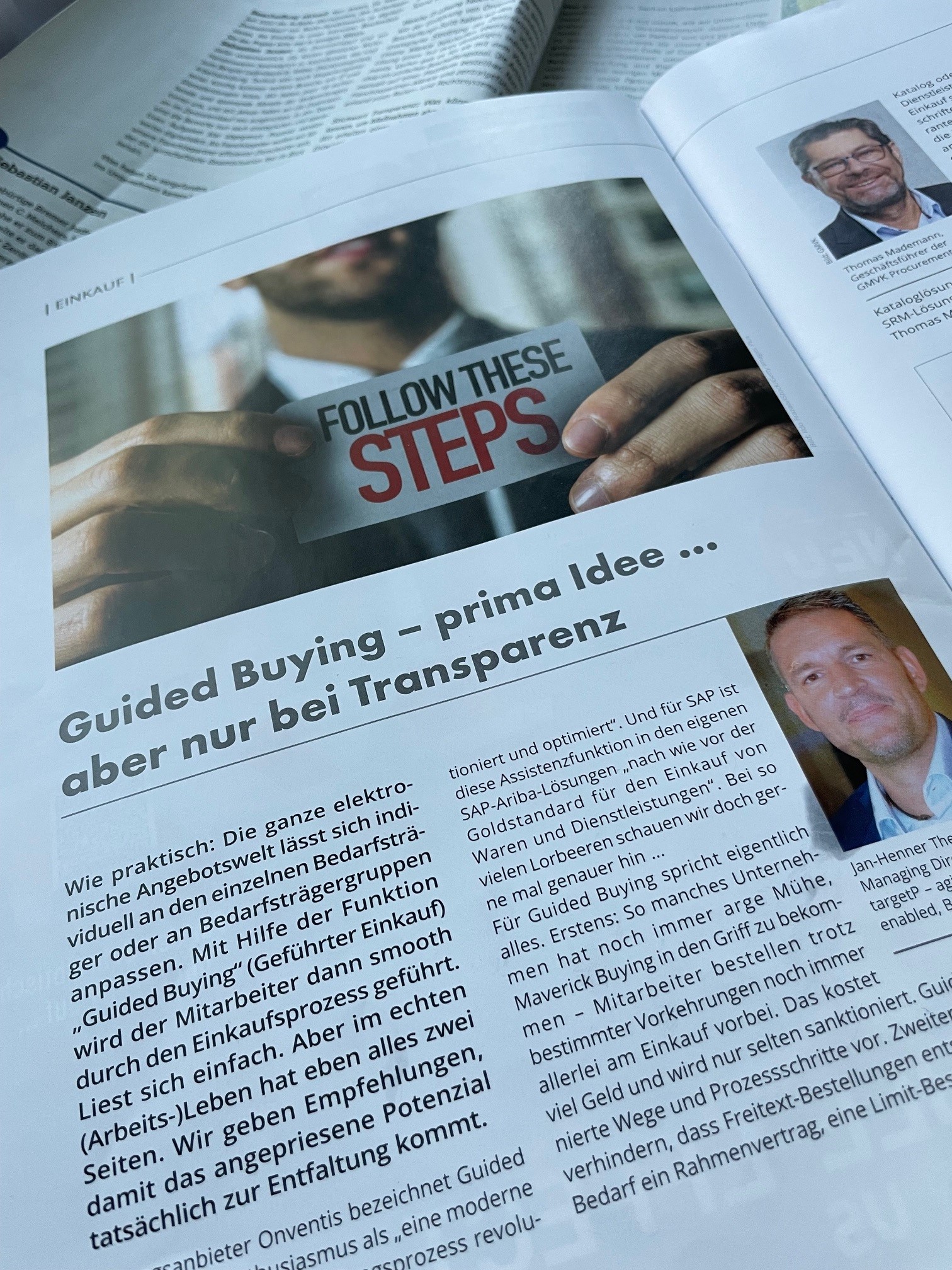
Guided Buying, eigentlich eine tolle Sache, aber….

👉 Guided Buying – Prima Idee……..aber nur bei Transparenz… und dem richtigen Ansatz & Partner…und dem Verständnis was man erreichen will….und…und…. Danke an Sabine Ursel für einen spannenden Artikel und die richtigen Fragen zu einem sehr aktuellen Thema und die Möglichkeit ein paar Gedanken beitragen zu können. ⏩Die ganze elektronische Angebotswelt lässt sich individuell an den einzelnen Bedarfsträger oder an Bedarfsträgergruppen anpassen. Mit Hilfe der Funktion „Guided Buying“ (Geführter Einkauf) wird der Mitarbeiter dann smooth durch den Einkaufsprozess geführt. Liest sich einfach, oder? ⏩Im echten (Arbeits-)Leben hat – wie immer – alles zwei Seiten. Für das Magazin C.ebra (Wiesbaden) hat Sabine recherchiert und nach Empfehlungen gefragt. Schließlich soll das angepriesene Potenzial ja hinreichend zur Entfaltung kommen. ⏩ Meine Gedanken gibt es dann im Artikel. Link zum vollständigen Artikel in den Kommentaren. Lust es näher zu beleuchten, Vorteile und Grenzen zu verstehen und es umzusetzen? 👉Dann sprechen Sie mich gerne an. Bei weit über 30 digitalen Projekten trennen wir Hype und Blabla von Funktionierendem und setzen es um. Von Digitalstrategie (inkl. was heisst es für uns eigentlich, was wollen wir damit erreichen und was nicht), über Digitalarchitektur, Systemauswahl und die Implementierung bis es läuft. Quelle: Artikel von Sabine Ursel, in: C.ebra (1/2 2024, Seiten 6-8) Foto: Sabine Ursel

Einkauf: Mehr Effektivität – Transformation zu mehr Schlagkraft

SCHLAGKRAFT erlangen oder zu TODE sparen ❓ 2024 ist ein Jahr der Konsolidierung und des Kostenmanagements und führt auch in Einkaufsorganisationen wieder zum klassischen Verhaltensmuster. Savings einholen, dabei die eigene Befähigung reduzieren und das Hamsterrad mit neuem Schwung drehen. Auf der Strecke bleibt die Schlagkraft für einen GuV-wirksamen Wertbeitrag! Nach über 25 Jahren und dutzenden Einkaufsorganisationen, sehe ich immer das gleiche Muster. Die Wirksamkeit vieler Einkaufsabteilungen ist noch weit von Doppelwumms entfernt und dennoch reden viele von Prozesseffizienz, KI, schlanken Organisationen, usw. Die eigentlichen Werthebel (z.B. Warengruppen-, Lieferanten-, Risikomanagement, Digital, Mensch) sind noch immer unzureichend gestärkt. Von oftmals fehlender Personalausstattung und Fähigkeiten ganz zu schweigen. 👉 Dabei wissen wir doch alle: Effektivität sorgt dafür, dass wir die richtigen Dinge tun, während Effizienz sicherstellt, dass wir die Dinge richtig tun. Zuerst die richtigen Dinge zu tun, ist aber essenziell, um sicherzustellen, dass Effizienzprogramme sinnvoll eingesetzt werden.   🏠Veranschaulichung: Wir bauen ein Haus. Effektivität bedeutet, sicherzustellen, dass wir das richtige Haus an der richtigen Stelle bauen. Effizienz bedeutet, das Haus schnell und mit minimalen Ressourcen zu bauen. Wenn wir jedoch das falsche Haus oder an der falschen Stelle bauen, nützt es wenig, dass wir dabei effizient waren. Bei der Weiterentwicklung vieler Einkaufsorganisationen muss Effektivität vor Effizienz stehen. Warum: 📌Zielerreichung: Effektivität=Sicherstellung, dass die Bemühungen in die richtige Richtung gehen. Effizienz hingegen bedeutet, Dinge auf die bestmögliche Weise zu tun. 📌Prioritäten: Effektivität hilft dabei, Prioritäten zu setzen und sich auf die wichtigsten Aufgaben zu konzentrieren. 📌Ressourcenallokation: Effektivität stellt sicher, dass Ressourcen wie Zeit, Geld und Arbeitskraft auf die wichtigsten und wertvollsten Aufgaben verwendet werden. 📌Langfristiger Erfolg: Effektivität fördert nachhaltigen Erfolg, indem sie sicherstellt, dass die richtigen Strategien und Maßnahmen umgesetzt werden. Effizienz kann kurzfristige Gewinne bringen, aber ohne die richtige Richtung und Ziele kann dies langfristig schädlich sein. 📌Flexibilität und Anpassung: Effektive Organisationen sind besser in der Lage, sich an Veränderungen anzupassen, da sie sich auf die richtigen Ziele konzentrieren und ihre Strategien entsprechend anpassen können. 👉Wie auch immer die individuelle Planung und Umsetzung zusätzlicher Hebel aussieht, wir glauben an diese Vorgehensweise und richten unsere Projekte & #Transformationen konsequent danach aus! Gerade im #Mittelstand sehen wir eher fehlende Ressourcen und ausbaufähige Kompetenzen denn eine Notwendigkeit für Effizienzprogramme.

Risikomanagement für die Lieferkette – Ansatzpunkte

⚡Professionelles Risikomanagement für die Lieferkette Die Sicherstellung stabiler Lieferketten ist Kernaufgabe des Einkaufs. Ebenso wie die Schaffung transparenter Lieferketten, für die wir die Verantwortung übernehmen müssen. Immer mehr Gesetze (lksg, csddd) fordern dieses ein. Vor ein paar Wochen hatte ich die Chance, dem im IHK-Netzwerk Einkauf Ideen, Impulse und Best-Practices mitzugeben und aufzuzeigen, wie mittelständische Unternehmen durch den Aufbau 𝘀𝘁𝗮𝗯𝗶𝗹𝗲𝗿 𝘂𝗻𝗱 𝗶𝗻𝘁𝗲𝗴𝗿𝗲𝗿 𝗟𝗶𝗲𝗳𝗲𝗿𝗸𝗲𝘁𝘁𝗲𝗻 nicht nur Risiken minimieren, Verantwortung für Ihre Lieferkette übernehmen und Gesetze einhalten, sondern auch ihre Wettbewerbsfähigkeit erhöhen können. Wie immer PRAGMATISCH – KLARTEXT – UMSETZUNGSORIENTIERT mit praktischen Tipps für einen sofortigen Start. Worüber sprachen wir: 📌Professionelles und ganzheitliches Risikomanagement für die Lieferkette Risiken, Chancen und Regularien: Was wirkt heute auf den Einkauf ein und wie muss er darauf reagieren 📌Aufbau eines Risikomanagements. Wichtige Bausteine und Werkzeuge für Mittelstand und Konzern 📌Von Anderen lernen und Fehler vermeiden: Wie gehe ich bei der Umsetzung vor 📌Risiko – Verantwortung – Resilienz: Integre Lieferketten als Weiterentwicklung des klassischen Risikomanagements 📌Digitale Lieferkette– ein wichtiges Werkzeug für ganzheitliche Transparenz und Leistungssteuerung. Wie baue ich es auf.

Digitale Lieferketten für Compliance und Stabilität

Von Excel zur ganzheitlichen Digitalisierung der Lieferkette. 👉So geht ein effizientes Lieferantenmanagement und ESG-Compliance. Ein Praxis- und Umsetzungsbericht aus dem Mittelstand. Aktuelle Lieferkettengesetze wie das LkSG oder die CSDDD stellen international agierende Unternehmen oft vor zahlreiche Herausforderungen. Auch das familiengeführte Hochtechnologieunternehmen ORAFOL aus Oranienburg, Weltmarktführer in der Kunststoffveredelung, nutzt die gesetzlichen Anforderungen als Chance zur Weiterentwicklung und Professionalisierung seines Einkaufs (z.B Lieferantenmanagement) und seiner digitalen Architektur und Systeme im Einkauf und den Schnittstellenbereichen. Unser Kunde ORAFOL ist ein tolles Beispiel, wie man auch im Mittelstand budgetfreundlich und zügig leistungsfähige digitale Landschaften umsetzen kann. Verantwortung für die eigene Lieferkette übernimmt, ie Vielzahl der aktuellen und kommenden Gesetze umsetzt und parallel den Einkauf digital und (!) analog nach vorne bringt Was stellten wir vor: 📌Von der Pflicht zur Kür: Warum ORAFOL von Excel zu vernetzten SaaS-Lösungen gewechselt hat und wie das Technologieunternehmen dadurch ESG-Anforderungen effizienter erfüllen konnte. 📌Single Source of Truth durch Standard-API: Wie ein zentrales Lieferanten-Management-System abteilungsübergreifende Nutzung und Transparenz ermöglicht. 📌Auswirkungen auf Richtlinien, Einkaufs- und Warengruppenstrategien sowie das Lieferanten-Onboarding. 📌Compliance und Risikomanagement: Wie vernetzte Systeme zu einem effektiven Compliance-Verbund werden und das Risiko über die gesamte Lieferkette hinweg minimieren helfen. 📌Lessons Learned: Erkenntnisse aus der Projektumsetzung, inklusive der Zusammenarbeit mit Anbietern, der Sicherstellung zukunftssicherer Systeme und der Bewältigung interner Stolpersteine. Sprechen Sie mich gerne für Ihren persönlichen Impuls an. Oder auch für eine Zusammenfassung des Webinars. Auf Basis von mehr als 30 digitalen Projekten zur Weiterenwicklung von Einkaufsorganisationen zeigen wir auch Ihnen Ihre Optionen und persönliche Roadmap auf!

en_USEnglish
About the company:
Joint Venture Truck OEMs
(Germany & Sweden)
Development Hydrogen fuel cell systems
approx. 500Employees, strong growth
GlobalTechnologyInnovator

Case Study

Industry: Automotive

Area: Organisation

Land: Deutschland & USA

Duration: 12 Months

Starting Point / Assignment

  • approx. EUR 400 million Procurement spend p.a. (rapidly increasing)
  • Independent joint venture between two large truck manufacturers
  • Start of series production in 2027 and development of the North American market with local production requires far-reaching development and expansion of Procurement, particularly regarding a global organization (skills, capacities, x-functional collaboration) and digitalization

Objectives

  • Creating transparency about the maturity level of the Procurement function
  • Prioritized action plan to gradually increase the maturity level regarding competencies, x-functional cooperation, productivity/efficiency, digitalization, etc.
  • Development of target organization model (2023, 2027, 2030) for production and non-production materials Procurement incl. all role descriptions and necessary capacity (FTE sizing)
  • Detailed transformation plan for the global Procurement organization aligned with the milestones "Start of series production" and "Market entry & local production North America“
  • Review of Procurement’s digital strategy and projects including future recommendations

Approach

  • Comprehensive maturity analysis of Procurement (targetP! method) with a focus on organization and digitalization based on personal interviews (all Procurement staff and top stakeholders) as well as in-depth document and data analysis (strategies, guidelines, process descriptions, digitalization initiatives, standards for category & supplier management, order & invoice volumes, etc.).
  • S/T/O analysis to determine the actual capacity utilization of all Procurement employees as part of individual interviews
  • Workshops/interviews with IT & Procurement on the Procurement system landscape and digital strategy

Results / „Deliverables“

  • Detailed maturity assessment report on Procurement (production and non-production materials) including prioritized actions and quick wins
  • Procurement digital strategy benchmark against best practices with specific recommendations for actions, risk analysis, and quick wins
  • Transparency regarding the actual use of capacity in Procurement, gap analysis of the respective profiles and stakeholder expectations
  • Role-based target Procurement organization with a step-by-step development plan (staffing, development, reallocation)
  • Tailor-made role descriptions for use in subsequent recruiting measures
About the company:
Joint Venture Truck OEMs
(Germany & Sweden)
Development Hydrogen fuel cell systems
approx. 500Employees, strong growth
GlobalTechnologyInnovator

Case Study

Industry: Automotive

Area: Organisation

Land: Deutschland & USA

Duration: 12 Months

Starting Point / Assignment

  • approx. EUR 400 million Procurement spend p.a. (rapidly increasing)
  • Independent joint venture between two large truck manufacturers
  • Start of series production in 2027 and development of the North American market with local production requires far-reaching development and expansion of Procurement, particularly regarding a global organization (skills, capacities, x-functional collaboration) and digitalization

Objectives

  • Creating transparency about the maturity level of the Procurement function
  • Prioritized action plan to gradually increase the maturity level regarding competencies, x-functional cooperation, productivity/efficiency, digitalization, etc.
  • Development of target organization model (2023, 2027, 2030) for production and non-production materials Procurement incl. all role descriptions and necessary capacity (FTE sizing)
  • Detailed transformation plan for the global Procurement organization aligned with the milestones "Start of series production" and "Market entry & local production North America“
  • Review of Procurement’s digital strategy and projects including future recommendations

Approach

  • Comprehensive maturity analysis of Procurement (targetP! method) with a focus on organization and digitalization based on personal interviews (all Procurement staff and top stakeholders) as well as in-depth document and data analysis (strategies, guidelines, process descriptions, digitalization initiatives, standards for category & supplier management, order & invoice volumes, etc.).
  • S/T/O analysis to determine the actual capacity utilization of all Procurement employees as part of individual interviews
  • Workshops/interviews with IT & Procurement on the Procurement system landscape and digital strategy

Results / „Deliverables“

  • Detailed maturity assessment report on Procurement (production and non-production materials) including prioritized actions and quick wins
  • Procurement digital strategy benchmark against best practices with specific recommendations for actions, risk analysis, and quick wins
  • Transparency regarding the actual use of capacity in Procurement, gap analysis of the respective profiles and stakeholder expectations
  • Role-based target Procurement organization with a step-by-step development plan (staffing, development, reallocation)
  • Tailor-made role descriptions for use in subsequent recruiting measures
About the company:
Family Owned Business with international Footprint
approx. 500 Mio.Turnover
approx. 3.000 Employees
Technology & Market Leaderin Harvesting Equipment

Case Study

Industry: Agricultural Machines

Area: Transformation

Country: Germany

Duration: ~ 18 Months

Starting Point / Assignment

  • approx. 200 million Procurement volume
  • Sole focus on operational processes (clerical function)
  • Strong focus on German plants, not prepared for internationalization and cooperation, despite of having operating units in the USA and China
  • Strong growth in turnover and increased internationalization
  • Procurement’s priority: Supply security (“keep the plants running”)
  • Digitalization not actively driven

Objectives

  • Create an understanding of Procurement’s maturity level
  • Identify potential (e.g., value contribution, efficiency, compliance), through more professional category & supplier management and digital support
  • Elaborate on alternative measures to develop Procurement and create an action plan, particularly concerning process improvements
  • If necessary, determine and argue capacity requirements
  • Optimize structures to prepare for growth and improved resource utilization

Approach

  • Comprehensive maturity analysis of Procurement (targetP! method) with a focus on organization and operational improvements (personal interviews with Procurement staff and top stakeholders) as well as in-depth document and data analysis (strategies, guidelines, process descriptions, digitalization initiatives, etc.)
  • Development of a holistic transformation plan and target organization model including roles and responsibilities, stakeholder integration, etc.
  • Early involvement of employees "future conferences to build my organization“
  • Joint creation of a practicable category structure, a Procurement Vision & Strategy


Results / „Deliverables“

  • First-time definition of a Procurement strategy with aligned objectives
  • Capacity optimization through targeted personnel expansion
  • Optimized organizational model and a more rigid category structure established
  • First system reviews with digital solution providers based on a digital action plan and precise requirements
  • Design of a customized multi-year training program for all roles
  • Implementation of Category Management training with pilots
  • Development and implementation of Procurement processes
About the company:
Family Owned Business with international Footprint
approx. 500 Mio.Turnover
approx. 3.000 Employees
Technology & Market Leaderin Harvesting Equipment

Case Study

Industry: Agricultural Machines

Area: Transformation

Country: Germany

Duration: ~ 18 Months

Starting Point / Assignment

  • approx. 200 million Procurement volume
  • Sole focus on operational processes (clerical function)
  • Strong focus on German plants, not prepared for internationalization and cooperation, despite of having operating units in the USA and China
  • Strong growth in turnover and increased internationalization
  • Procurement’s priority: Supply security (“keep the plants running”)
  • Digitalization not actively driven

Objectives

  • Create an understanding of Procurement’s maturity level
  • Identify potential (e.g., value contribution, efficiency, compliance), through more professional category & supplier management and digital support
  • Elaborate on alternative measures to develop Procurement and create an action plan, particularly concerning process improvements
  • If necessary, determine and argue capacity requirements
  • Optimize structures to prepare for growth and improved resource utilization

Approach

  • Comprehensive maturity analysis of Procurement (targetP! method) with a focus on organization and operational improvements (personal interviews with Procurement staff and top stakeholders) as well as in-depth document and data analysis (strategies, guidelines, process descriptions, digitalization initiatives, etc.)
  • Development of a holistic transformation plan and target organization model including roles and responsibilities, stakeholder integration, etc.
  • Early involvement of employees "future conferences to build my organization“
  • Joint creation of a practicable category structure, a Procurement Vision & Strategy


Results / „Deliverables“

  • First-time definition of a Procurement strategy with aligned objectives
  • Capacity optimization through targeted personnel expansion
  • Optimized organizational model and a more rigid category structure established
  • First system reviews with digital solution providers based on a digital action plan and precise requirements
  • Design of a customized multi-year training program for all roles
  • Implementation of Category Management training with pilots
  • Development and implementation of Procurement processes
About the company:
Leading Healthcare Provider
High reputation (Top rated Medical Care)
Site: approx. 825 Mio. Turnover
approx. 1.700employees
> 80.000 Patienten/Jahr

Case Study

Industry: Health Care/Clinic

Bereich: Interim & Entwicklung

Country: Germany

Duration: 6 Months

Starting Point / Assignment

  • approx. EUR 60 million spend p.a., complex spend structure
  • Procurement with a strong focus on processing and operational processes, no systematic spending management
  • Significant operational problems in day-to-day business led to high costs
  • Very insecure, demotivated team due to degrading treatment and extreme micromanagement by the previous Procurement Manager
  • Non-existent digitalization of core processes and tasks
  • Extensive, sometimes paralyzing bureaucracy in general and when approving requirements such as Requisitions, Purchase Orders and Contracts
  • Lack of discipline and ethics among sales reps (back-door selling, etc.)
  • Low reputation within the hospital, especially among chief physicians

Objectives

  • Main objective: Stabilization and reactivation of a highly frustrated team
  • Stabilization of day-to-day business, also due to above-average absences
  • Better distribution of the workload among the team members
  • Creating an understanding of the actual maturity level of Procurement, identifying potential (e.g., value contribution, efficiency, compliance)
  • Elaborating alternative measures to develop Procurement, and create an action plan, particularly concerning process simplifications (approvals of Requisitions, Purchase Orders, Contracts)
  • Improving customer service quality and interaction with internal customers

Approach

  • Comprehensive maturity analysis of Procurement involving stakeholders
  • Creation and coordination of a holistic development plan
  • Open door policy and individual meetings several times a week
  • Regular visits to the hospital wards to understand the needs and build trust
  • Frequent exchange with internal customers (regular personal exchange, participatory approach: Involvement of all employees, e.g. we
  • Weekly team meetings to discuss issues, improvement ideas, and solutions to ensure full commitment and involvement in improvement projects
  • Strong involvement in day-to-day business (negotiations, sourcing)
  • Process analyses, in particular, SAP optimization options & approvals

Results / „Deliverables“

  • Team stabilized, motivation increased, absences and absenteeism reduced (CEO quote: "You calmed people down very quickly with professional empathy and got them behind you")
  • First-time definition of a Procurement strategy with agreed upon targets
  • Regular coordination with internal customers (Chief physician quote: "we talk to each other now, things run faster, we finally feel well looked after")
  • Approval and implementation of moderate staff expansion with restructuring of work areas and balancing of workload
  • Redesign of framework agreements with improved commercial conditions
  • Complete processing of unfinished order processes (backlog)
  • Simplification and definition of core Procurement processes;
  • Addition of new SAP functionalities to drive automation & workload reduction
About the company:
Leading Healthcare Provider
High reputation (Top rated Medical Care)
Site: approx. 825 Mio. Turnover
approx. 1.700employees
> 80.000 Patienten/Jahr

Case Study

Industry: Health Care/Clinic

Bereich: Interim & Entwicklung

Country: Germany

Duration: 6 Months

Starting Point / Assignment

  • approx. EUR 60 million spend p.a., complex spend structure
  • Procurement with a strong focus on processing and operational processes, no systematic spending management
  • Significant operational problems in day-to-day business led to high costs
  • Very insecure, demotivated team due to degrading treatment and extreme micromanagement by the previous Procurement Manager
  • Non-existent digitalization of core processes and tasks
  • Extensive, sometimes paralyzing bureaucracy in general and when approving requirements such as Requisitions, Purchase Orders and Contracts
  • Lack of discipline and ethics among sales reps (back-door selling, etc.)
  • Low reputation within the hospital, especially among chief physicians

Objectives

  • Main objective: Stabilization and reactivation of a highly frustrated team
  • Stabilization of day-to-day business, also due to above-average absences
  • Better distribution of the workload among the team members
  • Creating an understanding of the actual maturity level of Procurement, identifying potential (e.g., value contribution, efficiency, compliance)
  • Elaborating alternative measures to develop Procurement, and create an action plan, particularly concerning process simplifications (approvals of Requisitions, Purchase Orders, Contracts)
  • Improving customer service quality and interaction with internal customers

Approach

  • Comprehensive maturity analysis of Procurement involving stakeholders
  • Creation and coordination of a holistic development plan
  • Open door policy and individual meetings several times a week
  • Regular visits to the hospital wards to understand the needs and build trust
  • Frequent exchange with internal customers (regular personal exchange, participatory approach: Involvement of all employees, e.g. we
  • Weekly team meetings to discuss issues, improvement ideas, and solutions to ensure full commitment and involvement in improvement projects
  • Strong involvement in day-to-day business (negotiations, sourcing)
  • Process analyses, in particular, SAP optimization options & approvals

Results / „Deliverables“

  • Team stabilized, motivation increased, absences and absenteeism reduced (CEO quote: "You calmed people down very quickly with professional empathy and got them behind you")
  • First-time definition of a Procurement strategy with agreed upon targets
  • Regular coordination with internal customers (Chief physician quote: "we talk to each other now, things run faster, we finally feel well looked after")
  • Approval and implementation of moderate staff expansion with restructuring of work areas and balancing of workload
  • Redesign of framework agreements with improved commercial conditions
  • Complete processing of unfinished order processes (backlog)
  • Simplification and definition of core Procurement processes;
  • Addition of new SAP functionalities to drive automation & workload reduction
About the company:
Highly renowned Qatari company
approx. 825 mn.Turnover
approx. 3.500 Employees
Regional Market Leader
Shipping, Maritime Logistik & Services

Case Study

Industrie: Reederei & Maritim

Bereich: Organisation & Interim

Country: Qatar

Duration: ~ 12 Months

Starting Point / Assignment

  • approx. EUR 300 million Procurement spend p.a.
  • Procurement with a strong focus on processing and operational processes, no systematic spending management
  • Significant operational problems in day-to-day business led to high costs for troubleshooting, escalations, and internal conflicts with stakeholders
  • Low acceptance and appreciation of Procurement and high political pressure despite excellent company results
  • Long-term vacancy in Procurement leadership impacts performance, customer satisfaction, and insecurity and leading to high fluctuation on buyer level
  • Digitalization of core processes and tasks only marginally developed

Objectives

  • Create an understanding of the true maturity level of Procurement and gain buy-in from the Executive Board
  • Identify potential (e.g., value contribution, efficiency, compliance), through more professional category & supplier management and automation
  • Elaborate on alternative measures to develop Procurement and create an action plan, particularly concerning process simplifications
  • Improve strategic and operational reporting for the CFO
  • Implement organizational and structural optimization to improve service quality
  • After two months: additional Role as VP Ad Interim due to the dismissal of the Head of Procurement

Approach

  • Comprehensive maturity analysis of Procurement involving stakeholders
  • Creation and coordination of a holistic transformation plan with staff adjustments, digitalization, and skills requirements
  • Development of a target organization model (category management) with role descriptions, responsibilities and recruiting support
  • Highly participative approach with intensive involvement of all employees, e.g., as part of "future conferences" (for the first time in the company) and expert teams with topic champions
  • Further development of Procurement and sourcing governance, e.g., tailored Category Structure, Procurement Vision & Procurement strategy and policies

Results / „Deliverables“

  • First-time definition of a Procurement strategy with aligned objectives
  • Approval and implementation of moderate staff expansion and allocation and expansion of required skills through comprehensive training plans
  • Start of digitalization projects based on a digital action plan (Supplier Portal)
  • Implementation of a Category Management approach and process and execution of 10 category pilots to identify additional value contribution
  • Development and implementation of comprehensive Supplier Management involving a newly designed supplier qualification process (Supplier Portal)
  • Implementation of a Procurement guideline & process manual and creation of comprehensive Procurement reporting with PowerBI
  • 10-month Interim Management and stabilization of the organization
About the company:
Highly renowned Qatari company
approx. 825 mn.Turnover
approx. 3.500 Employees
Regional Market Leader
Shipping, Maritime Logistik & Services

Case Study

Industrie: Reederei & Maritim

Bereich: Organisation & Interim

Country: Qatar

Duration: ~ 12 Months

Starting Point / Assignment

  • approx. EUR 300 million Procurement spend p.a.
  • Procurement with a strong focus on processing and operational processes, no systematic spending management
  • Significant operational problems in day-to-day business led to high costs for troubleshooting, escalations, and internal conflicts with stakeholders
  • Low acceptance and appreciation of Procurement and high political pressure despite excellent company results
  • Long-term vacancy in Procurement leadership impacts performance, customer satisfaction, and insecurity and leading to high fluctuation on buyer level
  • Digitalization of core processes and tasks only marginally developed

Objectives

  • Create an understanding of the true maturity level of Procurement and gain buy-in from the Executive Board
  • Identify potential (e.g., value contribution, efficiency, compliance), through more professional category & supplier management and automation
  • Elaborate on alternative measures to develop Procurement and create an action plan, particularly concerning process simplifications
  • Improve strategic and operational reporting for the CFO
  • Implement organizational and structural optimization to improve service quality
  • After two months: additional Role as VP Ad Interim due to the dismissal of the Head of Procurement

Approach

  • Comprehensive maturity analysis of Procurement involving stakeholders
  • Creation and coordination of a holistic transformation plan with staff adjustments, digitalization, and skills requirements
  • Development of a target organization model (category management) with role descriptions, responsibilities and recruiting support
  • Highly participative approach with intensive involvement of all employees, e.g., as part of "future conferences" (for the first time in the company) and expert teams with topic champions
  • Further development of Procurement and sourcing governance, e.g., tailored Category Structure, Procurement Vision & Procurement strategy and policies

Results / „Deliverables“

  • First-time definition of a Procurement strategy with aligned objectives
  • Approval and implementation of moderate staff expansion and allocation and expansion of required skills through comprehensive training plans
  • Start of digitalization projects based on a digital action plan (Supplier Portal)
  • Implementation of a Category Management approach and process and execution of 10 category pilots to identify additional value contribution
  • Development and implementation of comprehensive Supplier Management involving a newly designed supplier qualification process (Supplier Portal)
  • Implementation of a Procurement guideline & process manual and creation of comprehensive Procurement reporting with PowerBI
  • 10-month Interim Management and stabilization of the organization