
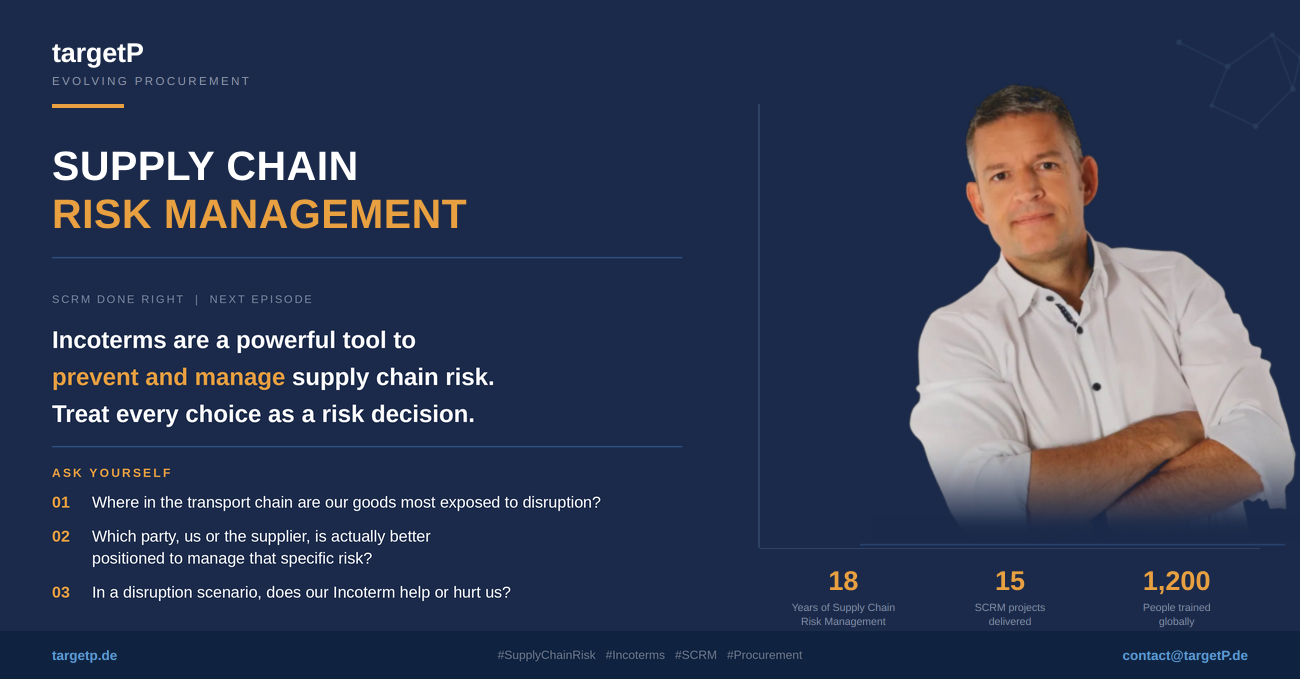
Most Procurement Teams Treat Incoterms Just as a Logistics Decision
Next episode of our series: Supply Chain Risk Management done right!
Incoterms can do more for you than you think. They are also a powerful risk tool and a risk decision. And that distinction costs companies more than they realize.
When you buy DDP (Delivered Duty Paid), your supplier owns the risk of getting goods to your door. Port congestion, customs delays, a freight rate spike: technically, that is their problem to solve. However, I would never recommend working that way. Solve it jointly, but remind your supplier that he must be an active problem solver!
When you buy EXW (Ex Works), you own all of that risk the moment the goods leave their factory floor. Neither is automatically the right choice. But the selection should be a deliberate risk decision, not a default inherited from a contract template from ten years ago.
Here are the questions every category/supply chain manager and buyer should be asking:
⚠️Where in the transport chain are our goods most exposed to disruption?
⚠️ Which party, us or the supplier, is actually better positioned to manage that specific risk? ⚠️ Does our current Incoterm reflect where risk actually sits, or is it just what we have always done?
⚠️ In a disruption scenario like a port closure, political instability, or a strike, does our Incoterm help or hurt us?
In high-risk sourcing regions, Incoterm selection can be one of the fastest, lowest-cost risk-mitigation levers available to procurement. It does not require a new supplier. It does not require a capital investment. It requires a conversation and a contract amendment. Yet it is rarely reviewed as part of your risk prevention and mitigation!
Now, let’s turn those lessons into capability. Build people and organizations who are ready to act. My training/workshop will perfectly prepare you for it.
—-
Hi. I am Jan, your SCRM Builder. Not a consultant who theorizes about risk. A procurement leader and risk practitioner who has built 15 SCRM programs globally, trained 1,200 people, and led procurement and risk organizations through crisis. I share what works and help you build an effective SCRM. I work globally.
 Deutsch
  English