
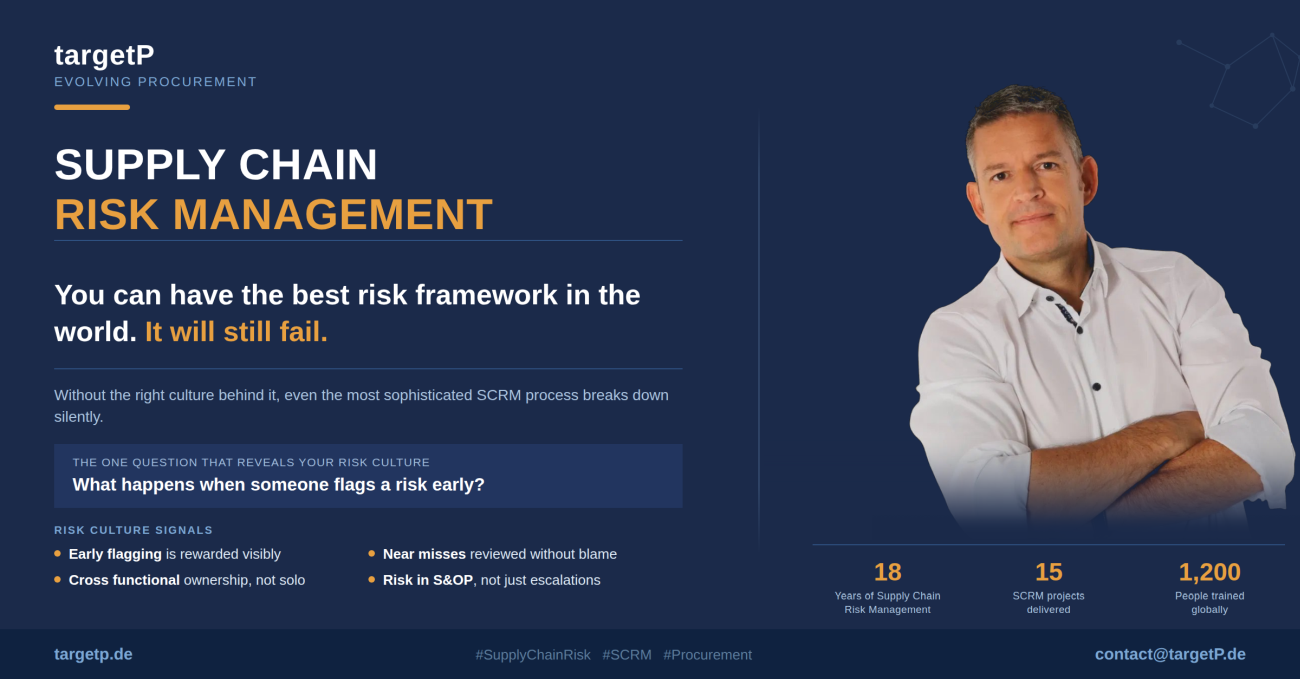
🧠 You Can Have the Best Risk Framework in the World. It Will Still Fail if There is No Risk Culture
Next episode of our series: Supply Chain Risk Management done right!
Here is the part nobody puts in a framework document. It is also THE part that determines whether everything else works. I have seen it in multiple organizations across different industries. A buyer spots a worrying signal from a supplier. They are not sure it is serious enough to escalate. They do not want to be seen as alarmist. They wait: Three weeks later, it becomes a crisis.
The process existed. The governance existed. The risk register existed. But the culture did not support early escalation. Nor was there any trust (remember my post 2 weeks ago?). And that made all the difference.
➡️Risk culture is not a values poster on the wall. It comes down to one question: „In your organization, what actually happens when someone flags a risk early?“
If the answer involves extra meetings, justification overhead, or quiet skepticism, you have a culture and trust problem, not a process problem.
Building a genuine risk culture means a few concrete things:
✅ Leadership visibly rewards early flagging, even when the risk does not materialize
✅ Leadership walks the talk and integrates managing risk into discussions, decisions, and processes – and they listen whenever they are asked to listen!
✅ Near-misses are reviewed without blame, not swept under the rug
✅ Risk is a normal topic in S&OP and supplier reviews, not a special escalation
✅ Cross-functional teams share ownership, so procurement is not carrying it alone
✅ Roles, responsibilities, and incentives get adjusted. Protecting the organization, its assets, and earnings becomes everyone’s responsibility by default.
My takeaway after years of building and leading supply chain risk organizations:
➡️ Culture is not just an enabler. It is THE enabler for managing supply chain risk organizations effectively.
➡️ Yes, culture change is slow. Process change is fast. Most organizations default to the fast option. And then they wonder why the processes never quite stick.
➡️If you ignore building and maintaining a risk culture, you are going nowhere, wasting budget and time, and frustrating your entire organization!
This isn’t from a textbook or study; it is the experience of a practitioner who learned it the hard way.
 Deutsch
  English